


BEIRUT: The Saudi and Kuwaiti foreign ministries have responded warmly to the Lebanese Prime Minister Najib Mikati’s call to restore diplomatic ties with Saudi Arabia and other Gulf states.
The Lebanese are hoping for a swift resumption of the suspended relations, hopes which have been bolstered by statements from Riyadh and Kuwait City.
Saudi Arabia praised the “positive points” in Mikati’s statement, adding that it hoped it would “contribute to the restoration of Lebanon’s role and status on the Arab and international levels.” The Kuwaiti government, meanwhile, said it was looking forward to engaging in practical measures that would contribute to more security, stability and prosperity for Lebanon.
Mikati’s expression has also been enhanced by the announcement of the launch of the French-Saudi joint fund to support the Lebanese people.
The Saudi and Kuwaiti statements came after Mikati issued an official statement pledging that the Lebanese government would commit to taking all necessary measures to enhance cooperation with Saudi Arabia and the Gulf Cooperation Council countries.
Mikati also pledged that Lebanon would abide by all Arab League resolutions, focus on international legitimacy and complete the implementation of their decisions in a way that guarantees civil peace and national stability for Lebanon and fortifies its unity.
In the statement published on Monday evening, Mikati stressed the “necessity to stop all political, military, security and media activities that affect the sovereignty, security and stability of Saudi Arabia and the Gulf Cooperation Council countries, which originate from Lebanon.”
Mikati affirmed “the obligation to take all measures to prevent the smuggling of contraband, especially drugs, to Saudi Arabia and the Gulf Cooperation Council countries, directly or indirectly, tighten controls at all border crossings.”
He pledged Lebanon’s commitment to the Riyadh Agreement for judicial cooperation and the extradition of wanted persons to Saudi Arabia.
Mikati pledged that the “Lebanese government will work to prevent the use of Lebanese financial and banking channels to conduct financial transactions that might harm the security of Saudi Arabia and the Gulf Cooperation Council countries.”
In the Cabinet session that was held on Wednesday afternoon, Mikati welcomed “the statements issued by Saudi Arabia and Kuwait, which indicate that the cloud that disturbed Lebanon’s relations will soon disappear, and we are keen to implement the ministerial statement and call on the Arabs to stand by Lebanon.”
Lebanese political commentators declared that this step will help usher in the return of the Saudi and Kuwaiti ambassadors to Lebanon and that relationships between Lebanon and the Gulf countries should return to normal before the next Arab summit is held.
Saudi Arabia’s return to diplomatic engagement with Lebanon will be achieved primarily through the French-Saudi joint fund, according to some observers, who said that it will help the Lebanese people from beyond the framework of the state.
Politician and author Dr. Khaldoun Al-Sharif said the Saudi Foreign Ministry’s position on Lebanon is a good response to Mikati’s statement.
“As for the political return of the Kingdom, it needs a regional settlement, and Lebanon is not a party to it. The strong party in Lebanon is Hezbollah, which supports forces opposed to the Arabian Gulf directly or indirectly, and this affects the relationship between Lebanon and the Gulf,” said Al-Sharif.
He added: “What is currently required is the stability of Yemen, then Iraq, and Lebanon comes after that.”
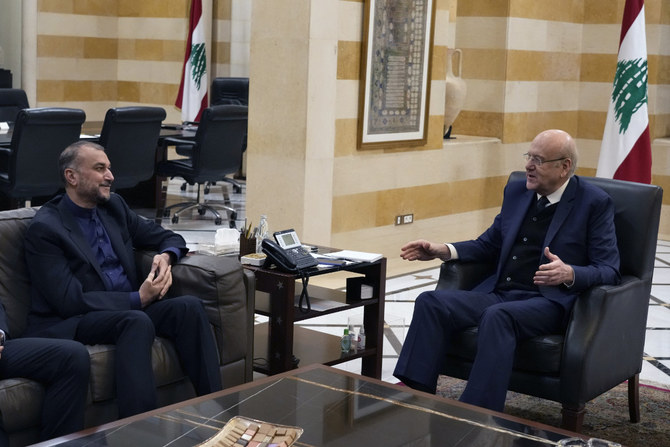
The reopening of closed doors between Lebanon and the Arabian Gulf states came about 36 hours before the arrival of Iranian Foreign Minister Hussein Amir Abdollahian to Beirut.
Flying over from Damascus, Abdollahian’s visit was supposed to take place a week ago after he visited Moscow, but developments related to the so-called nuclear deal delayed it until Thursday.
The Iranian official’s visit fell the day after Lebanese President Michel Aoun defended Hezbollah’s weapons and said in an interview during his stay in Rome that the group’s arms “have no security effect inside Lebanon, and resisting the occupation is not terrorism.”
At Beirut’s Rafic Hariri International Airport, the Iranian minister said that there are many important political developments and all parties must ensure everyone has an opportunity to exchange views.
The minister reaffirmed “Iran’s official readiness to extend bridges of cooperation with Lebanon in various fields, especially economic and commercial ones.”
Abdollahian also reiterated the proposal he made during his meeting with Mikati on the sidelines of the Munich Security Forum about a month ago regarding Iran’s willingness to contribute to building two power plants in Lebanon with a capacity of 1,000 MW each.


