

Saudi mining reforms unprecedented as supercycle begins, says minister

Short Url
Updated 24 March 2022
Follow

Saudi mining reforms unprecedented as supercycle begins, says minister

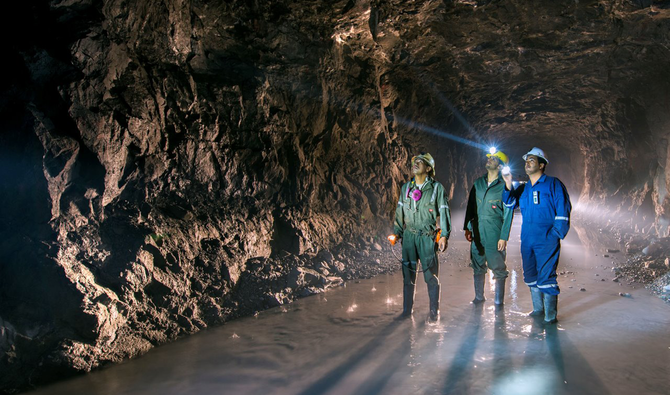
RIYADH: Saudi Arabia’s Vision 2030 is reforming and enhancing the Kingdom’s mining ecosystem in an unprecedented manner, according to Khalid Saleh Al-Mudaifer, vice minister of industry and mineral resources. 

Al-Mudaifer made this remark during his speech at the FT Commodities Global Summit on March 23, in Lausanne, Switzerland. 

Talking about the necessity of decarbonization, the vice minister said: “What we need to work on in the mining sector is the perception of mining.”

He stressed the need to clarify the concept of decarbonization. “People need to remember there are no minerals without mining,” he added.

During his speech, the vice minister also noted that there could be a 40-fold increase in the demand for critical minerals in the future. 

“Some argue a new commodity supercycle has begun as prices rise based on increasing demand, declining productivity and growing ESG issues. There are estimates that point to a 40-fold increase in demand for critical minerals,” said Al-Mudaifer. 

Reiterating his words at the 2022 Future Mineral Forum, Al-Mudaifer said, “During the #FMF2022 hosted in Riyadh, we began an intergovernmental dialogue to define this new mining region, explore investment opportunities and reimagine the role of mining in the global economy.”


Post-break return of students drives surge in education spending, SAMA data shows

Updated 58 min 20 sec ago
Follow

Post-break return of students drives surge in education spending, SAMA data shows

RIYADH: Spending on education in Saudi Arabia increased by 141.1 percent for the week ending Jan. 24, as students returned to the classroom after the mid-year break.

This was accompanied by a 7 percent increase in spending on books and stationery, which reached SR146.17 million ($38.9 million).

According to the latest data from the Saudi Central Bank, the over POS value dropped 10.6 percent to SR12.52 billion, with transactions representing a 9.7 percent week-on-week decrease to 213.62 million.

This week saw negative changes across all the remaining sectors. Spending on bakeries and pastries saw an 18.4 percent decline to SR229.71 million, while gas stations saw an 11 percent drop. Professional and business services decreased by 11.6 percent.

Expenditure on apparel and clothing fell by 19.7 percent to SR985.94 million, followed by a 2.8 percent drop in spending on jewelry.

Spending on car rentals in the Kingdom fell by 14.7 percent, while airlines saw a 9.3 percent decrease to SR38.16 million.

Expenditure on food and beverages saw a 7.9 percent decline to SR1.88 billion, claiming the largest share of the POS. Restaurants and cafes retained the second position despite an 18.5 percent decrease to SR1.50 billion.

Geographically, Riyadh accounted for the largest share of total POS spending, but still saw a 6 percent dip to SR4.46 billion, down from SR4.74 billion the previous week. The number of transactions in the capital settled at 69.07 million, down 6.8 percent week on week.

In Jeddah, transaction values decreased by 13.6 percent to SR1.75 billion, while Dammam reported a 4.8 percent decrease to SR640.59 million.

POS data, tracked weekly by SAMA, provides an indicator of consumer spending trends and the ongoing growth of digital payments in Saudi Arabia. 

The data also highlights the expanding reach of POS infrastructure, extending beyond major retail hubs to smaller cities and service sectors, supporting broader digital inclusion initiatives. 

The growth of digital payment technologies aligns with the Kingdom’s Vision 2030 objectives, promoting electronic transactions and contributing to the Kingdom’s broader digital economy.