Russia seeks new jail term for opposition leader Navalny

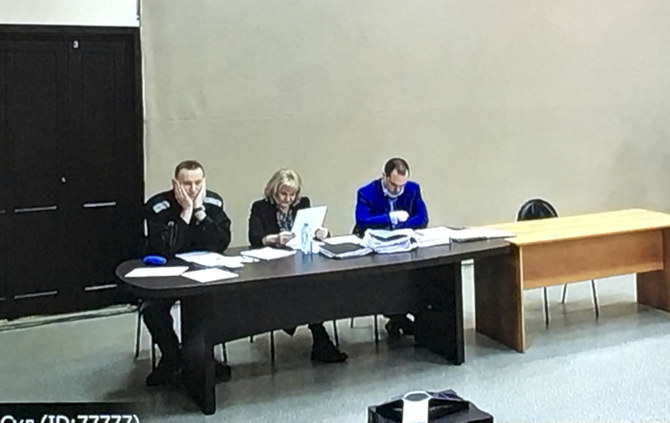
Russian opposition leader Alexei Navalny, left, is seen via a video link, sitting next to his layers during a court session in Pokrov, Vladimir region east of Moscow, Russia, Tuesday, March 15, 2022. (AP)
Short Url
Updated 16 March 2022
Follow

Russia seeks new jail term for opposition leader Navalny

  • After his arrest, Navalny’s political organizations across the country were declared “extremist” and shut down, while many key aides fled Russia fearing prosecution

MOSCOW: Russian prosecutors on Tuesday called for jailed Kremlin critic Alexei Navalny to serve 13 years in prison on new fraud charges.
Navalny, President Vladimir Putin’s most vocal domestic critic, was jailed last year after surviving a poison attack with Novichok nerve agent he blames on the Kremlin.
He now faces embezzlement and contempt of court charges and has been put on trial at the prison colony outside Moscow where he is already serving a 2.5 year sentence.
“I request that Navalny be sentenced to a term of 13 years and a subsequent two years of probation,” prosecutor Nadezhda Tikhonova was quoted as saying by Russian news agencies.
The prosecutor asked for Navalny to be sent to a “strict regime” penal colony, which would place him in much harsher conditions with cellmates who are repeat offenders.
The prosecutor also called for him to pay a fine of 1.2 million rubles ($10,600 or 9,500 euros).
“You can’t put everyone in prison. Even if you ask for 113 years, you won’t scare me or others like me,” Navalny said in court, his team wrote on social media.
The judge will issue a verdict on March 22.
It was not immediately clear whether the 13 years would include the sentence Navalny is currently serving.
Navalny spoke in court wearing his black prison uniform, with journalists watching via a video link.
The transmission constantly cut out during his final speech, Mediazona news site reported.
In a statement posted by supporters afterwards, Navalny said his speech focused on Russia’s military action in Ukraine, calling it a “bloody cover-up for the failure of Putin’s regime.”
“Every person must act. In their own way, as they can, considering the circumstances. But act,” Navalny said.
In court, he mentioned the “wonderful woman” Marina Ovsyannikova, who interrupted a state TV news broadcast on Monday holding up an anti-war poster.
He told supporters he was “totally OK” and “only worrying about the fact that others are worrying about me.”
A key Navalny aide and former head of his now outlawed regional offices, Leonid Volkov, said that Russia is seeking to keep Navalny jailed for life.
“He was sentenced to life from the very start. So long as Putin is still in the Kremlin,” Volkov said on Twitter.
Navalny’s spokeswoman Kira Yarmysh said his sentence depends on “how long Putin is in power.”

“Then we will do everything so that he doesn’t stay in power long,” Yarmysh said.
Investigators accuse Navalny of stealing for personal use several million dollars’ worth of donations that were given to his political organizations.
Before he was jailed, Navalny was Russia’s main opposition leader and his team frequently published investigations into the wealth of Russia’s elites that garnered millions of views on YouTube.
Navalny’s poisoning in 2020 with Novichok, a military-grade nerve agent, and arrest on his return from rehabilitation in Germany last year sparked widespread condemnation abroad as well as sanctions from Western capitals.
After his arrest, Navalny’s political organizations across the country were declared “extremist” and shut down, while many key aides fled Russia fearing prosecution.
Russia has also ramped up pressure on independent media and NGOs, with many declared foreign agents or shut down under fear of prosecution.
Russia has passed a new law introducing up to 15 years in jail for “fake news” about what Russia calls its military operation in Ukraine.
In an effort to further control the information available to its domestic audience, Russia this month restricted access to Twitter, Facebook and Instagram, and has blocked the websites of several independent news outlets.
On Instagram, Navalny has denounced the conflict and called on his supporters to protest despite the high likelihood of fines and arrest.
Over the past two weeks, close to 15,000 people have been detained at Ukraine demonstrations across Russia, according to independent monitor OVD-Info.


Trump says Australia will grant asylum to Iran women footballers

Team Iran listens to the national anthem before the AFC Women’s Asian Cup Australia 2026 football match.
Updated 09 March 2026
Follow

Trump says Australia will grant asylum to Iran women footballers

  • Presenter on Iranian state TV had branded the players “wartime traitors” after they stood motionless during the anthem

MIAMI: US President Donald Trump said Monday that Australia had agreed to grant asylum to some of Iran’s visiting women’s football team, amid fears they could face retaliation back home for not singing the national anthem before a match.
The gesture ahead of the team’s Asian Cup match against South Korea last week was seen by many as an act of defiance against the Islamic republic just two days after the United States and Israel attacked it.
“I just spoke to Prime Minister Anthony Albanese, of Australia, concerning the Iranian National Women’s Soccer Team. He’s on it! Five have already been taken care of,” Trump said Monday on his Truth Social network, less than two hours after an initial post urging Australia to take them in.
Trump added that “some, however, feel they must go back because they are worried about the safety of their families, including threats to those family members if they don’t return.”
There was no immediate comment from the Australian government, which has so far declined to say whether it could offer the players asylum.
Asked about their case on Sunday, Foreign Minister Penny Wong said Australia “stands in solidarity” with the people of Iran.
The son of Iran’s late shah, US-based Reza Pahlavi, warned on Monday that the refusal to sing the anthem could have “dire consequences,” and urged Australia to offer the team protection.
Trump then weighed in, pressing Albanese to “give ASYLUM” to the team and adding: “The US will take them if you won’t.”
“Australia is making a terrible humanitarian mistake by allowing the Iran National Woman’s Soccer team to be forced back to Iran, where they will most likely be killed,” the US leader said on Truth Social.
Pahlavi, who has not returned to Iran since before the 1979 Islamic revolution that ousted the monarchy, has billed himself as the man to lead a democratic transition to a secular Iran as the theocratic regime fights to survive.
Politicians, human rights activists and even “Harry Potter” author J.K. Rowling have also called for the team to be offered official protection.
“Please, protect these young women,” Rowling said in a post on social media.

‘Save our girls’ 

A presenter on Iranian state TV had branded the players “wartime traitors” after they stood motionless during the anthem before their match against South Korea.
In subsequent games, the players saluted and sang.
Crowds gathered outside the Gold Coast stadium where the side played their last match over the weekend, banging drums and shouting “regime change for Iran.”
They then surrounded the Iranian team bus, chanting “let them go” and “save our girls.”
On Monday, an AFP journalist saw members of the team speaking on phones from their balcony of their hotel.
Asked about the possibility of granted asylum, a spokesperson for Australia’s Home Affairs department told AFP earlier it “cannot comment on the circumstances of individuals.”
Amnesty International campaigner Zaki Haidari said they faced persecution, or worse, if they were sent home.
“Some of these team members probably have had their families already threatened,” Haidari told AFP.
“Them going back... who knows what sort of punishment they will receive?“
Despite being heavily monitored, the side would have a “small window of opportunity” to seek asylum at the airport, he said.
Iran’s embassy in Australia did not respond to a request for comment.