Ancient tombs unearthed at Paris’ Notre-Dame cathedral

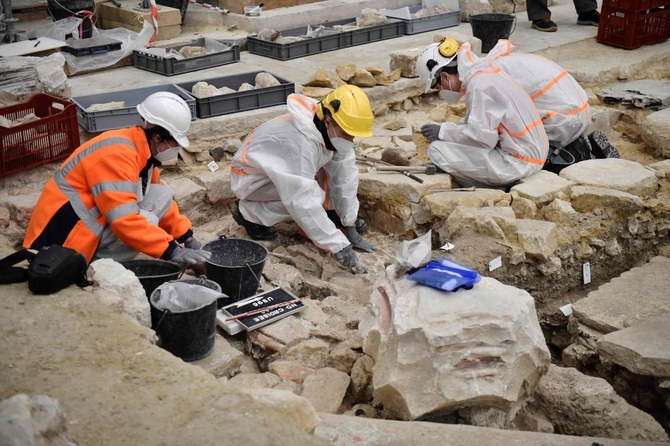
Archaeologists excavate the floor of Notre Dame Cathedral after the discovery of a 14th century lead sarcophagus, in Paris, on Tuesday. (AFP)
Short Url
Updated 15 March 2022
Follow

Ancient tombs unearthed at Paris’ Notre-Dame cathedral

  • Among the tombs was the "completely preserved, human-shaped sarcophagus made of lead"
  • Elements of painted sculptures were found just beneath the current floor level of the cathedral

PARIS: Several tombs and a leaden sarcophagus likely dating from the 14th century have been uncovered by archaeologists at Notre-Dame cathedral in Paris following its devastating 2019 fire.
The burial sites “of remarkable scientific quality” were unearthed during preparatory work for rebuilding the ancient church’s spire at the central spot where the transept crosses the nave, the culture ministry announced late Monday.
Among the tombs was the “completely preserved, human-shaped sarcophagus made of lead.”
It is thought the coffin was made for a senior dignitary in the 1300s — the century following the cathedral’s construction.
As well as the tombs, elements of painted sculptures were found just beneath the current floor level of the cathedral, identified as parts of the original 13th-century rood screen — an architectural element separating the altar area from the nave.
During a visit by AFP on Tuesday, archaeologists were delicately cleaning and excavating the sculptures emerging from the ground, including a pair of carved hands.
The bust of a bearded man and some sculpted vegetables, with traces of paint still visible, had been removed.
The team has already used a mini endoscopic camera to peek inside the sarcophagus, which appeared to be warped by the weight of the earth and stones.
“You can glimpse pieces of fabric, hair and above all a pillow of leaves on top of the head, a well-known phenomenon when religious leaders were buried,” said Christophe Besnier, the lead archaeologist.
“The fact that these plant elements are still inside means the body is in a very good state of conservation,” he added.
Its discovery will help improve our understanding of funeral practices in the Middle Ages, added Dominique Garcia of the National Institute of Archaeological Research.
The discoveries were made as reconstruction teams prepared to install huge scaffolding to rebuild the spire, and needed to check the stability of the ground.
In the process, they discovered an underground heating system from the 19th century, with the sarcophagus lying among its brick pipes.
Despite the excitement of the find, the clock is ticking for the archaeologists.
They have been given until March 25 to finish their work before the reconstruction project resumes — in order to keep to a planned reopening of the cathedral in 2024.


Sale of Saudi artist Safeya Binzagr’s work sets record at Sotheby’s auction in Riyadh

Updated 01 February 2026
Follow

Sale of Saudi artist Safeya Binzagr’s work sets record at Sotheby’s auction in Riyadh

RIYADH: A painting by Saudi artist Safeya Binzagr sold for $2.1 million at Sotheby’s “Origins II” auction in Riyadh on Saturday, emerging as the top lot of the evening and setting a new auction record for a Saudi artist.

The work, “Coffee Shop in Madina Road” (1968), sold for $1.65 million before the buyer’s premium, the additional fee paid by the purchaser to the auction house on top of the hammer price.

The result nearly doubled the previous auction record for a Saudi artist and became the most valuable artwork ever sold at auction in the Kingdom. It also ranks as the third-highest price achieved for an Arab artist at auction.

It was presented as part of “Origins II,” Sotheby’s second auction staged in Saudi Arabia, comprising 62 modern and contemporary lots and bringing together Saudi artists alongside regional and international names.

Collectors from more than 40 countries participated in the auction, with around one-third of the lots sold to buyers within Saudi Arabia.

The sale totaled $19.6 million, exceeding its pre-sale estimate and bringing the combined value of works offered across “Origins” and “Origins II” to over $32 million.

Saudi artists were central to the evening’s results. All nine Saudi works offered found buyers, achieving a combined total of $4.3 million, well above pre‑sale expectations.

Ashkan Baghestani, Sotheby’s head of contemporary art for the Middle East, told Arab News at the auction that “Safeya made more than any other artist tonight, which is incredible.”

He said the results demonstrated Sotheby’s broader objective in the Kingdom.

“The results tonight show exactly what we’re trying to do here. Bring international collectors to Saudi Arabia and give them exposure to Saudi artists, especially the pioneers.”

All nine works by Saudi artists offered in the sale found buyers, generating a combined $4.3 million. Additional auction records were set for Egyptian artist Ahmed Morsi and Sudanese artist Abdel Badie Abdel Hay.

An untitled work from 1989 by Mohammed Al-Saleem sold for a triple estimate of $756,000, while a second work by the artist, “Flow” from 1987, achieved $630,000.

The sale opened with the auction debut of Mohamed Siam, whose “Untitled (Camel Race)” sold for $94,500. Also making his first auction appearance, Dia Aziz Dia’s prize-winning “La Palma (The Palma)” achieved $226,800.

The sale coincided with the opening week of the Contemporary Art Biennale in Riyadh, reinforcing the city’s growing role as a focal point for both cultural institutions and the art market.

Baghestani added that Saudi modern artists are now receiving long‑overdue recognition in the market.

“There’s so much interest and so much demand, and the price is where it should be,” he said.

International highlights included works by Pablo Picasso, Roy Lichtenstein, Andy Warhol and Anish Kapoor, underscoring Saudi Arabia’s growing role as a destination for major global art events and collectors.

Picasso’s “Paysage,” painted during the final decade of the artist’s life, sold for $1,600,000, becoming the second most valuable artwork sold at auction in Saudi Arabia.

Seven works by Lichtenstein from the personal collection of the artist and his wife, including collages, prints, works on paper and sculptures, all found buyers. Warhol was represented in the sale with two works: “Disquieting Muses (After de Chirico),” which sold for $1,033,200, and a complete set of four screenprints of “Muhammad Ali,” which achieved $352,000.

Baghestani said the strength of the results was closely tied to the material’s freshness. “These were not works from the trade. Some of them had not been seen since the 1970s,” he said.