

Pope Francis calls for end to ‘armed aggression’ as Ukrainian refugees rise to 2.5 million

1 / 2
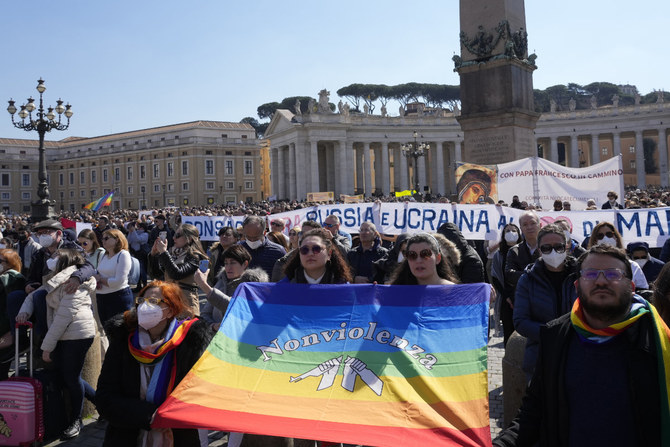
Catholic faithful show a peace flag reading "no violence" during Pope Francis' noon prayer in St. Peter's Square, at the Vatican, on March 13, 2022. (AP Photo/Gregorio Borgia)
2 / 2
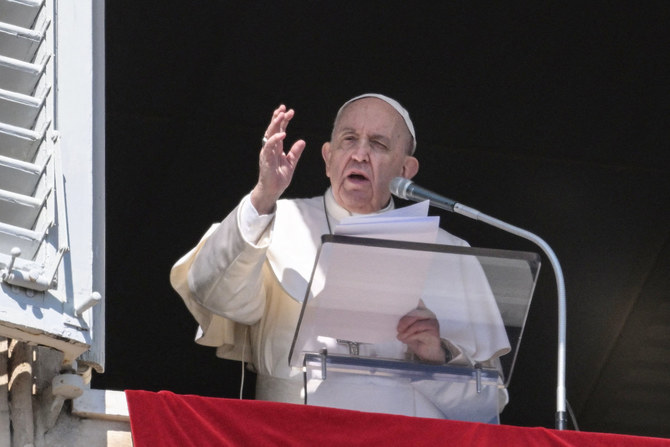
Pope Francis speaks from the window of the apostolic palace during the weekly noon prayer on March 13, 2022 in The Vatican.(Photo by Vincenzo Pinto / AFP)
Short Url
Updated 14 March 2022
Follow

Pope Francis calls for end to ‘armed aggression’ as Ukrainian refugees rise to 2.5 million

  • Calls for end to 'massacre' and urges nations to to take in refugees
  • Russia's invasion has forced more than 2.5 million people to flee Ukraine

ROME: Pope Francis on Sunday issued his toughest condemnation yet of the Russian invasion of Ukraine, saying the “unacceptable armed aggression” and “massacre” must stop.
“Faced with the barbarity of killing of children, of innocents and unarmed civilians, no strategic reasons can hold up,” he told 25,000 people in St. Peter’s Square during his Sunday blessing.
Moscow says its action is designed not to occupy territory but to demilitarize its neighbor. It has also denied targeting civilian areas.
“The only thing to do is stop this unacceptable armed aggression before it reduces cities into cemeteries,” Pope Francis said.
“In the name of God I ask you: Stop this massacre!” Pope Francis said, before asking the crowd to join him in silent prayer for an end to the war.
He called Ukraine’s besieged port of Mariupol a “martyred city” and again appealed for “truly secure humanitarian corridors” to allow residents to evacuate.
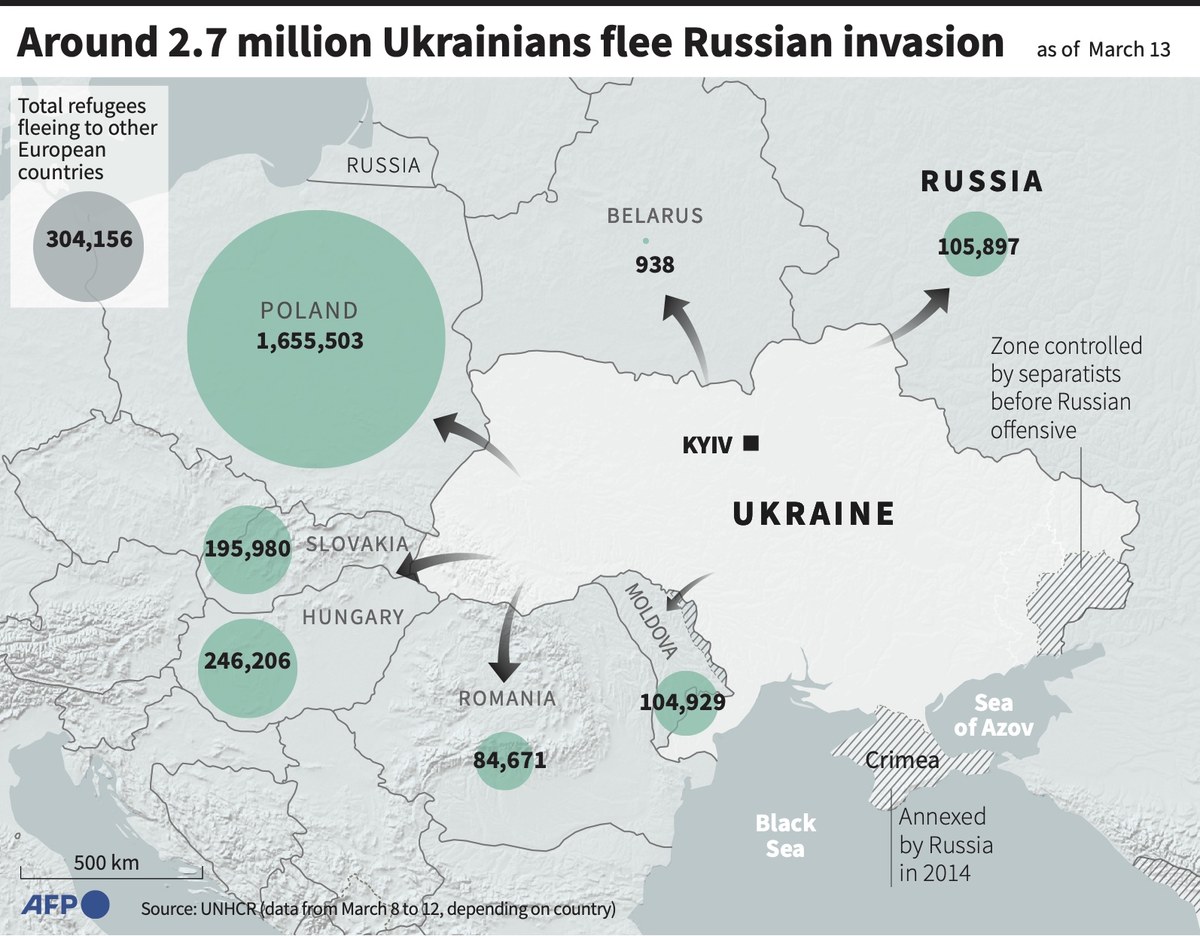
Now in its third week, Russia's invasion has forced more than 2.5 million people to flee Ukraine.
The UN has recorded at least 596 civilian deaths, though it believes the true toll is much higher, and Ukraine’s Prosecutor General’s office said that at least 85 children are among them. 

Pope Francis also urged people to take in refugees from Ukraine and thanked those who had joined a “great network of solidarity” to help those fleeing war.
The pope’s appeal came as Russia said it had attacked the Yavoriv training facility in western Ukraine.
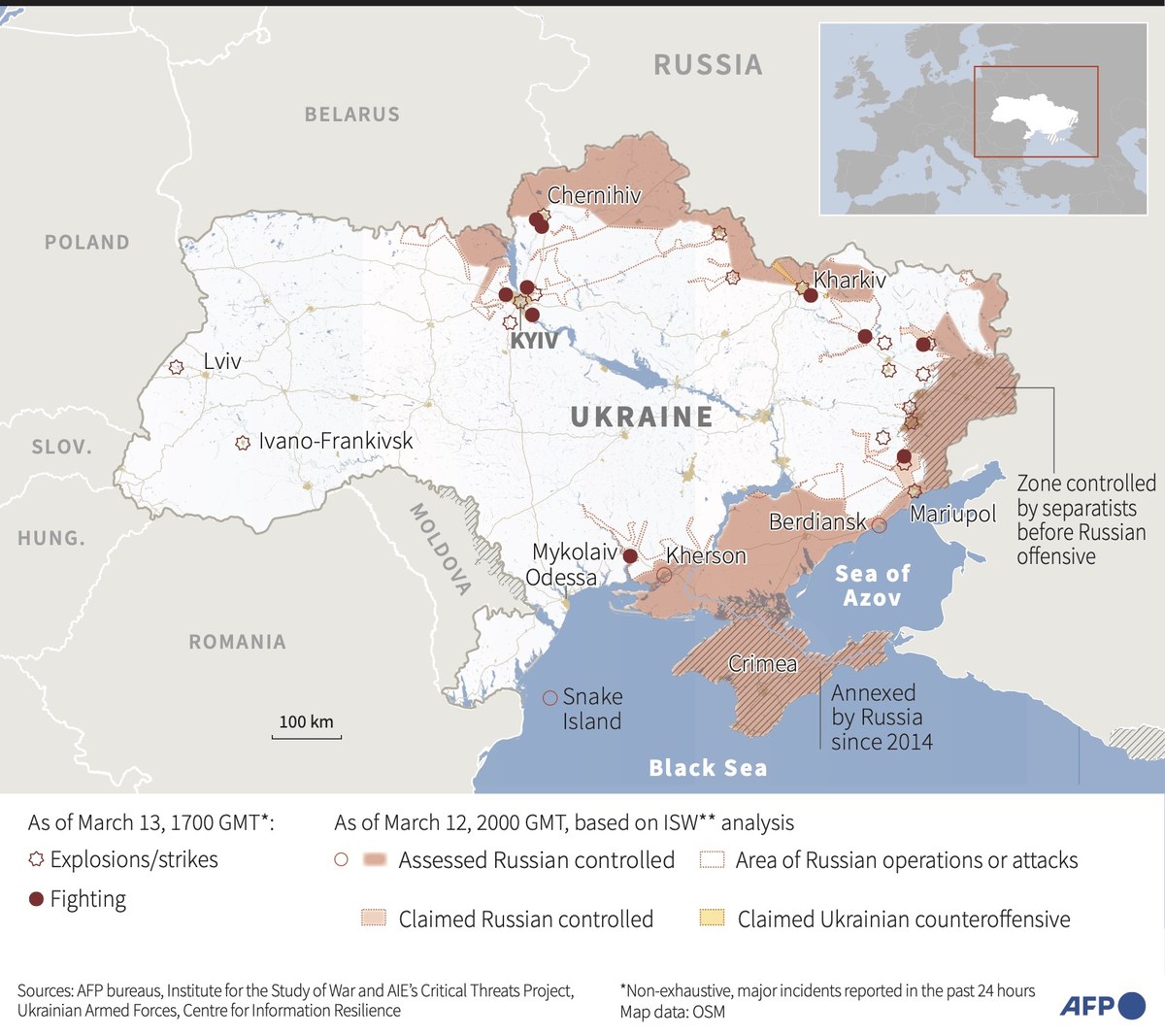
Ukrainian officials said at least 35 people were killed and 134 wounded Sunday when more than 30 cruise missiles were fired at the Yavoriv military range, just 25 kilometers (15 miles) from the Polish border.

Poland is also a transit route for Western military aid to Ukraine, and the strikes followed Moscow’s threats to target those shipments.
The training base appears to be the most westward target struck so far in the 18-day invasion. The facility, also known as the International Peacekeeping and Security Center, has long been used to train Ukrainian military personnel, often with instructors from the United States and other NATO countries.
The base has also hosted international NATO drills. As such, the site symbolizes what has long been a Russian complaint: That the NATO alliance of 30 member countries is moving ever closer to Russia’s borders. Russia has demanded that Ukraine drop its ambitions to join NATO.
The US issued a swift warning after the attack. White House national security adviser Jake Sullivan said on CBS News’ “Face the Nation” that Russia will face a response from NATO should any of its attacks in Ukraine cross borders and hit members of the security alliance — even by accident.
Russian airstrikes also again hit the airport in Ivano-Frankivsk, another city in western Ukraine south of Lviv and 250 kilometers (155 miles) away from Ukraine’s border with NATO members Slovakia and Hungary. The city’s mayor, Ruslan Martsinkiv, said Russia’s goal was “to sow panic and fear.”
Since their invasion more than two weeks ago, Russian forces have struggled in their advance across Ukraine, in the face of stiffer than expected resistance, bolstered by Western weapons support. 
Instead, Russian forces have besieged several cities and pummeled them with strikes, hitting two dozen medical facilities and leading to a series of humanitarian crises.


8 in 10 British Muslims face ‘financial faith penalty’ when seeking home finance, survey finds

Updated 04 February 2026
Follow

8 in 10 British Muslims face ‘financial faith penalty’ when seeking home finance, survey finds

  • Restricted choices plague potential buyers

LONDON: Eight in 10 British Muslims say their home finance choices are restricted because of their faith, according to a new national survey that highlighted what researchers describe as a growing “financial faith penalty” in the UK housing market.

The report, published by Islamic home finance fintech firm Offa, found that 80 percent of Muslim respondents believe their religious beliefs limit their access to suitable home finance, while those who do use Islamic products often face slower decisions, heavier paperwork and poorer customer experiences than in the conventional mortgage market.

Based on surveys of 1,000 British Muslims conducted by Muslim Census, and 2,000 non-Muslims carried out by OnePoll, the research calls on providers, brokers and policymakers to modernize Islamic home finance and improve access to Sharia-compliant products.

Among the 24.3 percent of British Muslims who have used Islamic home finance, just 5 percent said they had received a same-day decision.

Some 62 percent waited up to two weeks, while 33 percent waited more than 15 days, including 16 percent who waited over a month.

Long decision times were cited as the biggest challenge by 28 percent of respondents, followed by excessive paperwork (22.6 percent) and poor customer service (18.9 percent).

Islamic home finance differs from conventional mortgages by avoiding interest and steering investment away from sectors considered harmful to society, including gambling, alcohol, tobacco, arms trading and animal testing.

Sagheer Malik, chief commercial officer and managing director of home finance at Offa, said the findings showed British Muslims were being underserved by outdated systems.

Malik said: “Property is the asset class of choice for many of the UK’s 3.87 million Muslims, both as a route to generational wealth and as a long-term financial foundation, yet our insightful research report reveals that British Muslims are being underserved and deterred by slow, outdated and opaque Islamic home finance provision.

“This is not a niche concern. It goes to the heart of financial fairness and inclusion in modern Britain.”

He added that Muslims deserved Sharia-compliant products that matched mainstream standards on “price, speed and simplicity.”

Despite strong demand, uptake remains low.

Only 12.8 percent of British Muslims surveyed said they currently use Islamic home finance, with a further 11.5 percent having done so in the past. More than three quarters (75.7 percent) have never used it.

Faith plays a central role in financial decisions, with 94.2 percent saying it is important that their financial products align with their ethical or religious beliefs. Yet more than half of those using conventional mortgages said they felt unhappy or uneasy about doing so because of their faith.

The study also found that British Muslims share similar home ownership aspirations to the wider population, with 79.1 percent citing the desire to provide a stable home for their family, while 18.6 percent said building generational wealth was their main motivation. Only 2.2 percent said they did not want to own a home.

The report suggests Islamic finance could appeal beyond Muslim communities. While 64 percent of non-Muslim respondents had never heard of Islamic home finance, 63 percent said they favored its ethical principles once explained.

Younger generations were the most receptive, with 43 percent of Generation Z and 37 percent of millennials saying they would consider using Islamic home finance, compared with just 7 percent of baby boomers. More than three quarters of Gen Z and 72 percent of millennials also said it was important that their finance provider avoided investing in ethically harmful sectors.

Offa said the findings pointed to an opportunity to expand ethical finance in the UK, provided the industry can deliver faster, simpler and more transparent services.