

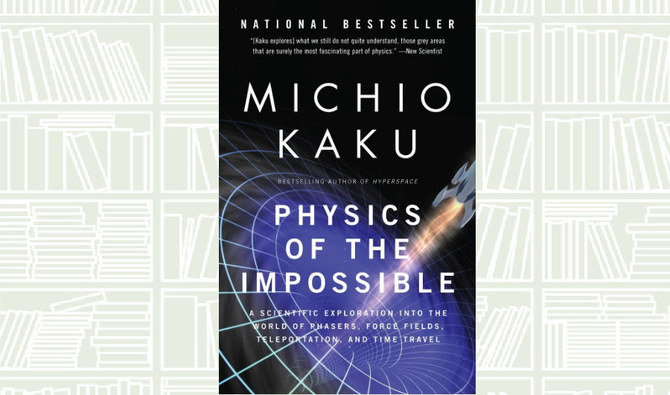

“Physics of the Impossible: A Scientific Exploration Into the World of Phasers, Force Fields, Teleportation, and Time Travel” is a nonfiction book written by American theoretical physicist Michio Kaku.
The book is a thought-provoking deep dive into the science of the impossible — the futuristic advances of science that are hard for today’s minds to grasp.
The author draws on mocking responses to present-day technology that were once deemed the work of science fiction.
Kaku uses popular culture references to interpret complex physics concepts to the reader, explaining why some fictional technologies are possible.
In the first chapter, entitled “Force fields,” the author refers to Star Trek’s shield that deflects lasers to explain the physics of force fields and whether this sci-fi technology is realistically feasible.
He is the co-founder of the cosmological string field theory or “the theory of everything,” which holds that everything is comprised of vibrating strings – smaller than atoms – that make up the fabric of all physical reality.
Kaku, who was given the Klopsteg Memorial Award in 2008 for the most notable physicist of the year, received the Sir Arthur Clark Lifetime Achievement Award for bridging the gap between sci-fi and science in 2021.
He was inspired by the great Albert Einstein to pursue a career in physics.
Kaku graduated with the highest honors from Harvard University and earned his doctorate from the University of California after his research at the Berkeley Radiation Laboratory.
He became a lecturer at Princeton University before moving to the City University of New York to research quantum mechanics in 1973.
Today, the internationally best-selling author is a professor of theoretical physics at CUNY, an active member of the scientific community who has made many media appearances over the years.


