

Foreign ministers of Saudi Arabia, other Muslim countries warn against Israel’s West Bank control measures

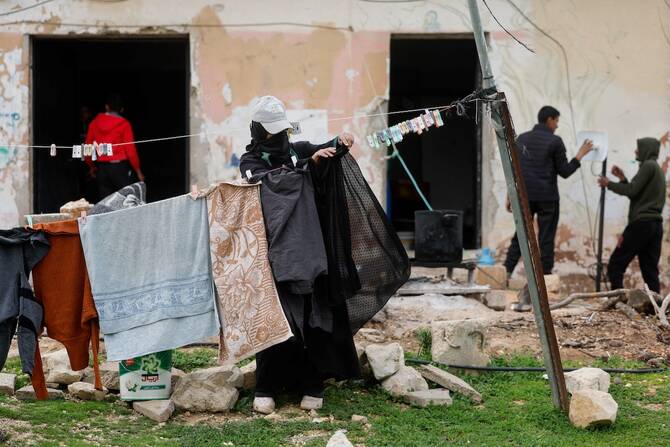
A woman takes clothes as members of a Palestinian Bedouin community leave following an Israeli army order in Arabba town near Jenin, in the Israeli-occupied West Bank, February 9, 2026. (Reuters)
Short Url
Updated 09 February 2026
Follow

Foreign ministers of Saudi Arabia, other Muslim countries warn against Israel’s West Bank control measures

  • Foreign ministers of Saudi Arabia, Jordan, UAE, Qatar, Indonesia, Pakistan, Egypt, and Turkiye strongly condemned the new Israeli measures
  • Measures will tighten control of the West Bank and pave the way for more settlements in the occupied Palestinian territory

RIYADH: The foreign ministers of Saudi Arabia and several other Muslim countries warned against the continuation of Israel’s expansionist policies and illegal measures in the occupied West Bank on Monday.

The foreign ministers of Saudi Arabia, Jordan, the United Arab Emirates, Qatar, Indonesia, Pakistan, Egypt, and Turkiye strongly condemned new Israeli measures to tighten control of the West Bank and pave the way for more settlements in the occupied Palestinian territory, the Saudi Press Agency reported.

Israel approved the measures, announced by Finance Minister Bezalel Smotrich and Defence Minister Israel Katz, on Sunday. They include allowing Jewish Israelis to buy West Bank land.

The Israeli measures also envisage transferring authority over building permits for settlements in parts of Palestinian cities, including Hebron, from the Palestinian Authority’s municipalities to Israel.

The foreign ministers reaffirmed that Israel has no sovereignty over occupied Palestinian territory and said such measures undermine ongoing efforts to achieve peace and stability in the region.

The ministers expressed their absolute rejection of these illegal measures, which constitute a flagrant violation of international law, undermine the two-state solution, and represent an attack on the inalienable right of the Palestinian people to establish their independent and sovereign state within June 1967 borders, with occupied East Jerusalem as its capital.

They said that the measures are null and void, and constitute a clear violation of UN Security Council resolutions, particularly Resolution 2334, which condemns all Israeli measures aimed at changing the demographic composition, character and status of the Palestinian territory occupied since 1967, including East Jerusalem.

The added that the measures also contradict a 2024 International Court of Justice advisory opinion, which concluded that Israel’s policies and practices in the occupied Palestinian territory and its continued presence therein are illegal.

The ministers reiterated their call for the international community to uphold its legal and moral responsibilities and compel Israel to halt its dangerous escalation in the occupied West Bank and inflammatory statements made by its officials.

They emphasized that fulfilling the legitimate rights of the Palestinian people to self-determination and the establishment of their state, based on the two-state solution and in accordance with international law and the Arab Peace Initiative, is the only way to achieve a just and comprehensive peace that guarantees security and stability in the region.


Saudi, Pakistan defense chiefs discuss ‘measures needed to halt’ Iranian attacks on Kingdom

Updated 11 min 46 sec ago
Follow

Saudi, Pakistan defense chiefs discuss ‘measures needed to halt’ Iranian attacks on Kingdom

RIYADH: Saudi Defense Minister Prince Khalid bin Salman and Pakistan’s  Chief of Defense Forces Asim Munir discussed Iran’s attacks on the Kingdom, amid the escalating military conflict in the Middle East. 

“We discussed Iranian attacks on the Kingdom and the measures needed to halt them within the framework of our Joint Strategic Defense Agreement,” Prince Khalid wrote on social media early on Saturday.

“We stressed that such actions undermine regional security and stability and expressed hope that the Iranian side will exercise wisdom and avoid miscalculation.”

The US and Israel began a large-scale military campaign against Iran on Feb. 28. Iran has since attacked a number of sites across the Gulf.

Tehran has also attacked US and Israeli military assets as the war as escalated, impacting lives in the peaceful Arabian Gulf peninsula and risked shaking the global economy as Iran continued restricting energy shipping along the Strait of Hormuz.

The Saudi Defense Ministry said a number of drones had been shot down that were targeting the Shayba oil field in the Empty Quarter on Saturday.

A drone attacked the US embassy in Riyadh on Tuesday causing a minor fire, but no one was hurt in the incident.

Saudi Arabia and Pakistan signed a “Strategic Mutual Defense Agreement”  in September, pledging that aggression against one country would be treated as an attack on both.

Separately, Prince Abdulaziz bin Saud bin Naif, the Saudi interior minister, received a call from his Pakistani counterpart Raza Naqvi, who condemned the blatant attacks targeting the Kingdom and affirmed his country’s solidarity in confronting any threats to the Kingdom’s security and stability, the Saudi Press Agency reported on Saturday.