

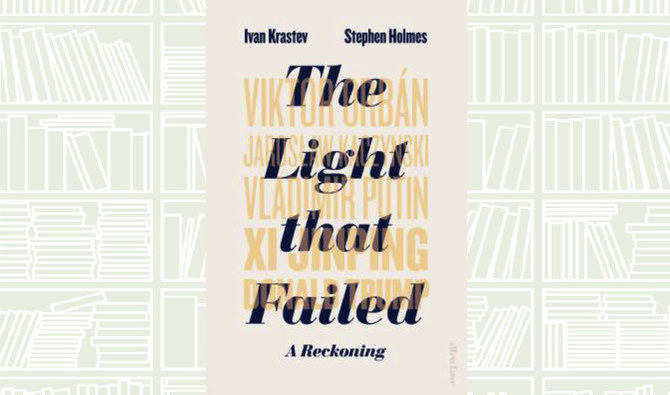
What We Are Reading Today: The Light that Failed

Short Url
Updated 13 March 2022
Follow

What We Are Reading Today: The Light that Failed

Authors: Ivan Krastev and Stephen Holmes

In the early 1990s, hopes for the eastward spread of liberal democracy were high. And yet the transformation of Eastern European countries gave rise to a bitter repudiation of liberalism itself, not only there but also back in the heartland of the West.

In this work of political psychology, Ivan Krastev and Stephen Holmes argue that the supposed end of history turned out to be only the beginning of an Age of Imitation.

Reckoning with the history of the last thirty years, they show that the most powerful force behind the wave of populist xenophobia that began in Eastern Europe stems from resentment at the post-1989 imperative to become Westernized. according to a review on goodreads.com.

Through this prism, the Trump revolution represents an ironic fulfilment of the promise that the nations exiting from communist rule would come to resemble the US.


What We Are Reading Today: The Power of Hope by Carol Graham

Updated 25 February 2026
Follow

What We Are Reading Today: The Power of Hope by Carol Graham

In a society marked by extreme inequality of income and opportunity, why should economists care about how people feel? The truth is that feelings of well-being are critical metrics that predict future life outcomes.

In this timely and innovative account, economist Carol Graham argues for the importance of hope—little studied in economics at present—as an independent dimension of well-being.

Given America’s current mental health crisis, thrown into stark relief by COVID, hope may be the most important measure of well-being, and researchers are tracking trends in hope as a key factor in understanding the rising numbers of “deaths of despair” and premature mortality.

Graham, an authority on the study of well-being, points to empirical evidence demonstrating that hope can improve people’s life outcomes and that despair can destroy them. These findings, she argues, merit deeper exploration.