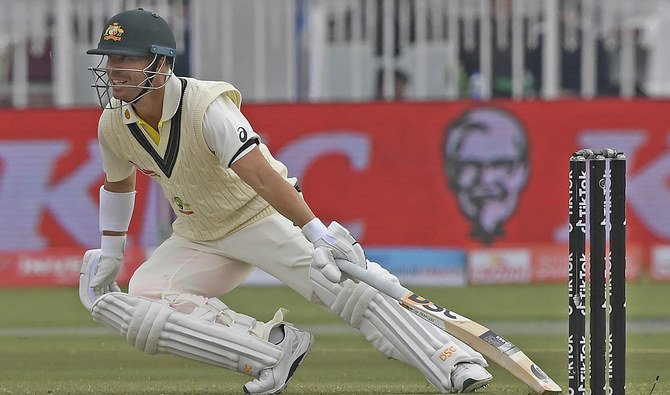
KARACHI: Australia opener David Warner said he hopes for an improved pitch for the second test in Karachi after the visitors could claim only four Pakistan wickets in the series-opening draw on Rawalpindi’s docile wicket.
“I just want a game where you can actually create 20 chances,” Warner said Thursday. “It’s something that’s going to be exciting and entertaining for the crowd.”
Pakistan Cricket Board chairman Ramiz Raja has acknowledged that drawn games are not a good advertisement for test cricket and Pindi Cricket Stadium’s wicket was described by Australia batter and vice captain Steve Smith as a “dead wicket.”
Pakistan scored 476-4 declared and 252-0 in its two innings against Australia’s three frontline fast bowlers and even veteran off-spinner Nathan Lyon couldn’t achieve any success on a lifeless track.
Australia also responded solidly with 449 all out, but the majority of left-arm spinner Nauman Ali’s six wickets resulted from bad strokes by the Australia batters.
“When he (Lyon) was hitting that rough, it wasn’t doing anything, was just pretty much going straight on slow off the wicket,” Warner said. “There wasn’t any variable bounce, which you generally do see on worn wickets.”
Raja said Pakistan has planned low-bouncy tracks for Australia’s first tour to Pakistan since 1998, keeping in mind Pakistan’s strength against a tough opponent.
Pakistan’s two test fast bowlers Hasan Ali and all-rounder Faheem Ashraf were ruled out due to injuries they had picked up during the Pakistan Super League.
Fast bowler Haris Rauf tested positive for COVID-19 ahead of the first test and Pakistan had to go in with only two fast bowlers — Shaheen Afridi and Naseem Shah.
Ashraf has recovered from a hamstring injury but was ruled out of the second test starting Saturday after testing positive for COVID-19 on Wednesday soon after the teams arrived in this southern port city from Rawalpindi and underwent testing.


Warner wants a better pitch for 2nd test against Pakistan
https://arab.news/w6m52
Warner wants a better pitch for 2nd test against Pakistan

- Australia could claim only four Pakistan wickets in the series-opening draw on Rawalpindi’s docile wicket
- “I just want a game where you can actually create 20 chances,” Warner said Thursday

Pakistan regulator says over 21,600 new companies registered in first half of FY26
- This reflects a 29 percent increase compared to the 16,839 companies that were registered during same period last year, says regulator
- These incorporations contributed $109.5 billion in paid-up capital, says Securities and Exchange Commission of Pakistan report
ISLAMABAD: The Securities and Exchange Commission of Pakistan (SECP) said this week it registered over 21,600 new companies in the first half of the current fiscal year, reflecting rising investor confidence and positive economic outlook in the country.
In a report issued on Jan. 6, the SECP said it registered 21,668 companies in the first six months of the current fiscal year, adding that these incorporations contributed Rs30.7 billion [$109.5 million] in paid-up capital.
The report said this represented a 29 percent increase compared to the 16,839 companies registered during the same period last year.
“Pakistan’s business landscape continues to demonstrate strong momentum, reflecting rising investor confidence and a positive economic outlook,” the SECP report said.
The SECP said the latest increase has brought the total number of registered companies in Pakistan to 279,724. It said the top ten sectors by incorporations were led by the IT & e-commerce, with 4,277 companies, followed by trading (2,997 companies), services (2,686 companies) and real estate (2,031 companies).
“This sectoral diversity highlights expanding entrepreneurial activity, particularly in technology-driven and service-oriented industries,” the report said.
The SECP said foreign investment also remained “robust” during the period, adding that 524 newly incorporated companies received foreign investment amounting to Rs1.26 billion [$4.5 million] with the participation from 731 foreign investors.
“China emerged as the leading source, accounting for 71 percent of total inflows,” the SECP said. “It was followed by Afghanistan (8 percent), the United States (2 percent), and the United Kingdom, Germany, South
Africa, South Korea, Norway, Vietnam, Nigeria, and Bangladesh, each contributing 1 percent,” it added.
The SECP said an additional 11 percent of the investment originated from other countries.


