

Pakistani man, wanting male offspring, kills infant daughter in Mianwali

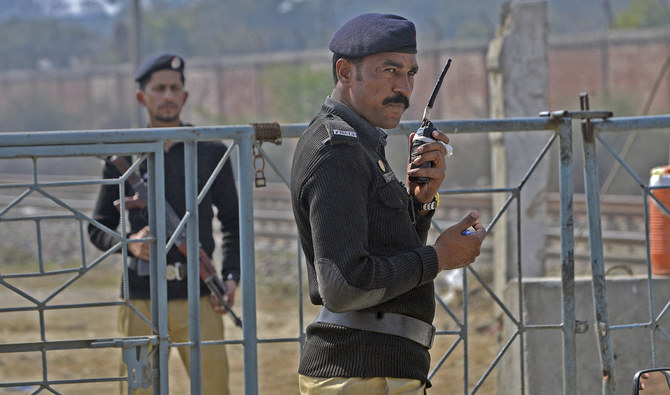
Pakistani policemen stand guard at the check point of Kot Lakhpat Jail where Mohammad Imran, the suspect accused of raping and murdering a young girl, shifted in Lahore on February 10, 2018. (AFP/File)
Short Url
Updated 08 March 2022
Follow

Pakistani man, wanting male offspring, kills infant daughter in Mianwali

  • According to police, the suspect shot the newborn in the head after snatching her away from his wife
  • The man pointed his pistol on other family members before managing to escape the crime scene

ISLAMABAD: A man who wanted a male child killed his infant daughter in Pakistan's Mianwali district before managing to escape the crime scene last week, Pakistani media widely reported on Tuesday.

Gender-based violence is not uncommon in Pakistan where, according to some surveys, 70 to 90 percent women are subjected to domestic violence.

Women are also killed by their male relatives in the name of family honor, and rights organizations have documented cases where young girls belonging to minority religious communities were married to Muslim men after forced conversions.

The incident in Mianwali has been widely reported by local media after police investigation revealed the suspect wanted a son and shot his seven-day-old daughter after snatching her away from his wife.

Other family members were also present at the house where the incident took place, though the man escaped after pointing his pistol at them.

According to some media houses, the suspect is a second-year student who had married two years ago. The autopsy report indicated that he had shot four bullets to kill the newborn.

Pakistan has tried to address the problem of violence against women by strengthening its legal framework in the past.

Earlier this year, it enacted a law to protect women from workplace harassment, though legal experts maintain such measures are not always fully implemented.

Pakistan launches cashless Ramadan market in Islamabad to promote digital payments

Updated 8 sec ago
Follow

Pakistan launches cashless Ramadan market in Islamabad to promote digital payments

  • Pilot market allows shoppers to buy subsidized food using digital payments
  • Initiative aims to improve transparency and public relief during Ramadan

KARACHI: Pakistan has launched a cashless subsidized Ramadan food market in the capital Islamabad, the interior ministry said on Wednesday, introducing digital payments for essential goods as authorities try to improve transparency and affordability during the Muslim holy month.

The facility in the G-6 Aabpara area allows citizens to purchase vegetables, fruit and staple food items at regulated prices without cash, part of a broader push toward digitizing subsidy delivery.

Ramadan bazaars, which are temporary and often state-supported markets, are set up across Pakistan each year to limit price spikes as demand rises during fasting hours and evening meals.

Ramadan is likely to start on Feb. 19 in Pakistan. 

“The objective is to provide the public affordable and quality items. No negligence in public relief will be tolerated,” the interior ministry said in a statement.

Officials said the market will operate daily from 9 a.m. to 4 p.m. and includes private vendors under monitoring mechanisms to ensure goods are sold according to wholesale market rates.

Authorities also instructed administrators to strengthen cleanliness, security and complaint-handling systems and ensure price lists are prominently displayed.

Pakistan last year launched its first-ever cashless weekly market in Islamabad, but slow Internet speeds and patchy phone connectivity have hampered adoption among vendors and shoppers. 

The government plans to turn Islamabad into Pakistan’s first fully cashless city, using QR-code payments to formalize retail transactions, reduce tax evasion and improve documentation in one of South Asia’s most informally run economies.

Pakistan relies heavily on cash, enabling widespread tax evasion and limiting financial transparency. Economists say expanding digital payments can raise government revenues, curb corruption, and make marketplaces safer for customers and traders.

Pakistan has increasingly experimented with targeted subsidies and digital systems to manage food affordability during Ramadan, when consumption rises sharply and lower-income households face pressure after years of high inflation.

Last week, Prime Minister Shehbaz Sharif launched a Rs38 billion ($136 million) Ramadan relief package, pledging direct digital cash transfers of Rs13,000 ($47) each to 12.1 million low-income families across Pakistan.

The government will distribute the relief package through bank accounts and regulated mobile wallet platforms, fully replacing the previous utility store-based subsidy model with a digital payment mechanism overseen by the State Bank of Pakistan.