

Police arrest man linked to sectarian attacks, 2011 assault on Saudi consulate in Karachi

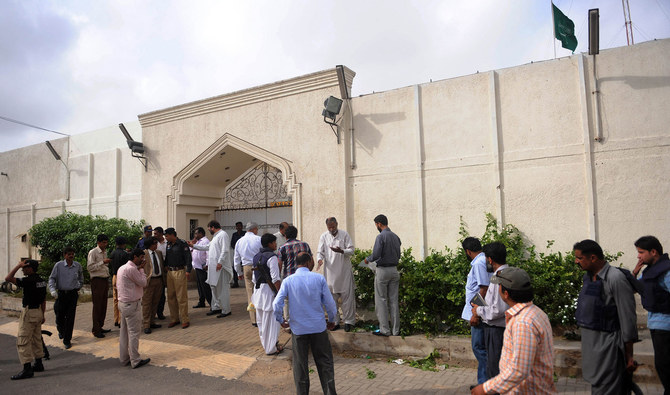
Pakistani security officials gather outside the Saudi consulate in Pakistan's port city of Karachi on May 11, 2011, following a grenade attack. (AFP/File)
Short Url
Updated 01 March 2022
Follow

Police arrest man linked to sectarian attacks, 2011 assault on Saudi consulate in Karachi

  • CTD officials described the suspect as a ‘most wanted terrorist’
  • Police say suspect also involved in attack on mosque, murder of a doctor

KARACHI: Police in Pakistan’s southern Sindh province said on Monday they had arrested a “most wanted terrorist” linked to sectarian incidents and a 2011 attack on the Saudi consulate in Karachi. 

Pakistan has witnessed several waves of sectarian violence since the 1980s, and its commercial capital Karachi has frequently been a hotspot for such assaults. 

In May 2011, unidentified attackers threw hand grenades at the Saudi Arabian consulate in Karachi, but no one was hurt, police said. A few days later, gunmen attacked a car belonging to the Saudi Arabian consulate in Karachi, killing a Saudi national.

“A CTD [counter terrorism department] team has arrested a most wanted terrorist in a raid who was involved in sectarian acts and remained associated with the Mehdi group,” an official handout circulated by the agency said, referring to a Karachi-based banned militant outfit. 

Deputy Superintendent of Police Investigations at the CTD, Naeem Ahmed, said Mehdi was a separate cell that operated out of Karachi and was not linked to any other proscribed outfit.

"Mehdi is a cell operated from Karachi, which has been involved in sectarian target killing," Ahmed told Arab News.

CTD has identified the accused as Syed Zaki Kazmi.

“He carried out a grenade attack on the Saudi [consulate] with his other accomplices and was arrested in the case in 2011,” the CTD statement said.

Ahmed said the accused was sentenced in the Saudi consulate attack case by a trial court, but he appealed the verdict in the high court, from where he was acquitted.

The CTD spokesperson said the accused was also linked to the murder of a doctor at his clinic and an attack on a mosque but had not been indicted in either case yet. 

Last month, Pakistani police asked for assistance from authorities in Tehran to catch the suspected killers of the Saudi diplomat assassinated in May 2011. Local officials believe the killers are hiding in Iran.

Last November, Pakistani authorities established a special team to investigate the murder after previous probes yielded no results, though Deputy Inspector General Omar Shahid Hamid has said his team was now working on some “fruitful leads.”


Pakistan demands political dialogue, immediate ceasefire as Sudan conflict rages on

Updated 4 sec ago
Follow

Pakistan demands political dialogue, immediate ceasefire as Sudan conflict rages on

  • Sudan’s civil war since April 2023 has killed over 40,000 people, displaced over 14 million people
  • Pakistan urges Security Council to reject parallel government entities undermining state institutions

ISLAMABAD: Pakistan’s UN envoy has demanded a political dialogue and an immediate ceasefire in Sudan, where fierce fighting has raged on for months between the military and a powerful paramilitary force.

Sudan plunged into chaos in April 2023 when a power struggle between the military and the Rapid Support Forces exploded into open fighting, with widespread mass killings and rapes, and ethnically motivated violence. This has amounted to war crimes and crimes against humanity, according to the UN and international rights groups.

Sudan’s Prime Minister Kamal Idris, who heads its transitional civilian government, proposed a peace plan on Monday. Idris said his plan includes a ceasefire monitored by the United Nations, African Union and Arab League, and the withdrawal of paramilitary forces from all areas they occupy, their placement in supervised camps and their disarmament.

“There is no military solution to the conflict in Sudan,” Usman Jadoon, Pakistan’s deputy ambassador at the United Nations, said on Monday. “The only durable path forward lies in a political dialogue and reconciliation.”

Jadoon said Pakistan supports all genuine efforts and political processes aimed at achieving an immediate cessation of hostilities and ceasefire, protecting civilians and providing unfettered humanitarian access to civilians. 

He called on the UN Security Council to support all efforts to safeguard Sudan’s territorial integrity and sovereignty and reject “so-called parallel government or structures” that undermine state institutions and risk the country’s fragmentation. 

The Pakistani envoy called for maintaining “zero tolerance” for war crimes, including attacks against UN peacekeepers and humanitarian workers, with credible investigations and accountability of the perpetrators.

“The brotherly people of Sudan have suffered beyond measure,” Jadoon said. “The guns must be silenced; hopes for a brighter future rekindled; with peace and normalcy visible on the horizon.”

The devastating war in Sudan has killed more than 40,000 people according to UN figures, but aid groups say the true number could be many times higher. 

The conflict has created the world’s largest humanitarian crisis, with over 14 million people displaced, disease outbreaks and famine spreading in parts of the country.