
At the Ukrainian border, a mother brings a stranger’s children to safety

1 / 2
Nataliya Ableyeva, 58, comforts a child who was handed over to her at the Ukrainian side of the border by a father who was not allowed to cross at a border crossing in Beregsurany, Hungary, February 26, 2022. (REUTERS)
2 / 2
Anna Semyuk, 33, hugs her children at the Beregsurany border crossing, Hungary, February 26, 2022. (REUTERS)
Short Url
Updated 27 February 2022
Follow

At the Ukrainian border, a mother brings a stranger’s children to safety

  • “Their father simply handed over the two kids to me, and trusted me, giving me their passports to bring them over,” 58-year-old Ableyeva said, the arms of the young boy she had known for just a few hours around her neck

BEREGSURANY, Hungary: Clutching a mobile phone number of a woman she had never met, Nataliya Ableyeva crossed the border from Ukraine into Hungary on Saturday, entrusted with a precious cargo.
A stranger’s children.
Waiting at the border crossing on the Ukrainian side, Ableyeva had met a desperate 38-year-old man from her home town of Kamianets-Podilskyi, with his young son and daughter.
The border guards would not let him pass. Ukraine has banned all Ukrainian men between the ages of 18 and 60 from leaving, so they can fight for their country.



Anna Semyuk, 33, hugs Nataliya Ableyeva, 58, who took Semyuk's children from their father who was not allowed to cross the border and kept them safe, at a border crossing in Beregsurany, Hungary, February 26, 2022 after Russia launched a massive military operation against Ukraine. (REUTERS)

“Their father simply handed over the two kids to me, and trusted me, giving me their passports to bring them over,” 58-year-old Ableyeva said, the arms of the young boy she had known for just a few hours around her neck.
The children’s Ukrainian mother was on her way from Italy to meet them and take them to safety, the father said. He gave Ableyeva the mother’s mobile number, and said goodbye to his children, wrapped up against the cold in thick jackets and hats.
Ableyeva had left her own two grown-up children behind in Ukraine. One a policeman, the other a nurse, neither could leave Ukraine under the mobilization decree.
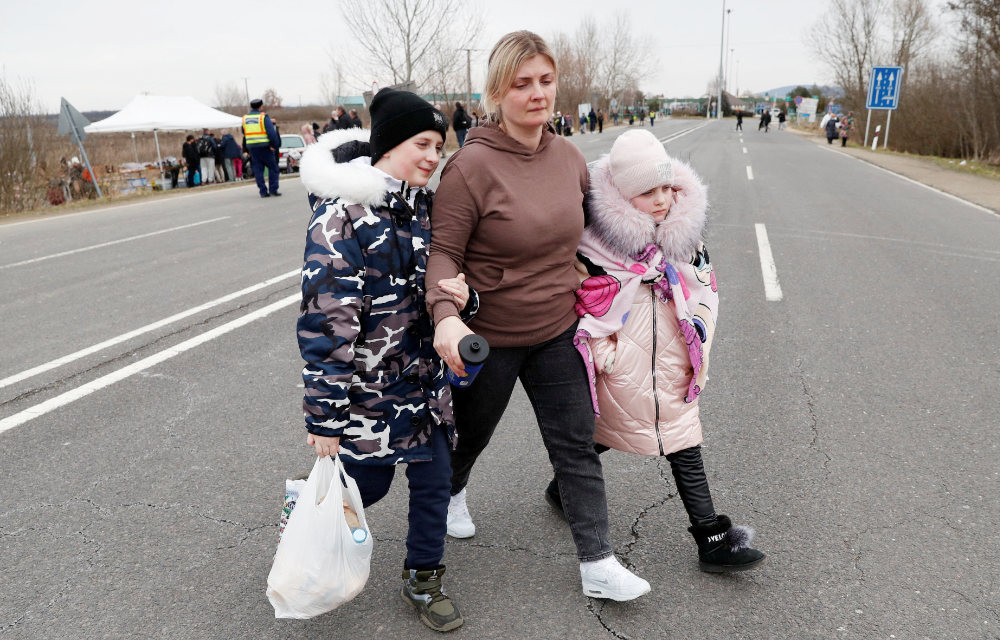


Anna Semyuk, 33, walks with her children at the Beregsurany border crossing, Hungary, February 26, 2022. The children were handed at the Ukrainian side of the border by the father, who is not allowed to cross, to Nataliya Ableyeva, 58, a stranger to the family who took the children across the border and kept them safe. (REUTERS)

She took the two small children by the hand and together they crossed the border.
On the Hungarian side at Beregsurany, they waited, sitting on a bench near a tent set up for the steady flow of refugees streaming over the frontier. The little boy was crying when his mobile phone rang.
It was his mother, she was nearly at the border post.
When 33-year-old Anna Semyuk arrived, her blonde hair scraped back in a pony tail, she hugged her son and went to her daughter, lying exhausted in the back of a car and wrapped in a pink blanket.
Then she thanked Ableyeva. Standing in the cold on the scrubby ground, two women embraced for several minutes and started to cry.
“All I can say to my kids now, is that everything will be alright,” said Semyuk. “In one or two weeks, and we will go home.”


Germany eyes lasers, spy satellites in military space spending splurge

Updated 3 sec ago
Follow

Germany eyes lasers, spy satellites in military space spending splurge

SINGAPORE: Germany is weighing investments ranging from spy ​satellites and space planes to offensive lasers under a 35 billion euro ($41 billion) military space spending plan aimed at countering growing threats from Russia and China in orbit, the country’s space commander said.
Germany will build an encrypted military constellation of more than 100 satellites, known as SATCOM Stage 4, over the next few years, the head of German Space Command Michael Traut told Reuters on the sidelines of a space event ahead of the Singapore Airshow.
He said the network ‌would mirror the ‌model used by the US Space Development Agency, ‌a ⁠Pentagon ​unit that ‌deploys low-Earth-orbit satellites for communications and missile tracking.
Rheinmetall is in talks with German satellite maker OHB about a joint bid for an unnamed German military satellite project, Reuters reported last week.
The potential deal comes as Europe’s top three space firms — Airbus, Thales and Leonardo — are seeking to build a European satellite communications alternative to Elon Musk’s Starlink.
Traut said Germany’s investment in military space architecture reflected a sharply more contested space environment since Russia’s ⁠full-scale invasion of Ukraine in 2022. Berlin and its European allies, he said, needed to bolster their deterrence ‌posture by investing not only in secure communications but ‍also in capabilities that could ‍hinder or disable hostile space systems.
“(We need to) improve our deterrence posture in ‍space, since space has become an operational or even warfighting domain, and we are perfectly aware that our systems, our space capabilities, need to be protected and defended,” Traut said.

INSPECTOR SATELLITES AND LASERS
Germany will channel funding into intelligence-gathering satellites, sensors and systems designed to ​disrupt adversary spacecraft, including lasers and equipment capable of targeting ground-based infrastructure, Traut said.
He added that Germany would prioritize small and large domestic and ⁠European suppliers for the program.
Traut emphasized Germany would not field destructive weapons in orbit that could generate debris, but said a range of non-kinetic options existed to disrupt hostile satellites, including jamming, lasers and actions against ground control stations.
He also pointed to so-called inspector satellites — small spacecraft capable of maneuvering close to other satellites — which he said Russia and China had already deployed.
“There is a broad range of possible effects in the electromagnetic spectrum, in the optical, in the laser spectrum, and even some active physical things like inspector satellites,” he said.
“You could even go after ground segments of a space system in order to deny that system to your adversary ‌or to tell him, ‘If you do something to us in space, we might do something to you in other domains as well.’”