

'God Save The Queen': messages pour in after Elizabeth tests positive for COVID

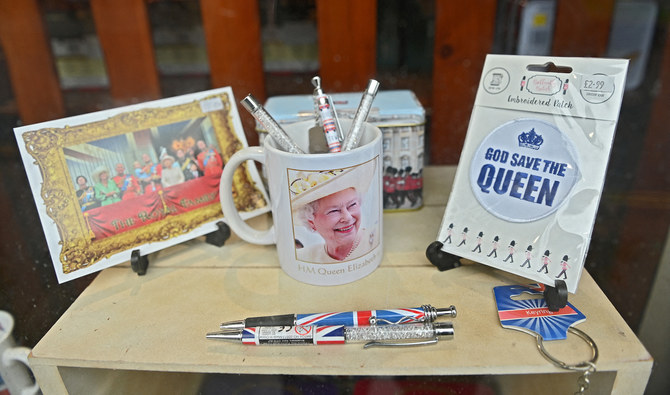
Royal souvenirs are seen on display in a shop opposite Windsor Castle, main residence of Britain's Queen Elizabeth II, in Windsor, on February 20, 2022. (AFP)
Short Url
Updated 21 February 2022
Follow

'God Save The Queen': messages pour in after Elizabeth tests positive for COVID

  • Illness follows anniversary earlier this month when she marked 70 years on the throne, first British sovereign to do so
  • The Palace said queen was showing mild symptoms and was expected to continue "light duties" over the coming week

WINDSOR: News that Britain's Queen Elizabeth had tested positive for COVID-19 drew shock, concern and messages of goodwill from across the country on Sunday, with politicians and the public willing the 95-year-old to recover.

On a wet and blustery day, a few sightseers gathered at the gates of Windsor Castle where the queen is receiving medical treatment for mild symptoms. Others went online to express support and message boards in the London Underground urged the monarch to "take it easy".

Many said they were troubled by the news after the world's longest reigning monarch pulled out of a number of high-profile events and spent a night in hospital last October, igniting fears about her health.

Julie and Rupert Wills, visiting Windsor to the west of London, said they loved the queen "to bits", with Rupert respecting her ability to just "quietly get on with" things. Sanil Solanki, 43, described her as the nation's mother.

For 19-year-old Gerard Smith, the news had come as a shock. "Everyone loves her," he said. "She can't do wrong to anyone. She's been there my whole lifetime and the lifetime of almost everyone. It's sad to hear. Hopefully she makes it through."

British Prime Minister Boris Johnson led the official response, saying he was sure he spoke for the nation when he wished the queen a swift recovery and a rapid return to vibrant good health.

Opposition leader Keir Starmer said: "Get well soon Ma'am." Many other politicians simply tweeted "God Save The Queen".

The U.S. Embassy in London sent best wishes. The chief minister of Gibraltar, Fabian Picardo, described the queen as "a rock" in reference to the British territory's landscape.

The widespread support for the queen follows the anniversary earlier this month when she quietly marked 70 years on the throne, the first British sovereign to do so.

The Palace said the queen was showing mild symptoms and was expected to continue "light duties" over the coming week.

In keeping with that, the queen released a statement shortly afterwards praising the British women's curling team for their Olympic gold medal in Beijing.

"I know that your local communities and people throughout the United Kingdom will join me in sending our good wishes to you, your coaches and the friends and family who have supported you in your great success," she said.


Geoeconomic confrontation tops global risks in 2026: WEF report

Updated 4 sec ago
Follow

Geoeconomic confrontation tops global risks in 2026: WEF report

  • Also armed conflict, extreme climate, public polarization, AI
  • None ‘a foregone conclusion,’ says WEF’s MD Saadia Zahidi

DUBAI: Geoeconomic confrontation has emerged as the top global risk this year, followed by state-based armed conflict, according to a new World Economic Forum report.

The Global Risks Report 2026, released on Wednesday, found that both risks climbed eight places year-on-year, underscoring a sharp deterioration in the global outlook amid increased international competition.

The top five risks are geoeconomic confrontation (18 percent of respondents), state-based armed conflict (14 percent), extreme weather events (8 percent), societal polarization (7 percent) and misinformation and disinformation (7 percent).

The WEF’s Managing Director Saadia Zahidi said the report “offers an early warning system as the age of competition compounds global risks — from geoeconomic confrontation to unchecked technology to rising debt — and changes our collective capacity to address them.

“But none of these risks are a foregone conclusion.”

The report assesses risks across three timeframes: immediate (2026); short-to-medium term (next two years); and long term (next 10 years).

Economic risks show the largest overall increase in the two-year outlook, with both economic downturn and inflation jumping eight positions.

Misinformation and disinformation rank fifth this year but rise to second place in the two-year outlook and fourth over the 10-year horizon.

The report suggests this reflects growing anxiety around the rapid adoption of artificial intelligence, with adverse outcomes linked to AI surging from 30th place in the two-year timeframe to fifth in the 10-year outlook.

Uncertainty dominates the global risk outlook, according to the report.

Surveyed leaders and experts view both the short- and long-term outlook negatively, with 50 percent expecting a turbulent or stormy global environment over the next two years, rising to 57 percent over the next decade.

A further 40 percent and 32 percent, respectively, describe the outlook as unsettled across the two- and 10-year timeframes, while just 1 percent anticipate a calm global outlook in either period.

Environmental risks ease slightly in the short-term rankings. Extreme weather fell from second to fourth place and pollution from sixth to ninth. Meanwhile, critical changes to Earth systems and biodiversity loss dropped seven and five positions, respectively.

However, over the next decade, environmental threats re-emerge as the most severe, with extreme weather, biodiversity loss, and critical changes to Earth systems topping the global risk rankings.

Looking ahead over the next decade, around 75 percent of respondents anticipate a turbulent or stormy environmental outlook, making it the most pessimistic assessment across all risk categories.

Zahidi said that “the challenges highlighted in the report underscore both the scale of the potential perils we face and our shared responsibility to shape what comes next.”

Despite the gloomy outlook, Zahidi signaled a positive shift in global cooperation.

 “It is also clear that new forms of global cooperation are already unfolding even amid competition, and the global economy is demonstrating resilience in the face of uncertainty.”

Now in its 21st year, the Global Risks Report highlights a core message: global risks cannot be managed without cooperation.

As competition intensifies, rebuilding trust and new forms of collaboration will be critical, with the report stressing that today’s decisions will shape future outcomes.

The report was released ahead of WEF’s annual meeting, which will be held in Davos from Jan. 19 to 23.