Pakistani man lynched over alleged blasphemy in Khanewal village

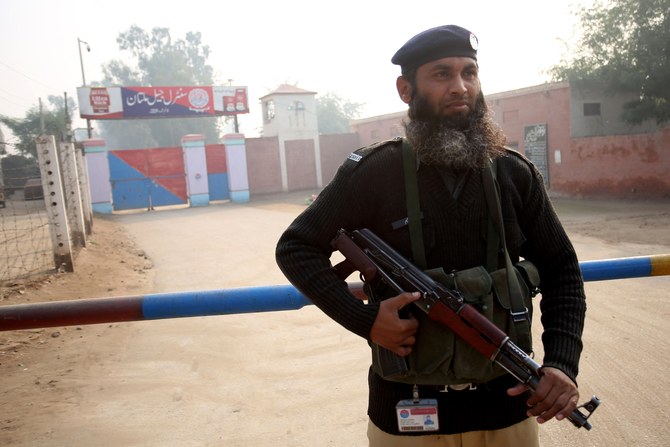
A policeman stands guard outside the central jail, as the court delivered the verdict on a blasphemy case, in Multan on December 21, 2019. (AFP/ File)
Short Url
Updated 13 February 2022
Follow

Pakistani man lynched over alleged blasphemy in Khanewal village

  • Media reports accused was in police custody but was allowed to exit police station even though angry mob waited outside
  • Incident comes months after mob tortured and burned Sri Lankan factory manager in Sialkot over apparent blasphemy

ISLAMABAD: A middle-aged man was stoned to death by a mob over alleged blasphemy in a remote village in Khanewal district on Saturday, Pakistani media widely reported on Sunday.
The killing comes just months after a mob of factory employees tortured and burned a Sri Lankan manager in Sialkot in December over apparent blasphemy in a "horrific" attack that Prime Minister Imran Khan said had brought shame on the country.
The incident drew nationwide condemnation and authorities arrested dozens of people over involvement in the killing of Priyantha Kumara. Those linked to Kumara’s murder are facing a trial in Pakistan.
“The Saturday incident took place in Jungle Dera village where hundreds of loc­als gathered after Magh­rib pra­yers following annou­n­cements that a man had torn some pages of the Holy Quran and later set them on fire,” Dawn newspaper reported. “The villagers first hanged him with a tree and then hit him with bricks, until he died.”
The Express Tribune newspaper reported that the accused, who claimed innocence, had been in police custody but was allowed to leave the police station even though an angry mob was present outside.
“Taking notice of the incident, IG Punjab Rao Sardar Ali Khan sought a report from Additional IG South Punjab over the incident,” Tribune said. “He also directed RPO Multan to conduct a thorough inquiry in this regard and ordered DPO Khanewal to reach the affected location as soon as possible.”
Mob killings over accusations of blasphemy - a crime that can carry the death sentence - have been frequent in Muslim-majority Pakistan.
In January this year, a Pakistani court sentenced a Muslim woman to death after finding her guilty of blasphemy for insulting Islam’s Prophet Muhammad (pbuh).
The woman, Aneeqa Atteeq, was arrested in May 2020 after the man alerted police that she sent him offensive caricatures via WhatsApp.
Under Pakistan’s blasphemy laws, anyone found guilty of insulting the religion or religious figures can be sentenced to death. While authorities have yet to carry out a death sentence for blasphemy, just the accusation can cause riots.


Pakistan urges concessional finance for developing nations to boost clean energy security

Updated 6 sec ago
Follow

Pakistan urges concessional finance for developing nations to boost clean energy security

  • Pakistan has emerged as one of world’s fastest growing solar markets, with 12GWs of off-grid and 6GWs of net-metered capacity in 2025
  • PM’s aide says Islamabad remains committed to Paris Agreement, looks for continued support in building a resilient and low-carbon future

ISLAMABAD: Pakistan has urged international partners to scale up concessional financing for developing countries, the country’s Press Information Department (PID) said on Sunday, citing an aide to Prime Minister Shehbaz Sharif.

The call was made by Sharif’s coordinator on climate change, Romina Khurshid Alam, while delivering Pakistan’s national statement at the 16th International Renewable Energy Agency (IRENA) Assembly in Abu Dhabi.

Pakistan has emerged as one of the world’s fastest growing solar markets, with 12 gigawatts (GWs) of off-grid and over 6GWs of net-metered solar capacity by the end of 2025. Last fiscal year, renewables accounted for a historic 53 percent of total electricity generation, according to Alam.

The prime minister’s aide stressed that affordable funding for developing nations is critical to accelerating their transition to clean energy and strengthening energy security amid rising climate and economic challenges.

“Alam reaffirmed Pakistan’s target of achieving 60 percent renewables in the power mix by 2030,” the PID said in a statement.

“In her call to action, she urged IRENA and Member States to increase concessional finance for developing nations, treat technologies such as energy storage and green hydrogen as global public goods, and strengthen regional cooperation for shared energy security.”

IRENA is a global intergovernmental agency for energy transformation that serves as the principal platform for international cooperation, supports countries in their energy transition, and provides state of the art data and analyzes on technology, innovation, policy, finance and investment. Its membership comprises 170 countries and the European Union (EU).

The 16th session of the IRENA Assembly is taking place on Jan. 10-12 in Abu Dhabi and focuses on the theme of “Powering Humanity: Renewable Energy for Shared Prosperity.” The session has gathered global leaders and energy decision-makers to discuss strategies and underline necessary actions for the acceleration of renewable energy across countries, regions, and the world, driving economic inclusion, equity, and human well-being.

Alam shared that Pakistan is taking action against energy poverty through initiatives like the Punjab Solar Panel Scheme 2026, which provides free or subsidized systems to low-income households.

She highlighted how distributed solar kits have restored power and livelihoods in flood-affected communities and offer a replicable model for climate-resilient recovery.

“Pakistan remains fully committed to the Paris Agreement and looks to IRENA for continued technical and financial support in building a resilient, inclusive, and low-carbon future,” Alam said.

Adopted in 2015 to combat climate change, the Paris Agreement binds nations to hold “the increase in the global average temperature to well below 2°C above pre-industrial levels” and pursue efforts “to limit the temperature increase to 1.5°C above pre-industrial levels.”