

Sudan rejects Western criticism of arrests as ‘blatant interference’

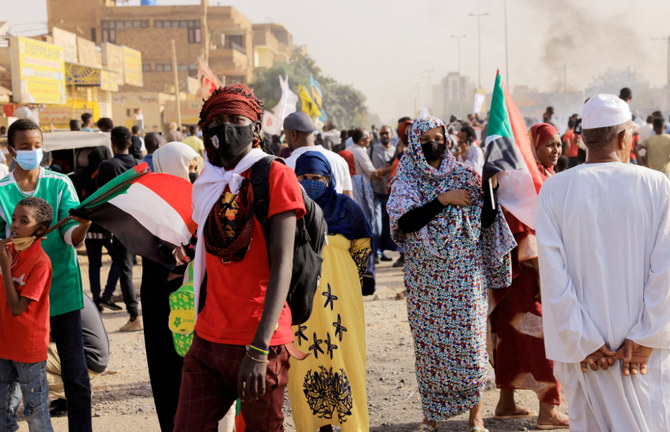
Protesters march during a rally against military rule following coup in Khartoum, Sudan, February 10, 2022. (Reuters)
Short Url
Updated 12 February 2022
Follow

Sudan rejects Western criticism of arrests as ‘blatant interference’

  • Protests organized by neighborhood resistance committees have drawn hundreds of thousands of people, and at least 79 have been killed and more than 2,000 injured in crackdowns

KHARTOUM: Sudan has denounced Western criticism of the arrest of two high-profile former officials opposed to military rule and charged with corruption, saying it was contrary to “diplomatic norms and practices.”
Khalid Omer Yousif and Wagdi Salih were arrested on Wednesday, a move Norway, the US, Britain, the EU, Canada, and Switzerland condemned as “harassment and intimidation” by Sudan’s military authorities.
“This is blatant interference in internal Sudanese affairs, contrary to diplomatic norms and practices,” the Sudanese Foreign Ministry said in a statement.
Both men had been part of the government that was toppled on Oct. 25 and had been detained in the weeks following. Since then, military leaders have repeatedly warned of foreign interference.
The two had been involved in a taskforce that seized assets from members of ousted President Omar Bashir’s regime that has come under criticism from the military. A committee reviewing its work said on Sunday it had found irregularities.

BACKGROUND

Lawyers said this week more than 100 people remain in prison, while some 2,000 had been arrested and released.

“The two citizens referred to were in fact detained based on clear criminal suspicion, not as a result of any political charge or motive, and the ambassadors concerned should have taken care to obtain accurate information from official sources,” the Foreign Ministry statement said.
The coup ended a partnership between the military and civilian political parties, drawing international condemnation and plunging Sudan into turmoil, with frequent nationwide demonstrations against the coup and a wave of political detentions.
Lawyers told Reuters this week more than 100 people remain in prison, while some 2,000 had been arrested and released.
Protests organized by neighborhood resistance committees have drawn hundreds of thousands of people, and at least 79 have been killed and more than 2,000 injured in crackdowns.
The wave of arrests has expanded following the killing of a senior police officer during a Jan. 13 protest close to the presidential palace in Khartoum.
The officer was stabbed to death, according to local media.
Security forces raided a Khartoum hospital and arrested six, including an injured protester and women who were visiting him, accusing them of being responsible for the killing.
The trend has frustrated diplomats working to bring the military and civilian leaders to some sort of an agreement.
“Arbitrary arrests and detention of political figures, civil society activists and journalists undermine efforts to resolve Sudan’s political crisis,” said Lucy Tamlyn, US chargé d’affaires in Sudan.


Turkiye’s approval of peace roadmap is important step, PKK source says

Updated 8 sec ago
Follow

Turkiye’s approval of peace roadmap is important step, PKK source says

  • “The vote is considered an achievement and an important step toward consolidating democracy in Turkiye,” said the PKK source
  • There were foundations for resolving the Kurdish issue, but there was a lack of clarity on the issue in the report

BAGHDAD: A Turkish parliamentary commission’s approval of a report setting out a roadmap for legal reforms alongside the disbandment of the Kurdistan Workers Party (PKK) militant group is an important step and the beginning of a fundamental change in Turkish policy, a PKK source told Reuters on Thursday.
The commission voted overwhelmingly on Wednesday to approve the report, advancing a peace process designed to end decades of conflict.
“The vote is considered an achievement and an important step toward consolidating democracy in Turkiye,” said the PKK source.
The PKK — designated a terrorist ⁠organization by Turkiye, ⁠the United States and the European Union — halted attacks last year and said in May it had decided to disband and end its armed struggle.
The parliamentary vote shifts the peace process to the legislative theater, as President Tayyip Erdogan, Turkiye’s leader of more than two decades, bids to end a conflict focused on mainly Kurdish southeast Turkiye.
The insurgency began in 1984 and has killed more than 40,000 people, sowing deep discord at home and ⁠spreading violence across borders into Iraq and Syria.

IMPORTANT ISSUES OUTSTANDING
The PKK source said there were foundations for resolving the Kurdish issue, but there was a lack of clarity on the issue in the report.
“There also remain other important issues, such as initiating constitutional amendments, especially in aspects related to the Kurdish language as well as amendments to the anti-terrorism law,” the source said.
Another issue was legislation concerning the return of PKK militants to Turkiye and their integration into society, the source said.
A key element of Wednesday’s report recommended strengthening mechanisms to ensure compliance with decisions by the European Court of Human Rights (ECHR) and the Constitutional Court.
Among key ECHR decisions related to Turkiye are rulings that the rights of ⁠jailed former pro-Kurdish ⁠party leader Selahattin Demirtas had been violated and that he should be released immediately.
Ankara’s final appeal against that was rejected in November.

SIGN OF INTENT
Demirtas’ lawyer Mahsuni Karaman told Reuters the report’s comments on the ECHR were important as a sign of intent.
“We hope this will be reflected in judicial practice— that is our wish and expectation,” Karaman said.
Demirtas was detained in November 2016 on terrorism-related charges, which he denies. In May 2024, a court convicted him in connection with deadly 2014 protests and sentenced him to more than 40 years in prison.
Turkish nationalist leader Devlet Bahceli, a key Erdogan ally whose call in 2024 triggered the current PKK peace process, said in November that it “would be beneficial” to release Demirtas from prison.
The opposition pro-Kurdish DEM Party — the successor party of Demirtas’ HDP — remains parliament’s third-largest bloc and has cooperated closely with the parliamentary commission.