

Bids for Saudi new large mining site to close in Q2, says mining official

Short Url
Updated 06 February 2022
Follow

Bids for Saudi new large mining site to close in Q2, says mining official

  • Gold, silver, zinc, and copper are among the 55 mineral occurrences in the region surrounding Al Khunayqiyah site, says Saudi mining official Abdulrahman Al-Belushi

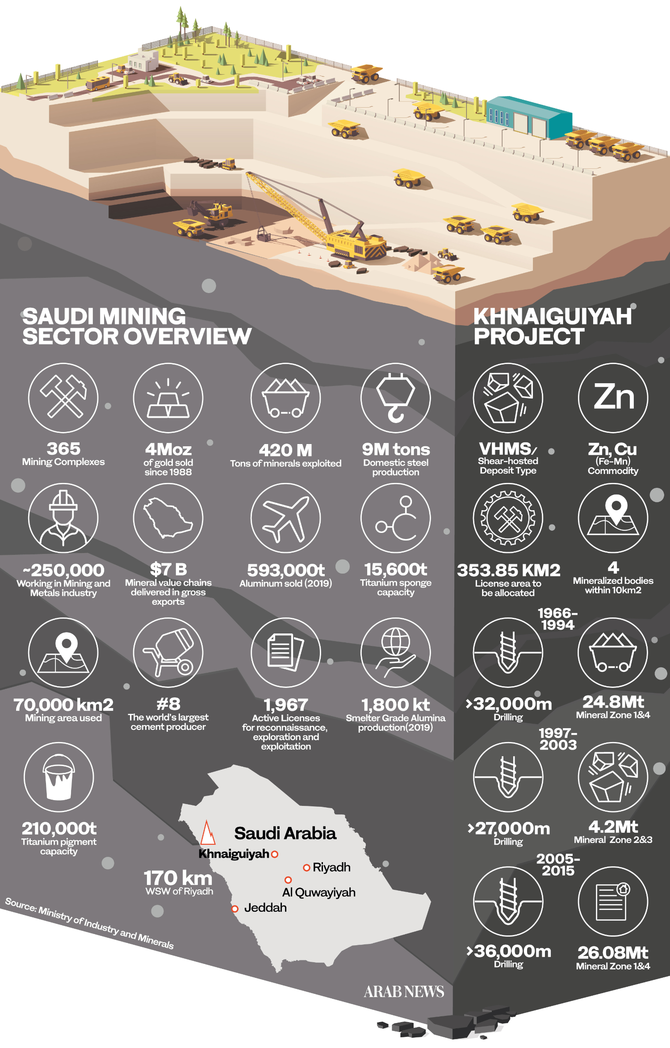
RIYADH: Bids to develop zinc and copper deposits at Saudi Arabia's new mining site, named Al Khunayqiyah, will close in the second quarter of this year, according to a mining official.

The site, located 170 kilometers away from the Saudi capital Riyadh, will go into production once the tendering documents are issued and the mining company is appointed, according to the head of the mining strategy department.

“The qualification process will happen during the first quarter of 2022 and the announcement of the bidder and the closing of the bidding process will happen in the second quarter of this year,” Abdulrahman Al-Belushi told Arab News on the sideline of the Future Mineral Forum, FMF.


“We already have a resource estimate of 25 million tons of zinc and copper, 3 to 4 percent zinc, and about 0.5 percent copper. We also could find manganese,” he said. Saudi Arabia has issued the largest ever exploration licence in the kingdom for an area of more than 350 square kilometres at Al Khunayqiyah.

More than 100,000 meters have already been drilled at the site searching for mineral occurrences, he added.

There are 55 mineral occurrences in the region surrounding Al Khunayqiyah, including gold, silver, zinc, and copper which will hopefully be explored and exploited, he added.

The ministry of industry and mineral resources established the process for investors to participate and invest in the Kingdom. 


“We've put in a lot of incentives, which are all performance-based. For every step that your raw material will stay in the country, you will receive a 30 percent reduction in your royalty. And also we have a five-year tax holiday. We want to encourage all miners to produce and develop their mines as fast as possible,” Al-Belushi added.

Like any other public sector in the Kingdom, this sector has its Saudization targets, focusing on the local community next to the mining project. 

“We don't want to just Saudize. We want to bring people from the community next door because they are from that location, they know the location, they know its capabilities, and we want to develop them, train them,” he said.


First EU–Saudi roundtable on critical raw materials reflects shared policy commitment

Updated 16 January 2026
Follow

First EU–Saudi roundtable on critical raw materials reflects shared policy commitment

RIYADH: The EU–Saudi Arabia Business and Investment Dialogue on Advancing Critical Raw Materials Value Chains, held in Riyadh as part of the Future Minerals Forum, brought together senior policymakers, industry leaders, and investors to advance strategic cooperation across critical raw materials value chains.

Organized under a Team Europe approach by the EU–GCC Cooperation on Green Transition Project, in coordination with the EU Delegation to Saudi Arabia, the European Chamber of Commerce in the Kingdom and in close cooperation with FMF, the dialogue provided a high-level platform to explore European actions under the EU Critical Raw Materials Act and ResourceEU alongside the Kingdom’s aspirations for minerals, industrial, and investment priorities.

This is in line with Saudi Vision 2030 and broader regional ambitions across the GCC, MENA, and Africa.

ResourceEU is the EU’s new strategic action plan, launched in late 2025, to secure a reliable supply of critical raw materials like lithium, rare earths, and cobalt, reducing dependency on single suppliers, such as China, by boosting domestic extraction, processing, recycling, stockpiling, and strategic partnerships with resource-rich nations.

The first ever EU–Saudi roundtable on critical raw materials was opened by the bloc’s Ambassador to the Kingdom, Christophe Farnaud, together with Saudi Deputy Minister for Mining Development Turki Al-Babtain, turning policy alignment into concrete cooperation.

Farnaud underlined the central role of international cooperation in the implementation of the EU’s critical raw materials policy framework.

“As the European Union advances the implementation of its Critical Raw Materials policy, international cooperation is indispensable to building secure, diversified, and sustainable value chains. Saudi Arabia is a key partner in this effort. This dialogue reflects our shared commitment to translate policy alignment into concrete business and investment cooperation that supports the green and digital transitions,” said the ambassador.

Discussions focused on strengthening resilient, diversified, and responsible CRM supply chains that are essential to the green and digital transitions.

Participants explored concrete opportunities for EU–Saudi cooperation across the full value chain, including exploration, mining, and processing and refining, as well as recycling, downstream manufacturing, and the mobilization of private investment and sustainable finance, underpinned by high environmental, social, and governance standards.

From the Saudi side, the dialogue was framed as a key contribution to the Kingdom’s industrial transformation and long-term economic diversification agenda under Vision 2030, with a strong focus on responsible resource development and global market integration.

“Developing globally competitive mineral hubs and sustainable value chains is a central pillar of Saudi Vision 2030 and the Kingdom’s industrial transformation. Our engagement with the European Union through this dialogue to strengthen upstream and downstream integration, attract high-quality investment, and advance responsible mining and processing. Enhanced cooperation with the EU, capitalizing on the demand dynamics of the EU Critical Raw Materials Act, will be key to delivering long-term value for both sides,” said Al-Babtain.

Valere Moutarlier, deputy director-general for European industry decarbonization, and directorate-general for the internal market, industry, entrepreneurship and SMEs at European Commission, said the EU Critical Raw Materials Act and ResourceEU provided a clear framework to strengthen Europe’s resilience while deepening its cooperation with international partners.

“Cooperation with Saudi Arabia is essential to advancing secure, sustainable, and diversified critical raw materials value chains. Dialogues such as this play a key role in translating policy ambitions into concrete industrial and investment cooperation,” she added.