

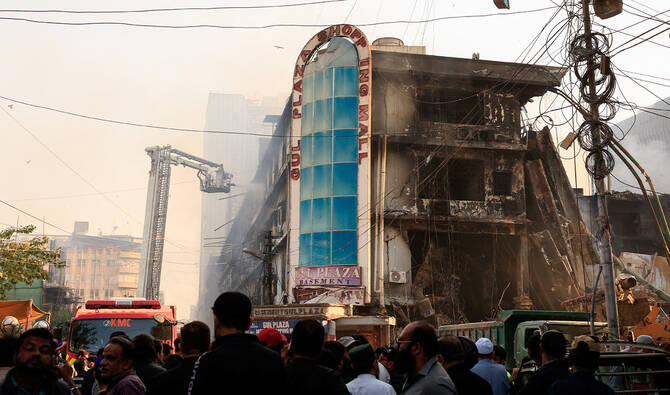

KARACHI: In most years, the weeks before Eid Al-Fitr bring a surge of shoppers to Karachi’s markets, as families buy clothes, shoes and gifts for the holiday. This year, for hundreds of traders displaced by a deadly mall fire, the season has passed without business and without recovery.
In January, a massive blaze tore through Gul Plaza, a densely packed commercial building in Karachi’s Saddar area, killing over 70
people and destroying more than 1,200 shops.
Traders say the fire wiped out inventory worth billions of rupees, much of it stocked in advance for the peak Eid shopping period.
A subsequent inquiry by Sindh authorities found the fire was triggered inside a shop selling artificial flowers, where a child reportedly lit a match that ignited flammable material, causing flames to spread rapidly through the building. The investigation also highlighted serious safety lapses that turned the blaze into a mass-casualty incident, including blocked or locked exits, a lack of fire-fighting equipment and years of ignored warnings about building violations.
The Sindh government announced Rs10 million ($36,000) in compensation for families of those who died, along with Rs500,000 ($1,785) in immediate relief for affected shopkeepers. But traders say the assistance covers only a fraction of their losses, leaving many struggling to rebuild. The Gul Plaza Market Association estimates total losses at over $25 million.
For Aisha Farrukh, whose shop was destroyed in the fire, the run-up to Eid has only underscored the scale of what has been lost.
“Now we have come to the point where, as I told you earlier, we have gone bankrupt,” Farrukh, 37, told Arab News. “And in this period, we can’t even see the way ahead. If we look behind, we are in debt. If we look ahead, there is nothing.”
She urged the government to approve her compensation claim “as soon as possible.”
Sindh Senior Minister for Information Sharjeel Inam Memon and provincial spokesperson Sadia Javed did not respond to requests for comment, including questions about the timeline for compensation payments and the latest confirmed death toll.
STRUGGLING TO START AGAIN
Like many affected traders, Farrukh is trying to rebuild her livelihood from a temporary stall at Karachi’s Expo Center during Ramadan. But she says the setup offers only limited relief.
“Our setup in Gul Plaza is not a story of lakhs of rupees, it’s a story of crores of rupees,” she said. “So, to set up again, we need the same capital.”
Muhammad Naeem Khan, 62, whose children’s clothing store was also destroyed, said he had hoped to revive his business in time for Eid, traditionally the most profitable period of the year.
He received Rs500,000 ($1,785) in relief, which he used to restock.
“The government gave us Rs500,000 ($1,785). We bought some items from suppliers; they helped us,” Khan said. “But it didn’t sell in the last eight days the way it should have.”
Khan said he now wants to shift his business online but lacks the funds to do so as debts mount.
“But the question remains: when will we get the money? When will we reopen the shop? We have to run our household.”
“People are calling us [for their money] and we tell them the government will compensate us,” he said. “As soon as we receive the money, we will pay each of your penny back.”
Trader representatives say the scale of losses has left many without a path to recovery.
“The total losses were about Rs7 billion ($25.1 million),” said Tanveer Pasta, president of the Gul Plaza Market Association. “All of them [shop owners] are effectively bankrupt. I am telling you, all of them are bankrupt.”
The impact has rippled beyond individual shopkeepers, affecting suppliers, wholesalers and landlords who depended on rental income from the plaza. Traders say some families, including widows reliant on shop rents, have lost their primary source of livelihood.
Pasta said compensation payments are expected after Ramadan, once documentation is processed.
“All documentation has been submitted to the chamber [of commerce] and the government. compensation will be based on individual shop losses,” he said.
Asked if the gutted shops in Gul Plaza were insured, he said, “None of the shops were insured.”
EID WITHOUT BUSINESS
The timing of the fire has compounded losses.
Traders typically stock up months in advance for the Eid season, importing goods from countries such as China and Turkiye.
“Our main season was Eid, Rajab, Shaban and Ramadan,” Khan said. “These three months would sustain us for the whole year. But all that wealth is gone now.”
According to Atiq Mir, chairman of the All Karachi Tajir Itehad (AKTI), the Eid season this year proved to be “the worst” for small traders due to higher inflation, reduced purchasing power and economic uncertainty.
Consumer prices in Pakistan have eased to single digits after peaking at a record 38 percent in 2023.
“This Eid’s turnover was as much as Rs10 billion ($35.7 million) as compared to Rs15 billion ($53.6 million) last year,” he told Arab News.
He said traders were able to sell only about 30 percent of their Eid stock this season.
For shoppers, too, the fire has altered long-standing habits of going to malls before Eid.
Rano Naveed, 48, said she had frequented Gul Plaza for years.
“But now, because of fear, things have changed,” she said. “Since this incident happened right in front of us, I am scared.”


