

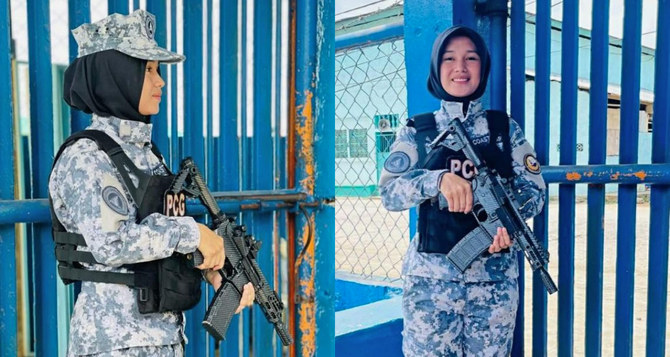
Philippine Coast Guard allows female Muslim personnel to wear hijab

Female Muslim members of the Philippine Coast Guard don the hijab as part of their new uniform. (PCG photo)
Short Url
Updated 03 February 2022
Follow

Philippine Coast Guard allows female Muslim personnel to wear hijab

  • PCG has about 1,850 Muslim personnel, 200 of whom are women
  • New regulations see PCG following moves made by the Philippine military and police 

MANILA: The Philippine Coast Guard announced on Thursday it had approved a new dress policy allowing the use of headscarves in uniform as it makes a bid for more Muslim women to join the service.

Muslims make up about 6 percent of the country’s 110 million citizens.

The PCG currently has 1,850 Muslim personnel, 200 of whom are women.

“The Philippine Coast Guard has approved the inclusion of hijab in the uniform of female Muslim Coast Guard personnel,” the force said in a statement, adding that the policy has been effective since last week.  

“The Muslim community in the PCG conveyed their sincere gratitude,” it said. “Members of the said community hope that the inclusion of hijab in the official PCG uniform will encourage more Muslim women to join the Coast Guard workforce.”

The service’s imam, Capt. Alicman S. Borowa, had proposed the inclusion of the hijab in the force’s uniform last year, arguing it would help foster inclusivity.

The National Commission on Muslim Filipinos welcomed the development. 

“GOOD NEWS! The Philippine Coast Guard released a statement allowing Muslim women under their office to wear their hijab as part of the official uniform,” the commission said in a social media post on Thursday.

The PCG is following in the footsteps of the Armed Forces of the Philippines, the Philippine National Police, and the Bureau of Jail Management and Penology, which have already allowed the use of headscarves as part of the official uniform for their Muslim personnel. 

In 2017, security forces deployed hijab-clad women soldiers, or “hijab troopers,” in Marawi, to provide vital support to communities traumatized by the siege of the city — a months-long armed conflict in northwest-central Mindanao between Philippine security forces and militants affiliated with Daesh.


Fourth Palestine Action activist ends hunger strike in UK prison

Protesters take part in a demonstration in support of "Defend Our Juries" and their campaign against the ban on Palestine Action
Updated 24 December 2025
Follow

Fourth Palestine Action activist ends hunger strike in UK prison

  • Amy Gardiner-Gibson began eating again after 49 days of protest
  • Govt rejects claims it ignored prison safety protocols

LONDON: A fourth Palestine Action activist imprisoned in the UK has ended her hunger strike.

Amy Gardiner-Gibson, who also uses the name Amu Gib, began eating again after 49 days of fasting, the campaign group Prisoners for Palestine said.

Qesser Zuhrah, another activist, ended her hunger strike last week after 48 days but said she might resume it next year, Sky News reported.

Four Palestine Action activists have now ended their hunger strikes while in prison, while four others are continuing to fast.

All of them are in prison on remand, awaiting trial for a series of high-profile alleged break-ins and criminal damage.

Palestine Action was proscribed as a terrorist organization and banned earlier this year.

On Tuesday, Swedish climate activist Greta Thunberg was arrested in central London at a rally in support of the hunger strikers.

The protesters are demanding that weapons factories in Britain with ties to Israel be shut down, as well as the removal of Palestine Action’s proscription.

They are also calling for immediate bail to be given to imprisoned pro-Palestine activists and an end to the alleged mistreatment of prisoners in custody.

Seven imprisoned members of Palestine Action have been transferred to hospital over the course of the hunger strike campaign. Doctors have highlighted concerns about the long-term impact of fasting on the activists.

Lawyers representing the group on Monday initiated legal action against the government over its alleged failure to follow prison safety regulations.

The government, however, has rejected this accusation, Sky News reported.

A Ministry of Justice spokesperson said: “Ministers do not intervene in individual cases. Where individuals are on remand, doing so would risk prejudicing ongoing legal proceedings and undermine the independence of the justice system.

“Concerns about welfare and process can be raised through established legal and administrative channels, including prison governors and ultimately the prison and probation ombudsman.

“Healthcare decisions are taken independently by qualified NHS professionals and appropriate care and oversight frameworks remain in place.”

The activists still on hunger strike include Heba Muraisi and Teuta Hoxha. Hoxha has been on remand for 13 months and her family told Sky News they feared she would die in prison.

Another of the activists, Kamran Ahmad, is believed to have been on hunger strike for 45 days and hospitalized three times.

Lewie Chiaramello, who has Type 1 diabetes, is on day 31 of his strike and taking part by fasting every other day.