

Saudi PMI slips to a 15-month low as omicron uncertainty weakens customer demand

(Shutterstock)
Short Url
Updated 03 February 2022
Follow

Saudi PMI slips to a 15-month low as omicron uncertainty weakens customer demand

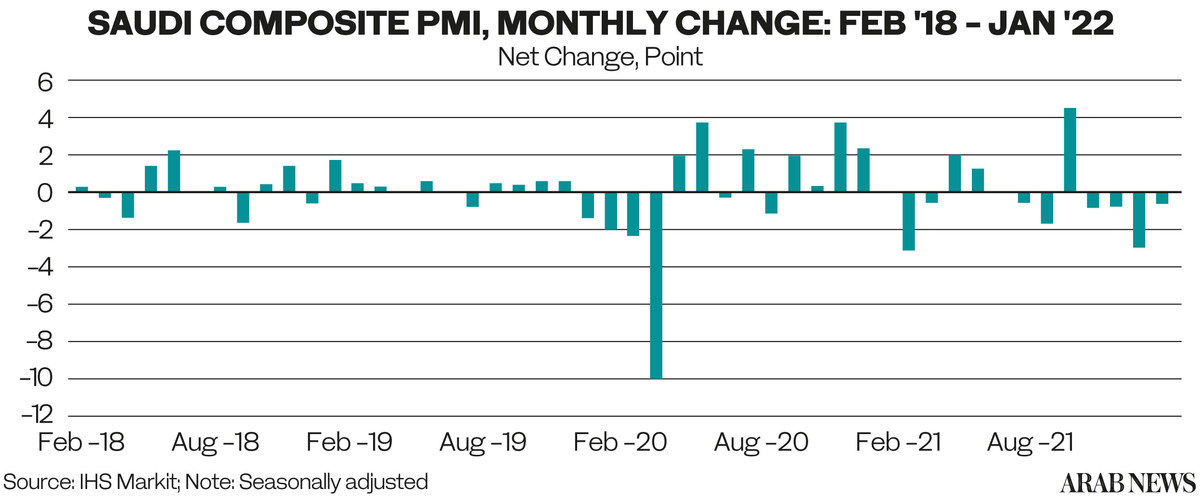
Saudi Arabia’s Purchasing Managers’ Index fell by 0.7 points in January, according to a press release from IHS Markit. 

The headline index figure slipped to 53.2 from 53.9 in December 2021, having fallen for the fourth consecutive month. 

It hit the 15-month lowest level after dropping to the nine-month low in December 2021.

“Customer demand in the non-oil sector was quelled by the omicron variant..., leading to slower rises in activity and new business, as well as the softest improvement in business conditions since October 2020,” the press release said quoting David Owen, Economist at IHS Markit.

As customer demand slowed in January, output growth slowed again as well, after hitting the lowest rate since August 2021 in December.

Growth in new orders has slowed for the fourth consecutive month and hit the lowest level since October 2020.

Export sales decreased for the first time since March, albeit marginally on fewer new orders from foreigners. Some firms cited high costs for global shipping and transport.
Meanwhile, firms’ purchasing activity remained at high levels similar to the previous month. Companies made efforts to build inventories and support output.

Growth in price of inputs, such as raw materials, moderated to mark the softest increase in total output charges since August 2021.

Business confidence strengthened after it fell to an 18-month low in December 2021. Optimism towards future activity picked up. Some of the firms covered in the survey hope that a recovery from the pandemic will lead to a stronger growth in new business and a stabilisation of global markets.

IHS Markit compiles the Saudi Arabia PMI from responses to questionnaires sent to purchasing managers in a panel of around 400 private sector companies.

The headline figure is the Purchasing Managers’ Index. The PMI is a weighted average of the following five indices: New Orders — 30 percent, Output — 25 percent, Employment — 20 percent, Suppliers’ Delivery Times — 15 percent; and Stocks of Purchases 10 percent.


Global trade isn’t deglobalizing — it’s reshuffling, Harvard economist says

Updated 16 min 52 sec ago
Follow

Global trade isn’t deglobalizing — it’s reshuffling, Harvard economist says

ALULA: Global trade is not retreating into deglobalization despite geopolitical shocks, but is instead undergoing a structural reshuffling led by US-China tensions, according to Harvard University economist Pol Antras. 

Presenting research at the AlUla Emerging Market Economies Conference, Antras said there is no evidence that countries are systematically turning inward. Instead, trade flows are being redirected across markets, creating winners and losers depending on export structure and exposure to Chinese competition. 

This comes as debate intensifies over whether supply-chain disruptions, industrial policy and rising trade barriers signal the end of globalization after decades of expansion. 

Speaking to Arab News on the sidelines of the event, Antras said: “I think the right way to view it is more a reorganization, where things are moving from some countries to others rather than a general trend where countries are becoming more inward looking, in a sense of producers selling more of their stuff domestically than internationally, or consumers buying more domestic products than foreign products.”  

He said a change of that scale has not yet happened, which is important to recognize when navigating the reshuffling — a shift his research shows is driven by Chinese producers redirecting sales away from the US toward other economies. 

He added that countries are affected differently, but highlighted that the Kingdom’s position is relatively positive, stating: “In the case of Saudi Arabia, for instance, its export structure, what it exports, is very different than what China exports, so in that sense it’s better positioned so suffer less negative consequences of recent events.” 

He went on to say that economies likely to be more negatively impacted than the Kingdom would be those with more producers in sectors exposed to Chinese competition. He added that while many countries may feel inclined to follow the United States’ footsteps by implementing their own tariffs, he would advise against such a move.  

Instead, he pointed to supporting producers facing the shock as a better way to protect and prepare economies, describing it as a key step toward building resilience — a view Professor Antras underscored as fundamental. 

Elaborating on the Kingdom’s position amid rising tensions and structural reorganization, he said Saudi Arabia holds a relative advantage in its economic framework. 

“Saudi Arabia should not be too worried about facing increased competitive pressures in selling its exports to other markets, by its nature. On the other hand, there is a benefit of the current situation, which is when Chinese producers find it hard to sell in US market, they naturally pivot to other markets.” 

He said that pivot could benefit importing economies, including Saudi Arabia, by lowering Chinese export prices. The shift could increase the Kingdom’s import volumes from China while easing cost pressures for domestic producers.