

US defense department releases first video of botched Kabul airstrike

1 / 2
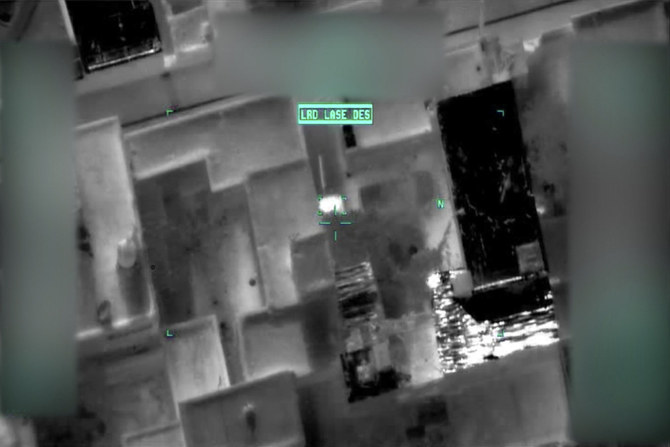
This image from video shows a fire in the aftermath of a drone strike in Kabul, Afghanistan, on Aug. 29, 2021, that killed 10 civilians. (US Department of Defense via AP)
2 / 2
This image from video shows a missile fired during a drone strike in Kabul that killed 10 civilians on Aug. 29, 2021. (US Department of Defense via AP)
Short Url
Updated 20 January 2022
Follow

US defense department releases first video of botched Kabul airstrike

  • The drone strike killed 10 civilians in the final hours of a chaotic American withdrawal that ended a 20-year war in Afghanistan

WASHINGTON: The Pentagon has declassified and publicly released video footage of a US drone strike in Kabul that killed 10 civilians in the final hours of a chaotic American withdrawal that ended a 20-year war in Afghanistan.
The New York Times obtained the footage through a Freedom of Information Act lawsuit against US Central Command, which then posted the imagery to its website. It marks the first public release of video footage of the Aug. 29 strike, which the Pentagon initially defended but later called a tragic mistake.

The videos include about 25 minutes of footage from what the Times reported were two MQ-9 Reaper drones, showing the scene of the strike prior to, during and after a missile struck a civilian car in a courtyard on a residential street. Indistinct images show individuals moving in or near the attack zone.
The military has said it struck what it thought was an extremist with the Daesh group’s Afghanistan affiliate who might imminently detonate a bomb near the Kabul airport, where a hurried evacuation was still under way.

Three days earlier a suicide bombing at the airport had killed 13 US troops and more than 160 Afghans. When it later acknowledged its error in the Aug. 29 drone strike, Central Command said it determined that the man driving the car had nothing to do with the Daesh group.
The man was Zemari Ahmadi, who worked for Nutrition and Education International, a US-based aid organization.


India to provide $450 million to cyclone-ravaged Sri Lanka

Updated 3 sec ago
Follow

India to provide $450 million to cyclone-ravaged Sri Lanka

COLOMBO: India has committed $450 million in humanitarian assistance to help Sri Lanka recover from the devastating damage caused by Cyclone Ditwah, foreign minister Subrahmanyam Jaishankar said Tuesday on a visit to the country.
The cyclone killed more than 640 people when it swept across the South Asian island last month, causing floods and landslides that inflicted about $4 billion in damage, according to the World Bank, or 4 percent of the country’s GDP.
Sri Lankan President Anura Kumara Dissanayake has described the storm, which affected more than two million people, as the most challenging natural disaster in the island’s history.
Jaishankar, who is on a two-day visit, told a media briefing in Colombo he had handed a letter from Prime Minister Narendra Modi to Dissanayake, committing to a “reconstruction package of $450 million.”
While $350 million will take the form of “concessional lines of credit,” the remaining $100 million will be given as grants.
Jaishankar also noted the 1,100 tons of relief material, along with medicine and other necessary equipment, sent to India’s southern neighbor in the cyclone’s immediate aftermath.
“Given the scale of damage, restoring connectivity was clearly an immediate priority,” he said, detailing the Indian military’s assistance in providing portable bridges.
Jaishankar said India would also look at other ways to mitigate the losses, including encouraging Indian tourism to Sri Lanka.
“Similarly, an increase in foreign direct investment from India can boost your economy at a critical time,” he added.
The cyclone struck as Sri Lanka was emerging from its worst-ever economic meltdown in 2022, when it ran out of foreign exchange reserves to pay for essential imports such as food, fuel and medicines.
Following a $2.9 billion bailout from the International Monetary Fund approved in early 2023, the country’s economy has stabilized.
str-abh/cwl