

Turkey’s Erdogan, Serbia’s Vucic agree to broker Bosnia crisis talks

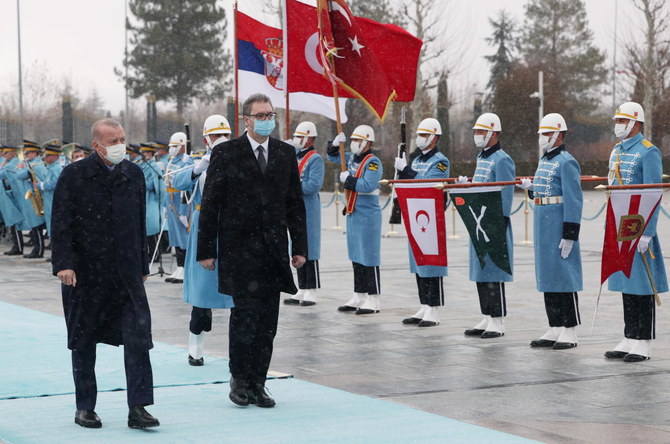
Turkish President Recep Tayyip Erdogan and Serbian President Aleksandar Vucic review a guard of honor, during a welcome ceremony, in Ankara, Turkey, Jan. 18, 2022. (Reuters)
Short Url
Updated 19 January 2022
Follow

Turkey’s Erdogan, Serbia’s Vucic agree to broker Bosnia crisis talks

  • Erdogan said Serbs, Croats and Bosniaks alike should refrain from steps that endanger Bosnia’s territorial integrity
  • Erdogan said, earlier, that Albanian Prime Minister Edi Rama and Bosnian Serb leader Milorad Dodik had voiced support for his mediation offer

ANKARA: Turkish President Tayyip Erdogan said he and Serbian counterpart Aleksandar Vucic agreed on Tuesday to broker crisis talks involving all parties in Bosnia after elections in Serbia in April.

The crisis flared after nationalist lawmakers in post-war Bosnia’s semi-autonomous Serb entity passed a non-binding motion last year to start pulling the region out of the country’s armed forces, tax system and judiciary — a move long backed by Bosnian Serb leader Milorad Dodik.

Turkey, which has deep-rooted historical ties in the Balkans, has criticized the move as “wrong, dangerous” and has offered to mediate in the crisis, which has raised fears of a relapse into ethnic conflict in Bosnia.

After a calamitous 1992-95 ethnic war that killed 100,000 people, Bosnia was split into two widely autonomous regions — a Serb Republic (RS) and a Federation dominated by Bosniaks and Croats, overlaid by a loose central government.

Addressing reporters along with Vucic after talks in Ankara, Erdogan said Serbs, Croats and Bosniaks alike should refrain from steps that endanger Bosnia’s territorial integrity and that all should act “with a sense of responsibility.”

“After these (Serbian) elections, we want to bring together the leaders of these three groups and to have a meeting with them. With this meeting, let us take steps to ensure Bosnia’s territorial integrity,” he said.

“We want to convene the three leaders — of Bosniaks, Croats, and Serbs — and accomplish this. We agreed on this,” Erdogan said, adding the talks could be held in Istanbul or Belgrade.

Mainly Muslim Turkey backed the late Bosniak Muslim wartime leader Alija Izebegovic and has forged good relations with Bosnia’s post-war, inter-ethnic Bosniak-Serb-Croat presidency.

Earlier, Erdogan was quoted by local media as saying Albanian Prime Minister Edi Rama, Dodik and other regional officials had voiced support for his mediation offer, and that Ankara would intensify its diplomacy to resolve the crisis.

Vucic told the news conference that Serbia was committed to Bosnia as an intact state and that the preservation of peace and stability in the Balkans was paramount, along “with respect for differences.”

Vucic called on Dodik last week to return to national institutions that the Serb Republic has boycotted since mid-2021 over a law criminalizing the denial of genocide.

International war crimes court judgments have branded the 1995 massacre of 8,000 Bosniak men and boys in Srebrenica by Bosnian Serb forces as genocide, something nationalist Serbs deny.

Serbia was the patron of wartime Bosnian Serb separatists and remains close to Bosnia’s post-war Serb entity, sharing a border with it.

Dodik’s secessionist rhetoric has spurred Serb nationalist rallies and incidents in towns across the Serb Republic.

Earlier this month, the United States imposed new sanctions on Dodik for alleged corruption and threatening Bosnia’s stability and territorial integrity. The European Union also said last week the Bosnian Serb leadership faced EU sanctions and a loss of aid should it continue to incite tensions.

France’s Le Pen insists party acted in ‘good faith’ at EU fraud appeal

Updated 3 sec ago
Follow

France’s Le Pen insists party acted in ‘good faith’ at EU fraud appeal

  • Le Pen said on her second day of questioning that even if her party broke the law, it was unintentional
  • She also argued that the passage of time made it “extremely difficult” for her to prove her innocence

PARIS: French far-right leader Marine Le Pen told an appeals trial on Wednesday that her party acted in “good faith,” denying an effort to embezzle European Parliament funds as she fights to keep her 2027 presidential bid alive.
A French court last year barred Le Pen, a three-time presidential candidate from the far-right National Rally (RN), from running for office for five years over a fake jobs scam at the European institution.
It found her, along with 24 former European Parliament lawmakers, assistants and accountants as well as the party itself, guilty of operating a “system” from 2004 to 2016 using European Parliament funds to employ party staff in France.
Le Pen — who on Tuesday rejected the idea of an organized scheme — said on her second day of questioning that even if her party broke the law, it was unintentional.
“We were acting in complete good faith,” she said in the dock on Wednesday.
“We can undoubtedly be criticized,” the 57-year-old said, shifting instead the blame to the legislature’s alleged lack of information and oversight.
“The European Parliament’s administration was much more lenient than it is today,” she said.
Le Pen also argued that the passage of time made it “extremely difficult” for her to prove her innocence.
“I don’t know how to prove to you what I can’t prove to you, what I have to prove to you,” she told the court.
Eleven others and the party are also appealing in a trial to last until mid-February, with a decision expected this summer.

- Rules were ‘clear’ -

Le Pen was also handed a four-year prison sentence, with two years suspended, and fined 100,000 euros ($116,000) in the initial trial.
She now again risks the maximum sentence of 10 years in prison and a one-million-euro ($1.16 million) fine if the appeal fails.
Le Pen is hoping to be acquitted — or at least for a shorter election ban and no time under house arrest.
On Tuesday, Le Pen pushed back against the argument that there was an organized operation to funnel EU funds to the far-right party.
“The term ‘system’ bothers me because it gives the impression of manipulation,” she said.
EU Parliament official Didier Klethi last week said the legislature’s rules were “clear.”
EU lawmakers could employ assistants, who were allowed to engage in political activism, but this was forbidden “during working hours,” he said.
If the court upholds the first ruling, Le Pen will be prevented from running in the 2027 election, widely seen as her best chance to win the country’s top job.
She made it to the second round in the 2017 and 2022 presidential polls, before losing to Emmanuel Macron. But he cannot run this time after two consecutive terms in office.