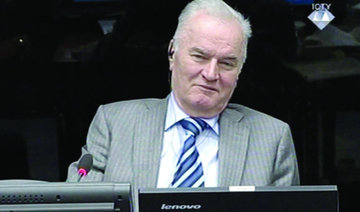
THE HAGUE: A UN tribunal on Wednesday convicted former Bosnian Serb military commander Ratko Mladic of genocide and crimes against humanity for orchestrating massacres and ethnic cleansing during Bosnia’s war and sentenced him to life in prison.
After the sentencing Mladic’s attorney said his client would appeal the decision.
Mladic, 74, was hustled out of the court minutes before the verdict for screaming “this is all lies, you are all liars” after returning from what his son described as a blood pressure test which delayed the reading-out of the judgment.
The UN Criminal Tribunal for the Former Yugoslavia found Mladic guilty of 10 of 11 charges, including the slaughter of 8,000 Muslim men and boys at Srebrenica and the siege of the Bosnian capital Sarajevo, in which more than 11,000 civilians were killed by shelling and sniper fire over 43 months.
The killings in Srebrenica of men and boys after they were separated from women and taken away in buses or marched off to be shot amounted to Europe’s worst atrocity since World War Two.
“The crimes committed rank among the most heinous known to humankind, and include genocide and extermination as a crime against humanity,” Presiding Judge Alphons Orie said in reading out a summary of the judgment.
“Many of these men and boys were cursed, insulted, threatened, forced to sing Serb songs and beaten while awaiting their executuion,” he said.
Mladic had pleaded not guilty to all charges and is expected to appeal against his conviction.
In its summary, the tribunal found Mladic “significantly contributed” to genocide committed in Srebrenica with the goal of destroying its Muslim population, “personally directed” the long bombardment of Sarajevo and was part of a “joint criminal enterprise” intending to purge Muslims and Croats from Bosnia.
In Geneva, UN human rights chief Zeid Ra’ad Al-Hussein called Mladic the “epitome of evil” and said his conviction after 16 years on the run and over four years of trial was a “momentous victory for justice.”
“The prosecution of Mladic is the epitome of what international justice is all about,” Zeid said in a statement.
“Today’s verdict is a warning to the perpetrators of such crimes that they will not escape justice, no matter how powerful they may be nor how long it may take.”
Speaking after the sentencing Mladic’s attorney, Dragan Ivetic told journalists: “It is certain we will file an appeal and the appeal will be successful.”

Ex-Bosnian Serb commander Mladic convicted of genocide, gets life in prison, but attorney says he will appeal
Isolated Kremlin critics lament lost future at Nemtsov memorial
- Hundreds used to flock to the makeshift memorial on the anniversary of his death
- Since Russia ordered troops into Ukraine it has intensified a crackdown on dissent, with almost no opposition to the Kremlin visible on the street
MOSCOW: On a bridge next to the Kremlin on a drizzly Friday morning, a lone Russian police officer stood looking at the half-dozen bunches of flowers laying in memory of slain opposition figure Boris Nemtsov.
The symbolism was almost too much.
Four years into Moscow’s full-scale offensive on Ukraine, which has seen President Vladimir Putin eradicate all forms of dissent and usher in strict military censorship laws that have silenced his critics, few Russians dared, or wanted, to pay tribute.
Nemtsov, a longtime Putin opponent, was shot and killed on February 27 2015, meters from the Kremlin’s red walls. He was 55.
Hundreds used to flock to the makeshift memorial on the anniversary of his death, which came on Friday.
This year, there was barely a trickle. Those who turned up were visibly nervous.
“So few people, they’ve all forgotten,” lamented one elderly man, who refused to give his name.
“Everybody is afraid,” a woman standing nearby added.
Since Russia ordered troops into Ukraine it has intensified a crackdown on dissent, with almost no opposition to the Kremlin visible on the street.
AFP reporters on Friday morning saw only around a dozen mourners alongside Western ambassadors laying red carnations.
“Keep moving, don’t gather in a crowd, don’t block the way for other citizens,” a police officer said through a megaphone.
Three days after Russia launched its offensive on Ukraine in 2022, protesters had staged an impromptu rally against the war at the memorial on the anniversary of Nemtsov’s death.
Nemtsov’s supporters have always accused Chechen leader and key Putin ally Ramzan Kadyrov of ordering his killing.
Kadyrov has rejected the claims.
Five Chechens were convicted of a contract killing but investigators never said who it was ordered by.
- ‘Everything is persecuted’ -
For his followers, Nemtsov is a totemic figure in Russian political life — seen as a once-future leader who might have taken the country on a different path.
“I come here every year,” said 79-year-old scientist Sergei at the bridge on Friday.
“Russia should have had — though unfortunately it didn’t work out — a leader exactly like Nemtsov,” he told AFP, declining to give his surname.
“Right now everything here is suppressed, everything is persecuted, people are sitting in prisons.”
A physicist by education, Nemtsov rose to fame in the 1990s as a young, liberal provincial governor, and was widely tipped to take over from Boris Yeltsin.
He gave his hesitant backing to Putin when the ex-KGB spy was tapped to enter the Kremlin instead, but became an early — and fierce — opponent of what he cast as the Russian leader’s creeping authoritarianism.
He had largely lost popularity and was only a marginal figure in Russian politics when he was killed in 2015. Still, his murder shocked the country and the world.
“The hopes of the whole country were pinned on him — of all the people who wanted it to be free here,” said Olga Vinogradova, a 66-year-old volunteer who tends to the pop-up memorial to Nemtsov on the bridge.
“When this man was killed, naturally, all of us were, we were all just executed at that moment. Because our hopes were destroyed,” she said.
“With this memorial, we remind people that there was a different path for Russia. And that there was a real person who could have led us down this path.”
- ‘Forced out’ -
Nemtsov had strongly opposed Putin’s 2014 annexation of Crimea from Ukraine and Moscow’s military backing for pro-Russian separatists in eastern Ukraine.
He was also a close and early ally of Alexei Navalny, who died in 2024 in an Arctic prison in what his supports say was a poisoning.
Open opposition to the Kremlin is unheard of inside Russia since the first days of the Ukraine offensive — when riot police cracked down hard on the thousands that took to the streets to protest.
All major critics of the Kremlin are in exile, prison or dead.
Those that remain have been silenced.
“Many have been forced out of the country, some have been killed,” said Gleb, a 23-year-old photographer.
A movement or person like Nemtsov was “impossible” to imagine right now, he said.
Still, he held on to a slither of hope.
“But everything can change at any moment.”