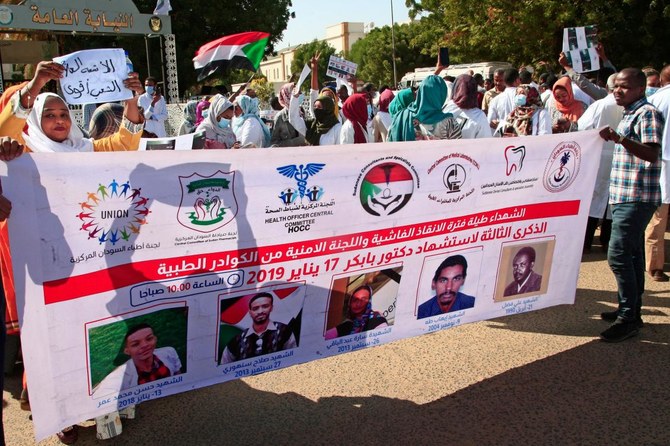
KHARTOUM: Sudanese doctors protested Sunday against violent attacks by security forces targeting medical personnel during pro-democracy rallies following last year’s military coup.
“During every protest they fire tear gas inside the hospital where I work,” one doctor, Houda Ahmad, said at the rally in Khartoum.
“They even attack us inside the intensive care unit,” she added at the rally, where medical personnel carried pictures of colleagues they said had been killed.
The demonstration was the latest in the crisis-hit north-east African country, where protesters in the north also blockaded roads to vent their anger against an electricity price hike announced last week, and that has since been frozen.
Sudan’s October 25 coup led by military leader General Abdel Fattah Al-Burhan derailed a fragile transition to civilian rule, that had started with the 2019 ouster of strongman Omar Al-Bashir following youth-led mass protests.
The military power grab has sparked an international outcry and triggered a new wave of street demonstrations, with another rally expected on Monday.
During the turmoil of recent months, prime minister Abdulla Hamdok was detained and later reinstated but then quit, warning that Sudan was at a dangerous crossroads threatening its very “survival.”
Deadly crackdowns have claimed the lives of 64 protesters, according to pro-democracy medics. A police general has also been killed in the street violence that has rocked Sudan, one of the world’s poorest countries.
The UN World Health Organization said last week there had been 11 confirmed attacks on Sudanese health facilities since November.
The WHO said it was “also aware of the interception of ambulances, medical personnel and patients during their attempts to seek safety.”
It called for the attacks to “stop now,” pointing out that they threaten health care services needed more than ever during the Covid pandemic.
Covid-19 is a “grave threat” for Sudan, where 94 percent of the population has not been vaccinated, said the WHO.
Sudan has confirmed 93,973 coronavirus infections and about 4,000 deaths. In September, it said 64 percent of about 1,000 health workers tested had been found to be Covid-positive.
Sudan’s 45 million people have also been dealing with a severe economic crisis and inflation approaching 400 percent.
On Sunday, hundreds blocked key roads in the Northern Province, 350 kilometers (229 miles) from the capital, angered by recent news electricity prices would double — a move that was then frozen, but not officially abolished.
“No vehicle will pass until the authorities have canceled this increase, because it signs the death certificate of our agriculture,” protester Hassan Idriss told AFP by phone.
The protests that led to the 2019 ouster of Bashir had started after the government decided to triple the price of bread.
During the recent protests, Sudan has also often shut down the Internet and moved to limit reporting on the unrest.
In the latest move it revoked the license of Al Jazeera Mubasher, the live TV unit of the Qatar-based network, accusing it of “unprofessional” coverage of protests, the channel said.
The United Nations is now seeking to organize talks involving political, military and social actors to resolve the crisis.
UN special representative Volker Perthes announced the bid last week saying it was “time to end the violence and enter into a comprehensive consultative process.”
The mainstream faction of the Forces for Freedom and Change, the leading civilian pro-democracy group, said Sunday it would accept the offer of dialogue if it were to revive the transition to civilian rule.
Sudan’s military in April 2019 put an end Bashir’s three-decade rule, leading to the arrest and imprisonment of the autocrat and many regime officials.
Bashir is also wanted by the International Criminal Court (ICC) on charges of genocide, war crimes and crimes against humanity in Darfur.
An imprisoned former foreign minister under Bashir, Ibrahim Ghandour, has begun a hunger strike along with several ex-regime officials, his family said Sunday.
They will only end it “once they have been freed or brought before an impartial tribunal,” his family said in a statement.
The public prosecutor’s office had recently ordered the release of several ex-officials, but Burhan instead ordered they stay in detention.
Ghandour’s family decried the “interference in judicial affairs.”
The protester movement however accuses Burhan, who was Bashir’s ground forces commander, of helping old regime figures come back to power.

Sudan doctors protest state violence in post-coup rallies
Short Url
https://arab.news/cbt38
Sudan doctors protest state violence in post-coup rallies
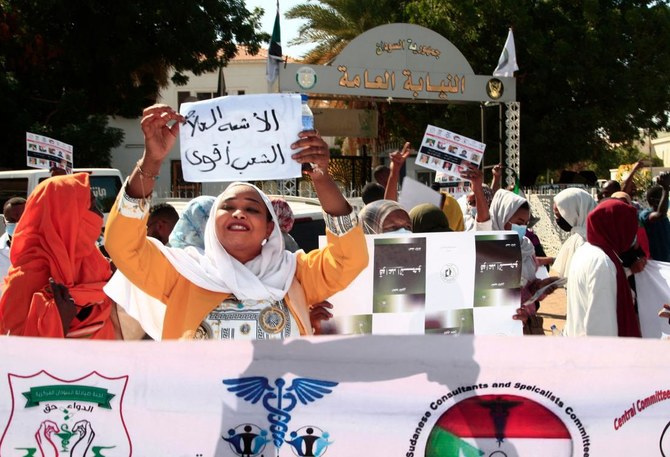
- “During every protest they fire tear gas inside the hospital where I work,” one doctor, Houda Ahmad, said
- “They even attack us inside the intensive care unit,” she added at the rally
US military transfers first 150 Daesh detainees from Syria to Iraq
- Transfer follows Syrian government forces taking control of Al-Hol camp from SDF
- US Central Command says up to 7,000 detainees could be transferred to Iraqi-controlled facilities
AL-HOL, Syria: The US military said Wednesday it has started transferring detainees from the Daesh group being held in northeastern Syria to secure facilities in Iraq.
The move came after Syrian government forces took control of a sprawling camp, housing thousands of mostly women and children, from the US-backed Syrian Democratic Forces, or SDF, which withdrew as part of a ceasefire. Troops on Monday seized a prison in the northeastern town of Shaddadeh, where some Daesh detainees escaped and many were recaptured, state media reported.
The Kurdish-led SDF still controls more than a dozen detention facilities holding around 9,000 Daesh members.
US Central Command said the first transfer involved 150 Daesh members, who were taken from Syria’s northeastern province of Hassakah to “secure locations” in Iraq. The statement said that up to 7,000 detainees could be transferred to Iraqi-controlled facilities.
“Facilitating the orderly and secure transfer of Daesh detainees is critical to preventing a breakout that would pose a direct threat to the United States and regional security,” said Adm. Brad Cooper, CENTCOM commander. He said the transfer was in coordination with regional partners, including Iraq.
US troops and their partner forces detained more than 300 Daesh operatives in Syria and killed over 20 last year, the US military said. An ambush last month by Daesh militants killed two US soldiers and one American civilian interpreter in Syria.
An Iraqi intelligence general told The Associated Press that an agreement was reached with the US to transfer 7,000 detainees from Syria to Iraq. He said that Iraqi authorities received the first batch of 144 detainees Wednesday night, after which they will be transferred in stages by aircraft to Iraqi prisons.
The general, who spoke on condition of anonymity because he was not authorized to speak to the media, said the Daesh members who will be transferred to Iraq are of different nationalities. He said they include around 240 Tunisians, in addition to others from countries including Tajikistan and Kazakhstan and some Syrians.
“They will be interrogated and then put on trial. All of them are commanders in Daesh and are considered highly dangerous,” the general said. He added that in previous years, 3,194 Iraqi detainees and 47 French citizens have been transferred to Iraq.
Regional threat despite battle setbacks
The Daesh group was defeated in Iraq in 2017, and in Syria two years later, but the group’s sleeper cells still carry out deadly attacks in both countries. The SDF played a major role in defeating Daesh.
Tom Barrack, the US envoy to Syria, said in a statement on Tuesday that the SDF’s role as the primary anti-Daesh force “has largely expired, as Damascus is now both willing and positioned to take over security responsibilities.”
He added that the “recent developments show the US actively facilitating this transition, rather than prolonging a separate SDF role.”
Syria’s Foreign Ministry welcomed the transfer of detainees, calling it “an important step to strengthen security and stability.”
Earlier on Wednesday, a convoy of armored vehicles with government forces moved into the Al-Hol camp following two weeks of clashes with the SDF, which appeared closer to merging into the Syrian military, in accordance with government demands.
At its peak in 2019, some 73,000 people were living at Al-Hol. Their number has since declined with some countries repatriating their citizens.
The camp is still home to some 24,000, most of them women and children. They include about 14,500 Syrians and nearly 3,000 Iraqis. Some 6,500 others, many of them loyal Daesh supporters who came from around the world to join the extremist group, are separately held in a highly secured section of the camp.
The Syrian government and the SDF announced a new four-day truce on late Tuesday after a previous ceasefire broke down.
The move came after Syrian government forces took control of a sprawling camp, housing thousands of mostly women and children, from the US-backed Syrian Democratic Forces, or SDF, which withdrew as part of a ceasefire. Troops on Monday seized a prison in the northeastern town of Shaddadeh, where some Daesh detainees escaped and many were recaptured, state media reported.
The Kurdish-led SDF still controls more than a dozen detention facilities holding around 9,000 Daesh members.
US Central Command said the first transfer involved 150 Daesh members, who were taken from Syria’s northeastern province of Hassakah to “secure locations” in Iraq. The statement said that up to 7,000 detainees could be transferred to Iraqi-controlled facilities.
“Facilitating the orderly and secure transfer of Daesh detainees is critical to preventing a breakout that would pose a direct threat to the United States and regional security,” said Adm. Brad Cooper, CENTCOM commander. He said the transfer was in coordination with regional partners, including Iraq.
US troops and their partner forces detained more than 300 Daesh operatives in Syria and killed over 20 last year, the US military said. An ambush last month by Daesh militants killed two US soldiers and one American civilian interpreter in Syria.
An Iraqi intelligence general told The Associated Press that an agreement was reached with the US to transfer 7,000 detainees from Syria to Iraq. He said that Iraqi authorities received the first batch of 144 detainees Wednesday night, after which they will be transferred in stages by aircraft to Iraqi prisons.
The general, who spoke on condition of anonymity because he was not authorized to speak to the media, said the Daesh members who will be transferred to Iraq are of different nationalities. He said they include around 240 Tunisians, in addition to others from countries including Tajikistan and Kazakhstan and some Syrians.
“They will be interrogated and then put on trial. All of them are commanders in Daesh and are considered highly dangerous,” the general said. He added that in previous years, 3,194 Iraqi detainees and 47 French citizens have been transferred to Iraq.
Regional threat despite battle setbacks
The Daesh group was defeated in Iraq in 2017, and in Syria two years later, but the group’s sleeper cells still carry out deadly attacks in both countries. The SDF played a major role in defeating Daesh.
Tom Barrack, the US envoy to Syria, said in a statement on Tuesday that the SDF’s role as the primary anti-Daesh force “has largely expired, as Damascus is now both willing and positioned to take over security responsibilities.”
He added that the “recent developments show the US actively facilitating this transition, rather than prolonging a separate SDF role.”
Syria’s Foreign Ministry welcomed the transfer of detainees, calling it “an important step to strengthen security and stability.”
Earlier on Wednesday, a convoy of armored vehicles with government forces moved into the Al-Hol camp following two weeks of clashes with the SDF, which appeared closer to merging into the Syrian military, in accordance with government demands.
At its peak in 2019, some 73,000 people were living at Al-Hol. Their number has since declined with some countries repatriating their citizens.
The camp is still home to some 24,000, most of them women and children. They include about 14,500 Syrians and nearly 3,000 Iraqis. Some 6,500 others, many of them loyal Daesh supporters who came from around the world to join the extremist group, are separately held in a highly secured section of the camp.
The Syrian government and the SDF announced a new four-day truce on late Tuesday after a previous ceasefire broke down.
© 2026 SAUDI RESEARCH & PUBLISHING COMPANY, All Rights Reserved And subject to Terms of Use Agreement.