

Tsunami hits Tonga, US West Coast on alert after volcano erupts

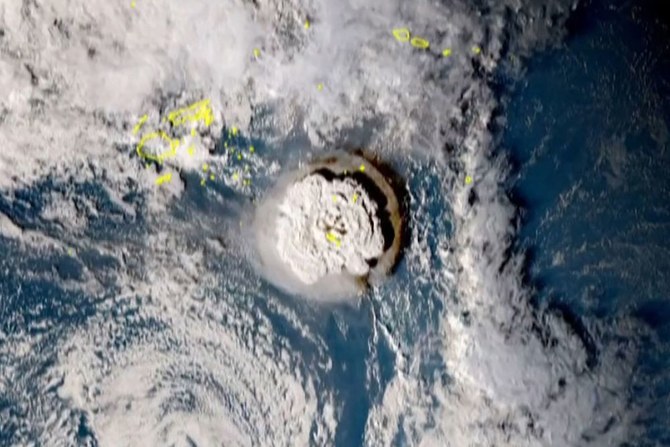
A grab taken from footage by Japan's Himawari-8 satellite shows the volcanic eruption that provoked a tsunami in Tonga. (AFP/National Institute of Information and Communications (Japan))
Short Url
Updated 16 January 2022
Follow

Tsunami hits Tonga, US West Coast on alert after volcano erupts

  • The explosion of the Hunga Tonga Hunga Ha’apai volcano was the latest in a series of spectacular eruptions

NUKU’ALOFA, Tonga: Frightened Tongans fled to higher ground Saturday after a massive volcanic eruption sent tsunami waves crashing onto the South Pacific island and triggered warnings as far as the US West Coast.
Dramatic images from space showed the moment the latest eruption of the Hunga Tonga-Hunga Ha’apai sent a mushroom of smoke and ash into the air and a shockwave across the surrounding waters.
A tsunami wave measuring 1.2 meters (four feet) was observed in Tonga’s capital Nuku’alofa, according to Australia’s Bureau of Meteorology.
Local resident Mere Taufa said she was in her house getting ready for dinner when the undersea volcano erupted — sending water surging into her home.
“It was massive, the ground shook, our house was shaking. It came in waves. My younger brother thought bombs were exploding nearby,” Taufa told the Stuff news website.
She said water filled their home minutes later and she saw the wall of a neighboring house collapse.
“We just knew straight away it was a tsunami. Just water gushing into our home.
“You could just hear screams everywhere, people screaming for safety, for everyone to get to higher ground.”
Tonga’s King Tupou VI was reported to have been evacuated from the Royal Palace in Nuku’alofa and taken by police convoy to a villa well away from the coastline.
The volcano’s eruption lasted at least eight minutes and sent plumes of gas, ash and smoke several kilometers into the air.
Residents in coastal areas were urged to head for higher ground following the eruption — which came just a few hours after a previous tsunami warning was lifted on the island.

The Hunga Tonga-Hunga Ha’apai volcano sits on an uninhabited island about 65 kilometers north of the Tongan capital Nuku’alofa.
Its latest eruption was so intense it was heard as “loud thunder sounds” in Fiji more than 800 kilometers (500 miles) away, according to officials in Suva City — where images shared on social media showed large waves hitting the coast.
Tsunami warnings were issued for American Samoa, New Zealand, Fiji, Vanuatu, Chile and Australia — where authorities said a swathe of coastline, including Sydney, could be hit by tsunami waves.
People in surrounding New South Wales state were “advised to get out of the water and move away from the immediate water’s edge.”
A tsunami warning was issued for the entire US West Coast — from the bottom of California to the tip of Alaska’s Aleutian islands — while tsunami waves triggered “minor flooding” in Hawaii according to the Pacific Tsunami Warning Center.
“Move off the beach and out of harbors and marinas in these areas,” advised the US National Weather Service, which predicted waves of up to two feet, strong rip currents and coastal flooding.
Fijian officials warned residents to cover water collection tanks in case of acidic rain fall.
Victorina Kioa of the Tonga Public Service Commission said Friday that people should “keep away from areas of warning which are low-lying coastal areas, reefs and beaches.”
The head of Tonga Geological Services, Taaniela Kula, urged people to stay indoors, wear a mask if they were outside and cover rainwater reservoirs and rainwater harvesting systems.


2025 among world’s three hottest years on record, WMO says

Updated 4 sec ago
Follow

2025 among world’s three hottest years on record, WMO says

  • All eight datasets confirmed that the last three years were the planet’s three hottest since records began, the WMO said
  • The slight differences in the datasets’ rankings reflect their different methodologies and types of measurements

BRUSSELS: Last year was among the planet’s three warmest on record, the World Meteorological Organization said on Wednesday, as EU scientists also confirmed average temperatures have now exceeded 1.5 degrees Celsius of global warming for the longest since records began.
The WMO, which consolidates eight climate datasets from around the world, said six of them — including the European Union’s European Center for Medium-Range Weather Forecasts (ECMWF) and the British national weather service — had ranked 2025 as the third warmest, while two placed it as the second warmest in the 176-year record.
All eight datasets confirmed that the last three years were the planet’s three hottest since records began, the WMO said. The warmest year on record was 2024.

THREE-YEAR PERIOD ABOVE 1.5 C AVERAGE ⁠WARMING LEVEL
The slight differences in the datasets’ rankings reflect their different methodologies and types of measurements — which include satellite data and readings from weather stations.
ECMWF said 2025 also rounded out the first three-year period in which the average global temperature was 1.5 C above the pre-industrial era — the limit beyond which scientists expect global warming will unleash severe impacts, some of them irreversible.
“1.5 C is not a cliff edge. However, we know that every fraction of a degree matters, particularly for worsening extreme weather events,” said Samantha Burgess, strategic ⁠lead for climate at ECMWF.
Burgess said she expected 2026 to be among the planet’s five warmest years.

CHOICE OF HOW TO MANAGE TEMPERATURE OVERSHOOT
Governments pledged under the 2015 Paris Agreement to try to avoid exceeding 1.5 C of global warming, measured as a decades-long average temperature compared with pre-industrial temperatures.
But their failure to reduce greenhouse gas emissions means that target could now be breached before 2030 — a decade earlier than had been predicted when the Paris accord was signed in 2015, ECMWF said. “We are bound to pass it,” said Carlo Buontempo, director of the EU’s Copernicus Climate Change Service. “The choice we now have is how to best manage the inevitable overshoot and its consequences on societies and natural systems.”
Currently, the world’s long-term warming level is about 1.4 C above the pre-industrial era, ECMWF said. Measured on a short-term ⁠basis, average annual temperatures breached 1.5 C for the first time in 2024.

EXTREME WEATHER
Exceeding the long-term 1.5 C limit would lead to more extreme and widespread impacts, including hotter and longer heatwaves, and more powerful storms and floods. Already in 2025, wildfires in Europe produced the highest total emissions on record, while scientific studies confirmed specific weather events were made worse by climate change, including Hurricane Melissa in the Caribbean and monsoon rains in Pakistan which killed more than 1,000 people in floods.
Despite these worsening impacts, climate science is facing political pushback. US President Donald Trump, who has called climate change “the greatest con job,” last week withdrew from dozens of UN entities including the scientific Intergovernmental Panel on Climate Change.
The long-established consensus among the world’s scientists is that climate change is real, mostly caused by humans, and getting worse. Its main cause is greenhouse gas emissions from burning fossil fuels like coal, oil and gas, which trap heat in the atmosphere.