
RIYADH: Saudi Arabia is to invest SR1.9 billion ($506 million) in development projects in Yemen, the Kingdom’s Defense Minister Prince Khalid bin Salman said on Wednesday.
The support includes 28 projects in the health, energy, education and transport sectors, the Saudi Press Agency reported.
The package includes a new grant of petroleum derivatives to operate power plants across Yemen.
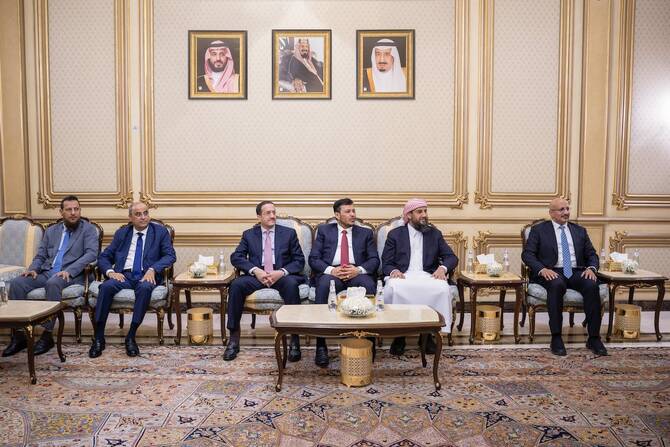
The announcement was made during a meeting with the head of Yemen’s Presidential Leadership Council Rashad Al-Alimi, Yemen’s Prime Minister Salem Saleh bin Braik, and the Governor of Aden Abdulrahman Sheikh Al-Yafai.
The funding will see the Saudi Development and Reconstruction Program for Yemen work with the Yemeni government and local authorities to support key institutions and services in Aden, Hadramaut, Al-Mahrah, Socotra, Marib, Shabwa, Abyan, Dhale, Lahij and Taiz.
“The launch of this new package of projects across vital sectors embodies an integrated approach to enhancing the efficiency of infrastructure and public services in Yemen, thereby supporting the long-term capacity of Yemeni institutions to meet citizens’ needs,” Abdullah Bin Kadasa, Assistant Supervisor General for Institutional Relations, Chief of Communication and International Cooperation Sector at SDRPY told Arab News.

Abdullah Bin Kadasa, Assistant Supervisor General for Institutional Relations, Chief of Communication and International Cooperation Sector at SDRPY. (Supplied)
He went on to say: “These projects and initiatives contribute to strengthening stability and growth of the brotherly Yemeni people, while supporting many vital and essential sectors.”
The projects include the construction of a desalination plant, the restoration of Aden’s airport — the country’s main aviation hub in the south — the opening of a hospital on Socotra island, and the construction and equipping of 30 schools.
Prince Khalid said the package “embodies the Kingdom’s commitment to strengthening security and stability and contributing to building a better future for Yemen and its people.”
The meeting also covered relations between Saudi Arabia and its neighbor, developments in Yemen and efforts to end the Yemeni crisis through a comprehensive political solution.
“We stressed the importance of continuing efforts, regarding the future of the southern issue, through the Riyadh conference to find a comprehensive vision for just solutions,” Prince Khalid said.
Other recent projects undertaken by the program include the signing of a memorandum of understanding with Yemen’s Ministry of Electricity and Energy and Gulf International Electric Power Co. in December to launch new power generation projects across several Yemeni governorates.
The signing ceremony, attended by Saudi Ambassador to Yemen Mohammed bin Saeed Al-Jaber, outlined cooperation to implement strategic power plants in Aden, Mukalla, Seiyun and Taiz, with an initial production capacity of 300 megawatts, the Saudi Press Agency reported.
The memorandum included provisions for training, sustainability, and implementation according to quality standards and timelines, aiming to improve electricity infrastructure, boost service delivery and support economic reforms, SPA added.

An aerial view of one of the schools that SDRPY developed in Yemen. (SDRPY)
Saudi Arabia announced in September fresh economic support for Yemen worth SR1.38 billion through the Saudi Program for the Development and Reconstruction of Yemen, the Saudi Press Agency reported.
The package included budget support, funding for petroleum derivatives, and operational costs for Prince Mohammed bin Salman Hospital in Aden.
Riyadh said the aid reflected its commitment to helping stabilize Yemen’s economy and backing the Yemeni government’s reform efforts.
In addition, the program has supported various sports and youth initiatives in the country as part of the Kingdom’s commitment to empowering Yemeni youth.
The SDRPY has built over 30 basketball and volleyball courts in schools across various Yemeni governorates, and supported the construction of FIFA-standard stadiums for clubs such as Al-Jazira, Al-Rawdah and Al-Menaa.
The SDRPY’s work in Yemen includes restoring sports facilities, sponsoring tournaments, providing technical support and sports education, and developing athletic skills among Yemeni children.
In recent years, the agency has helped restore the Ali Asad Muthanna Sports Hall in Aden after a long period of disuse, providing youth with a renewed space to engage in physical activities.
It has also organized major tournaments in the country, including the Marib Football Championship, which involved 14 clubs and 588 young participants and a basketball tournament in Hadramout, which involved 17 clubs and 289 young participants.
In December 2024, Saudi Arabia announced an economic support package for Yemen worth $500 million and aimed at bolstering the government’s budget, stabilizing the Central Bank of Yemen, and fostering the development and stability of the Yemeni people.
The assistance included a $300 million deposit into the Central Bank of Yemen to improve economic and financial conditions, alongside $200 million to address the Yemeni budget deficit, the Saudi Press Agency reported.

The Prince Mohammed bin Salman Hospital in Aden. (SDRPY)
The agency’s “Decent Housing” project has benefited nearly 900 families by rehabilitating 650 housing units in Aden’s Al-Mualla and Khor Maksar districts.
A tripartite partnership between SDRPY, Alwaleed Philanthropies and the UN Human Settlements Program, the project has also contributed to building the capacity of workers in the housing, construction and building sectors, the Saudi Press Agency reported.
The Decent Housing project, the first of its kind in the housing sector in Yemen, aims to provide suitable living conditions for Yemeni families.
It also offers thousands of job opportunities and hundreds of training opportunities, deepening the impact of such projects that contribute to sustainable development.
The SDRPY was established in May 2018 through a royal decree by King Salman, aiming to meet the needs of the Yemeni people by providing institutional, technical and logistical support.
Its partners include the Yemeni government and non-government agencies, ministries, development funds, local authorities in Yemeni governorates and various regional and international development organizations and agencies.