

Pakistan, Qatar leaders discuss Middle East tensions amid Iran crisis

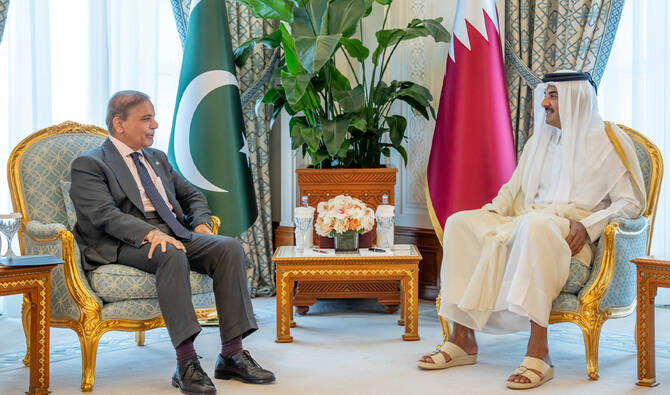
Pakistan Prime Minister Shehbaz Sharif meets Qatar’s Emir Sheikh Tamim bin Hamad Al-Thani (right) in Doha, Qatar, on September 13, 2025. (PID/File)
Short Url
Updated 14 January 2026
Follow

Pakistan, Qatar leaders discuss Middle East tensions amid Iran crisis

  • Iran has warned of retaliation against US military bases in region if Washington intervenes in support of anti-government protests
  • United States on Wednesday withdrew some personnel from Mid East key bases, including Al Udeid Air Base, according to Reuters

ISLAMABAD: Pakistani Prime Minister Shehbaz Sharif spoke by telephone on Wednesday with Qatar’s Emir Sheikh Tamim bin Hamad Al Thani, discussing regional developments as tensions escalated in the Middle East following warnings from Iran over potential US military action.

The phone call comes as Iran warned it would retaliate against US military bases in the region if Washington intervenes in support of anti-government protesters, prompting the United States to withdraw some personnel from key bases, including Al Udeid Air Base, according to Reuters.

For Pakistan, a wider escalation could have economic and security implications, including pressure on energy supplies, shipping routes and regional trade, as well as potential risks to Pakistani workers and businesses across the Gulf. Islamabad has traditionally sought to balance relations with Iran, Gulf Arab states and the United States, and analysts say heightened tensions could complicate that diplomacy at a time when Pakistan remains dependent on external financing, remittances and stable energy imports.

According to a statement from the Prime Minister’s Office, Sharif and Al Thani expressed satisfaction with the trajectory of Pakistan-Qatar relations and reaffirmed their commitment to strengthening bilateral ties. 

“Recent developments in the Middle East were also discussed,” a statement from Sharif’s office said. “The Prime Minister appreciated Qatar’s constructive and proactive role in promoting peace, dialogue, and mediation across the region, and acknowledged its meaningful efforts to defuse tensions through diplomatic solutions.”

Sharif also assured the Qatari leadership that Pakistan would also continue “to play a positive role in maintaining regional peace and stability.”

Tensions are high in the Middle East, with Iranian officials having said Tehran has conveyed messages to regional states, including Saudi Arabia, the United Arab Emirates and Turkiye, warning that US bases in those countries could be attacked if Iran is struck. Direct contacts between Iranian and US officials have reportedly been suspended.

The unrest in Iran, sparked by demonstrations over worsening economic conditions, has escalated into the most violent internal challenge faced by the Islamic Republic since the 1979 revolution, according to Western officials and rights groups. Iranian authorities have accused the United States and Israel of fomenting the protests, which they describe as acts of terrorism.

Human rights organizations have reported thousands of deaths and arrests amid a sweeping crackdown by Iranian security forces, while Western governments say Iran’s leadership remains in control but under unprecedented pressure.

Qatar, which maintains close ties with both Washington and Tehran and has played a mediating role in multiple regional crises, has emerged as a key diplomatic hub as fears grow of a wider regional escalation involving US forces, Iran and its allies.

At least 13 civilians killed in Pakistan strikes in Afghanistan, UN says

Updated 23 February 2026
Follow

At least 13 civilians killed in Pakistan strikes in Afghanistan, UN says

  • Pakistan said it launched the strikes after blaming recent suicide attacks on militants operating from Afghan territory
  • The reported toll adds to fears of a renewed cycle of retaliation between the neighbors, threatening a fragile ceasefire

ISLAMABAD/KABUL: At least 13 civilians ‌were killed and seven injured in Pakistani airstrikes in eastern Afghanistan, the United Nations said on Monday, as cross-border tensions escalated following a string ​of suicide bombings in Pakistan.

The reported toll adds to fears of a renewed cycle of retaliation between the neighbors, threatening a fragile ceasefire along their 2,600-km (1,600-mile) frontier and further straining ties as both sides trade blame over militant violence.

The United Nations Assistance Mission in Afghanistan (UNAMA) said it had received “credible reports” that overnight Pakistani airstrikes on February 21–22 killed at least 13 ‌civilians and injured ‌seven in the Behsud and Khogyani ​districts ‌of ⁠Nangarhar province.

Taliban ​spokesman Zabihullah ⁠Mujahid earlier reported dozens killed or wounded in the strikes, which also hit locations in Paktika province. Reuters could not independently verify the reported toll.

Pakistan said it launched the strikes after blaming recent suicide attacks, including during Ramadan, on militants operating from Afghan territory.

Pakistan’s information ministry in a post on X said ⁠the “intelligence-based” operation struck seven camps of the Pakistani Taliban ‌and Daesh (Islamic State) Khorasan Province ‌and that it had “conclusive evidence” the militant ​assaults on Pakistan were directed ‌by “Afghanistan-based leadership and handlers.”

Kabul has repeatedly denied allowing militants ‌to use Afghan territory to launch attacks in Pakistan.

The strikes took place days after Kabul released three Pakistani soldiers in a Saudi-mediated exchange aimed at easing months of tensions along the border.

Afghanistan’s defense ministry condemned ‌the strikes and called them a violation of sovereignty and international law, saying an “appropriate and measured ⁠response will ⁠be taken at a suitable time.” The Afghan foreign ministry said it had summoned Pakistan’s ambassador.

In a statement on the February 21-22 strikes, Afghanistan’s education ministry said eight school students; five boys and three girls, were killed in Behsud in Nangarhar province, and one madrasa student injured in Barmal in Paktika province, adding that dozens of other civilians were killed or wounded and educational centers destroyed. Reuters could not independently verify the information.

The latest strikes follow months of clashes and repeated border closures ​that have disrupted trade ​and movement along the rugged frontier.