

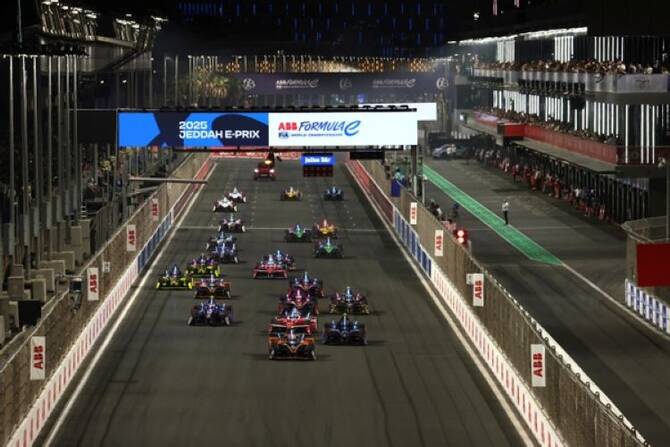

JEDDAH: With just 30 days to go, excitement is building ahead of the ABB FIA Formula E World Championship’s return to the Jeddah Corniche Circuit, Feb. 13–14, 2026, following a record-breaking debut on the Red Sea Coast last season.
The celebrated track — the world’s fastest street circuit — will once again be transformed into a floodlit showcase of speed and innovation as the fastest electric race car drivers compete in the only night races on the Formula E calendar.
The Jeddah E-Prix not only showcases the future of sustainable motorsport but also cements Saudi Arabia’s growing status as a global destination for major sporting events.
The 3.001km Jeddah Corniche Circuit is one of Formula E’s most exciting challenges: an anticlockwise street track lined with 19 sweeping turns and spectacular views of the Red Sea. Known for its speed and precision, it pushes drivers to their limits, while fans can look forward to daring overtakes and strategic battles as competitors hit the Attack Zone at Turn 13.
Fans can expect more than just wheel-to-wheel racing at the Jeddah E-Prix, with world-class live entertainment including a headline act by Grammy Award-winning rapper and singer-songwriter Future, who will take to the stage for an unforgettable concert on Friday, Feb. 13. Across the two-day event, fans can also explore interactive zones and enjoy a wide variety of food offerings alongside adrenaline-fueled entertainment experiences in the Fan Zone.
2025 JEDDAH E-PRIX — An Unforgettable Debut
Following six landmark seasons in Diriyah, the championship’s move to Jeddah in 2025 had an immediate impact, with last year’s double-header becoming the most-watched Formula E weekend in history, attracting more than 65 million viewers worldwide.
Indeed, the Jeddah E-Prix weekend delivered non-stop drama under the lights, with the action going right down to the wire on the first night. In a thrilling final-lap showdown, Maximilian Günther claimed a commanding win for DS Penske in Friday’s race, with Oliver Rowland hot on his heels and Taylor Barnard — then driving for NEOM McLaren — completing the podium.
Twenty-four hours later, Rowland turned the tables, charging to victory on Saturday ahead of Barnard and Jake Hughes — then driving for Maserati — to close out an electric weekend of racing by the Red Sea.
Off-track, the Jeddah E-Prix had no shortage of star power. Global music icons Akon and Grammy Award-winning rapper Lil Baby lit up the fan stage with unforgettable headline performances, keeping the energy high long after the chequered flag.
The event also drew a glittering crowd of VIP guests, from boxing star Chris Eubank Jr. and footballer Riyad Mahrez to Georgina Rodríguez, entrepreneur, model, and partner to Cristiano Ronaldo, underscoring the E-Prix’s growing reputation as a must-attend fixture on the global sporting and entertainment calendar.
Formula E Drivers Full of Praise
Drivers and podium finishers from last season’s Jeddah E-Prix hailed the race weekend as a resounding success, praising the circuit and Saudi Arabia’s renowned hospitality
Season 11 Drivers’ Champion and Round 4 Jeddah E-Prix winner, Oliver Rowland (Nissan), is excited to return to Jeddah next month commenting: “The night race with the lights and the spectacle is one of the best things about Jeddah…I had a really successful weekend finishing first and second in Season 11, so I’m really looking forward to Season 12 and hopefully we can do the same.”
Maximilian Günther (DS Penske), who secured his first victory with DS Penske in the Round 3 Jeddah E-Prix, also praised last year’s race weekend: “Jeddah was fantastic for us. We had a great pace, great strategy on that day. We achieved pole position and the race win, so I have very good memories of Jeddah. I think the whole event is outstanding. The track is so good, so fast and just a perfect fit for Formula E because you really saw the speed of the cars, overtaking — perfect mix for year one. There is a lot of enthusiasm about motorsports in Saudi... I just enjoy being there. Everything is very well organized. We get an amazing welcome.”
Nyck de Vries (Mahindra) was also impressed, commenting: “The Jeddah race last year was very good for us, especially on Saturday. We were happy to be fighting at the front and to score a top five finish (P4). I think racing under the floodlights always makes the racing a little bit more exciting and dramatic. All the emotions are a bit amplified. So, I personally really enjoyed the race.”
The drivers’ undeniable enthusiasm and excitement at returning to Jeddah further underlines why the Jeddah E-Prix is one of the most eagerly anticipated stops on the Formula E calendar, showcasing the Jeddah Corniche Circuit— and Saudi Arabia— as a world-class stage for elite motorsport.
Season 12 – The Season So Far
Season 12 kicked off on December 6, 2025, where Andretti Formula E’s Jake Dennis converted his pole position into a victory in a hectic season opening race. It marked Dennis’ first win since Diriyah in 2024.
Last weekend’s second round in Mexico City was another thrilling race where Citroën Racing’s Nick Cassidy made up 12 positions in a calculated, pitch-perfect drive to head home Edoardo Mortara (Mahindra Racing) and reigning champion Oliver Rowland (Nissan Formula E Team) for a win in only the French automotive giant’s second race in the ABB FIA Formula E World Championship.
This result now sees Cassidy top the Drivers’ table with 40 points to Dennis’ 36 and Rowland with 34. Citroën leads Andretti in the Teams’ Standings 44 to 36 points. In the Manufacturers’ World Championship, Stellantis has a seven-point lead on Porsche.
Ahead of the all-electric series’ return to the Middle East, the championship will first continue with Round 3 in Miami on 31 January 2026 at the Miami International Autodrome, located at the Hard Rock Stadium, where another exhilarating instalment of Season 12 awaits.
JEDDAH E-PRIX TICKETS AVAILABLE NOW
With record crowds expected and the world’s top drivers returning to battle under the lights, the 2026 Jeddah E-Prix promises to deliver an unforgettable showcase of speed, innovation, and spectacle on the shores of the Red Sea.
Tickets for the much-anticipated event are now on sale via WeBook, starting from 100 SAR for single day passes and 180 SAR for two-day access.


