Strong quake shakes Indonesia’s capital; no tsunami alert

1 / 2
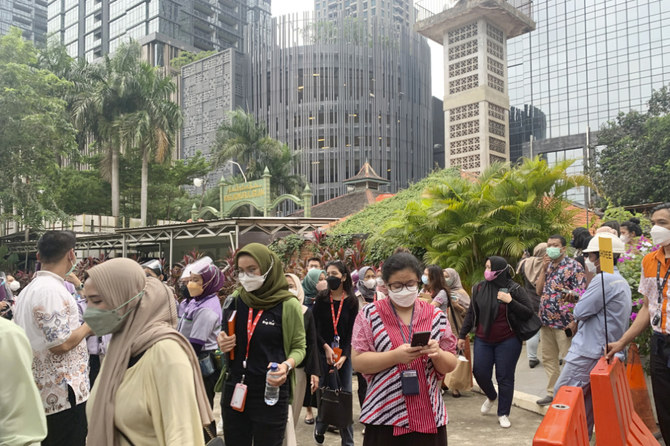
People wait outside as they have to evacuate their office buildings following an earthquake, at the main business district in Jakarta, Indonesia, Friday, Jan. 14, 2022. (AP)
2 / 2
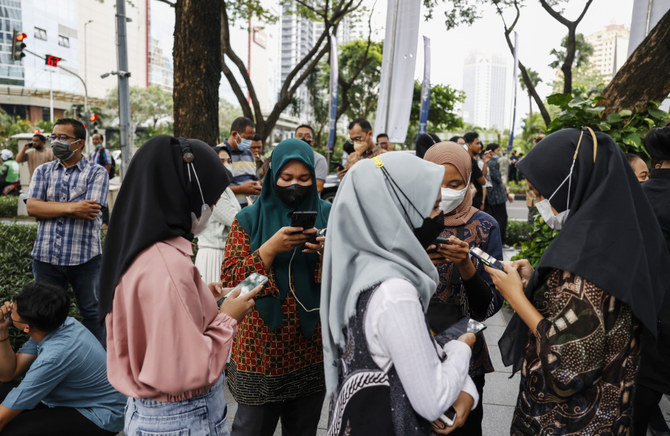
Office employees check their phones as they wait outside of an office tower amid fears of aftershocks following an earthquake at a business district in Jakarta, Indonesia, 14 January 2022. (EPA)
Short Url
Updated 15 January 2022
Follow

Strong quake shakes Indonesia’s capital; no tsunami alert

  • Earthquakes occur frequently across the sprawling archipelago nation, but it is uncommon for them to be felt in Jakarta

JAKARTA, Indonesia: A powerful earthquake shook parts of Indonesia’s main island of Java on Friday, damaging buildings and houses and sending people into the streets, but no casualties were reported. Officials said there was no danger of a tsunami.
The US Geological Survey said the magnitude 6.6 quake was located in the Indian Ocean about 88 kilometers (54 miles) southwest of Labuan, a coastal town in Banten province. It was centered at a depth of 37 kilometers (23 miles), it said.
Dwikorita Karnawati, head of Indonesia’s Meteorology, Climatology, and Geophysical Agency, said there was no danger of a tsunami but warned of possible aftershocks.
High-rises in Jakarta, the capital, swayed for more than 10 seconds and some ordered evacuations, sending streams of people into the streets. Even two-story homes shook strongly in the satellite cities of Tangerang, Bogor and Bekasi.
Earthquakes occur frequently across the sprawling archipelago nation, but it is uncommon for them to be felt in Jakarta.
“The tremor was horrible ... everything in my room was swinging,” said Laila Anjasari, a Jakarta resident who lives on the 19th floor of an apartment building, “We ran out and down the stairs in panic.”
At least 257 houses and buildings were damaged, mostly in Pandeglang, the closest district to the epicenter, said National Disaster Mitigation Agency spokesperson Abdul Muhari. Minor damage was also reported elsewhere, but there were no reports of injuries.
Indonesia is prone to seismic upheaval due to its location on major geological faults known as the Pacific “Ring of Fire.”
In January last year, a magnitude 6.2 earthquake killed at least 105 people and injured nearly 6,500 in West Sulawesi province.
In 2004, an extremely powerful Indian Ocean quake set off a tsunami that killed more than 230,000 people in a dozen countries, most of them in Indonesia’s Aceh province.


Blair pressured UK officials over case against soldiers implicated in death of Iraqi

Former British Prime Minister Tony Blair. (File/AFP)
Updated 30 December 2025
Follow

Blair pressured UK officials over case against soldiers implicated in death of Iraqi

  • Newly released files suggest ex-PM took steps to ensure cases were not heard in civilian court
  • Baha Mousa died in British custody in 2003 after numerous assaults by soldiers over 36 hours

LONDON: Former UK Prime Minister Tony Blair pressured officials not to let British soldiers be tried in civil courts on charges related to the death of an Iraqi man in 2003, The Guardian reported on Tuesday.

Baha Mousa died in British Army custody in Basra during the Iraq War, having been repeatedly assaulted by soldiers over a 36-hour period.

Newly released files show that in 2005 Antony Phillipson, Blair’s private secretary for foreign affairs, had written to the prime minister saying the soldiers involved would be court-martialed, but “if the (attorney general) felt that the case were better dealt with in a civil court he could direct accordingly.”

The memo sent to Blair was included in a series of files released to the National Archives in London this week. At the top of the memo, he wrote: “It must not (happen)!”

In other released files, Phillipson told Blair that the attorney general and Ministry of Defence could give details on changes to the law they were proposing at the time so as to avoid claims that British soldiers could not operate in a war zone for fear of prosecution. 

In response, Blair said: “We have, in effect, to be in a position where (the) ICC (International Criminal Court) is not involved and neither is CPS (Crown Prosecution Service). That is essential. This has been woefully handled by the MoD.”

In 2005, Cpl Donald Payne was court-martialed, jailed for a year and dismissed from the army for his role in mistreating prisoners in custody, one of whom had been Mousa.

Payne repeatedly assaulted, restrained and hooded detainees, including as part of what he called “the choir,” a process by which he would kick and punch prisoners at intervals so that they made noise he called “music.”

He became the first British soldier convicted of war crimes, admitting to inhumanely treating civilians in violation of the 2001 International Criminal Court Act.