

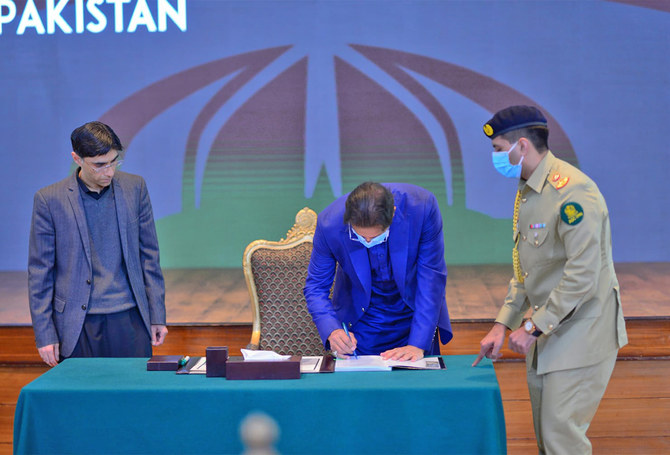

ISLAMABAD: Pakistani Prime Minister Imran Khan on Friday launched a public version of the country’s first ever national security policy, referring to it as an “all-encompassing, multidimensional” document.
In December 2021, Pakistan’s National Security Committee (NSC) approved the National Security Policy (NSP) 2022-2026, which articulates a citizen-centric framework, places economic security at its core and seeks a secure and economically resilient Pakistan.
The main themes of the NSP are national cohesion, securing an economic future, defense and territorial integrity, internal security, foreign policy in a changing world and human security.
“Based on the all-encompassing, multidimensional national security policy that you [National Security Division] have helmed, we will now focus our efforts to ensure the government and people proceed in one direction,” PM Khan said at the launch of the NSP’s public version.
He said it was not possible for a country to remain secure for long if its economy was not stable. “If you have to go to the International Monetary Fund at regular intervals, it means you security will be [adversely] affected,” he said.
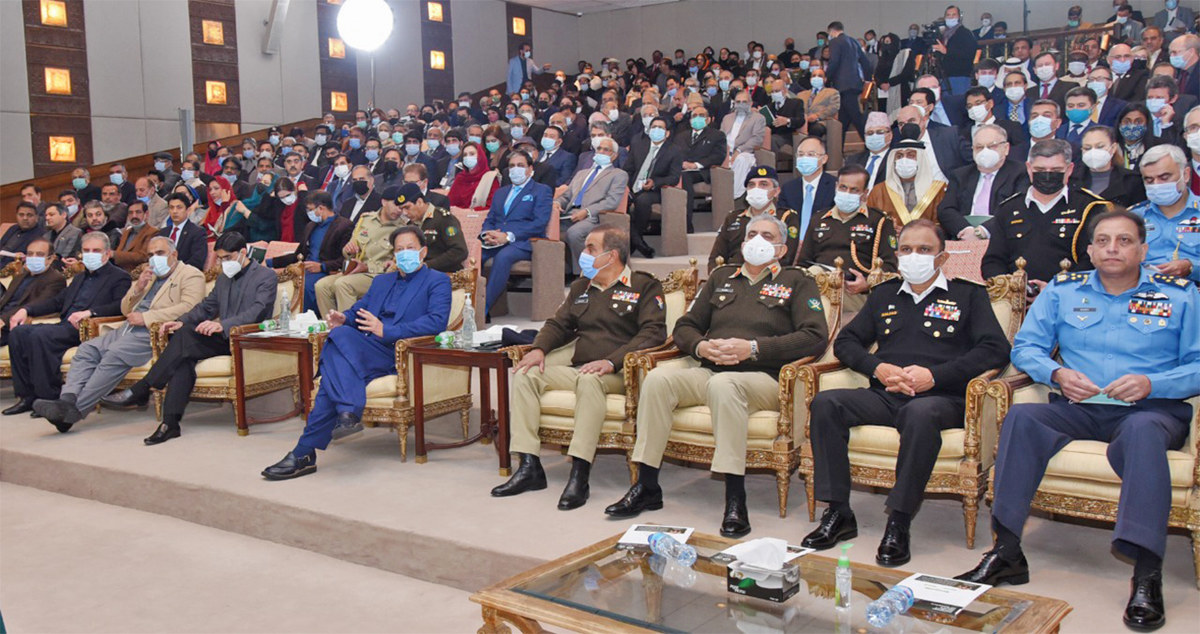
Pakistan's Prime Minister Imran Khan, fifth from left, and top military brass attend the launching ceremony of country’s first ever National Security Policy in Islamabad, Pakistan, on January 14, 2021. (Prime Minister Office)
The prime minister said Pakistan had never adopted a coordinated approach regarding its national security or even its economy. Citing examples of previous governments, he said Pakistan’s current account deficit increased whenever the country registered growth.
“When the current account deficit increased, it put pressure on the currency. Due to pressure on the currency, Pakistan had to go to the IMF [to secure loans],” PM Khan said.
Hence, he said, Pakistan always had to go to the IMF “as a last resort” and was forced to agree to its terms. “And when you agree to their terms, somewhere, our security gets compromised,” he contended.
The prime minister praised the new policy for highlighting the need for inclusive growth, adding that the State of Madinah established by Holy Prophet (Peace Be Upon Him) was the first to introduce it. “We should secure the most vulnerable segment of our society,” he added.
PM Khan stressed the need for enforcement of law and compliance with contracts.
“One of the main reasons there is minimal foreign investment in Pakistan is that they [investors] do not trust Pakistan’s judicial system,” he said, adding that these companies and investors instead sought arbitration in international courts.
The prime minister said that this was a “great impediment” to Pakistan’s growth and with such a huge population, it was the need of the hour to attract well-known global companies.
He lauded National Security Adviser Moeed Yusuf and the National Security Division for carving out such a policy and that too with consensus.


