Indian man on the run after ‘cheating’ vaccine system with 12 jabs

1 / 2
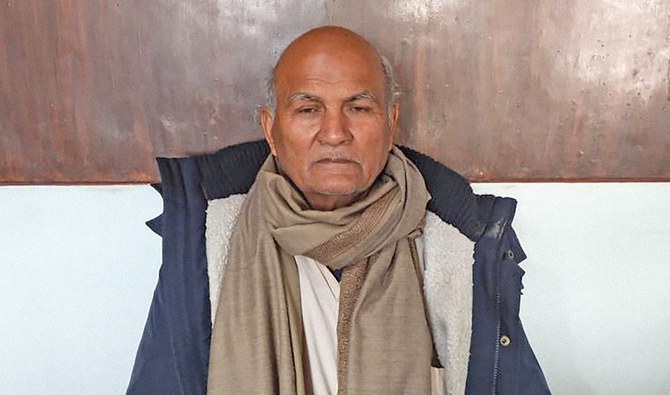
This undated photo shows 84-year-old Brahmadev Mandal, a resident of India's Bihar state, who has received 12 COVID-19 shots since February 2020. (Photo courtesy: Brahmadev Mandal)
2 / 2
This undated photo shows 84-year-old Brahmadev Mandal, left, a resident of India's Bihar state, who has received twelve COVID-19 shots since February 2020. (Photo courtesy: Brahmadev Mandal)
Short Url
Updated 12 January 2022
Follow

Indian man on the run after ‘cheating’ vaccine system with 12 jabs

  • 84-year-old clerk was vaccinated every month after he felt improvements in long-standing knee pain after first dose
  • The case raises questions about India’s vaccine registration system and concerns about overdose side effects

NEW DELHI: When Brahmadev Mandal, an 84-year-old resident of India’s eastern Bihar state, got his first COVID-19 vaccine dose in February last year, he said he felt a “great improvement” in the knee pain that had bothered him for years. 

After the second dose, the retired clerk said he no longer needed to use a cane to walk and decided to get vaccinated every month.

Mandal, who then went on to get jabbed at least another 10 times and kept a diary of all his doses, has been charged with abusing the vaccination system. According to one entry in his diary, the father of six and grandfather of 10 was vaccinated twice in the span of 10 days last September. 

“For me, the vaccine was some kind of treatment and way to achieve better health,” Mandal told Arab News on Sunday from his village, Aurai. “I know a case has been registered against me, but I will seek judicial redressal.”

The police charges against Mandal fall under sections 188 (disobedience to order duly promulgated by public servant), 419 (cheating by personation), and 420 (cheating) of the Indian Penal Code, all non-bailable offenses. 

Despite the police case, Mandal said he wouldn’t mind getting a 13th jab “if the opportunity comes.”

Mandal spoke to Arab News before a visit by the police to his house on Sunday night, by which time he had fled. His wife said officers broke the lock of the couple’s bedroom, calling it “harassment.”

“I don’t understand what is the crime of my husband,” Nirmala Devi, 80, told Arab News.

She said Mandal had tried all kinds of treatments for his back and knee aches, even traveling to see doctors in Bhagalpur, a city 100 km away from his village.

“But he started seeing a difference in his pain after he got the vaccination and that’s why he got used to taking jabs at regular intervals,” Devi said. 

Deepak Dharamdas, the station house officer at the Aurai police station, confirmed that the police had visited Mandal’s home on Sunday night but he had absconded. He denied that the police had vandalized his house. 

“How can you trust a man who has taken 12 vaccines by producing different documents? He is a fraud,” Dharamdas said. 

Health workers, upon whose complaints the police registered a case, said Mandal had “exploited loopholes” in the vaccine registration system.  

In order to get vaccinated, Indian residents need to register on the government’s CoWIN platform using their national identification numbers. The system then directs them to designated vaccination centers. 

But in rural areas like Madhepura district where Mandal lives and where access to the Internet is limited, data from locally organized vaccination camps is often not immediately uploaded to the system.

“Mandal took advantage of that,” Dr. Abdus Salam, an additional chief medical officer in the district, told Arab News. “We are now trying to address this.”

Mandal’s case is not the only one that highlights shortcomings in the registration system.

To mark Indian Prime Minister Narendra Modi’s birthday on Sept. 17, 2021, states competed to administer the most jabs. 

When Bihar was declared the winner with 3.4 million out of 25 million jabs recorded across the country, an investigation by local journalists found that the figure had been inflated by state authorities, with data from previous days withheld and uploaded to the system during the contest.

Madhepura-based journalist Kumar Ashish, who works for the Hindi-language daily Prabhat Khabar that broke the news about Mandal, said the police case against him was an attempt by local officials to “save their skin” after failing to maintain transparency in the data.

“This case raises question marks over the accuracy of vaccination data,” Ashish told Arab News.

To doctors, however, it raises questions of a different nature.

“The man is lucky that he does not have any side effects,” said Dr. Ashim Gupta from Madhepura, listing pneumonia, kidney and heart problems as some possible complications. “It’s a matter for research. I want to examine Mandal.”

He added that Mandal’s belief that the vaccine jabs had cured his knee was probably just a “psychological impact.”

The doctor warned: “There are chances of sudden death also if you take an overdose of vaccines.”


Pope names veteran Vatican diplomat as ambassador to the US to manage relations with Trump

Updated 4 sec ago
Follow

Pope names veteran Vatican diplomat as ambassador to the US to manage relations with Trump

  • Italian Archbishop Gabriele Caccia, 68, is currently the Holy See’s ambassador to the UN
  • He replaces French-born Cardinal Christophe Pierre

ROME: Pope Leo XIV on Saturday named a veteran Vatican diplomat as his new ambassador to the United States to manage one of the Holy See’s most important bilateral relationships at a crucial time, with ties strained over the Trump administration’s war in Iran and immigration crackdown.
Italian Archbishop Gabriele Caccia, 68, is currently the Holy See’s ambassador to the United Nations in New York. He replaces French-born Cardinal Christophe Pierre, who at age 80 is retiring as apostolic nuncio in Washington.
Caccia served as the Holy See’s ambassador to Lebanon and the Philippines before being posted to the UN in 2019. Ordained a priest in Milan in 1983, Caccia later served as “assessor” in the Vatican secretariat of state, a key administrative post in the Holy See’s most important office.
He inherits a complicated and consequential dossier on both the US church and state fronts at a time of global turmoil.
Pierre’s tenure as ambassador was notable for clear signs of friction between the leadership of the US Conference of Catholic Bishops, which tends to skew conservative, and the more progressive priorities of Pope Francis’ pontificate.
The relationship with the US and its church is crucial for the Holy See, not least because US Catholics are the most generous donors to the Holy See’s coffers.
Leo, history’s first US-born pope, is well aware of the dynamic, having served as Francis’ point man on bishop nominations for two years before his 2025 election. Leo has emphasized a message of pacification and unity in the church.
The first Trump administration clashed with Francis especially on migration, and that tension has continued in Leo’s pontificate and the second Trump term. Leo has repeatedly insisted that the Trump administration respect the human dignity of migrants, while acknowledging its right to its borders.
More recently, Leo has expressed “profound concern” about the US-Israeli war in Iran and urged both sides to “stop the spiral of violence before it becomes an irreparable abyss.”
In comments last Sunday, Leo called for the resumption of diplomacy. Weapons, he said, only sow “destruction, pain and death.”
In a major foreign policy speech earlier this year, Leo also made clear he opposed the US aggressive use of military power, in an apparent reference to Washington’s incursion in Venezuela and threats to take Greenland. He denounced how nations were using force to assert their dominion worldwide and “completely undermine” peace and the post-World War II international legal order.
Caccia said in a statement Saturday he was humbled by Leo’s appointment and faith in naming him ambassador to his native country.
“I receive this mission with both joy and a sense of trepidation,” according to a statement reported by Vatican News. He said his was a mission “at the service of communion and peace,” recalling that this year marks the 250th anniversary of the US independence.
The current president of the US conference, Archbishop Paul S. Coakley, welcomed Caccia’s appointment and offered the US hierarchy’s “warmest welcome and our prayerful support.”
The Holy See has a tradition of diplomatic neutrality, though Leo has spoken out strongly against the humanitarian toll of Israel’s military action in Gaza and Russia’s invasion of Ukraine.