

Fight against terrorism ‘greater challenge’ than ever before, says UK police official

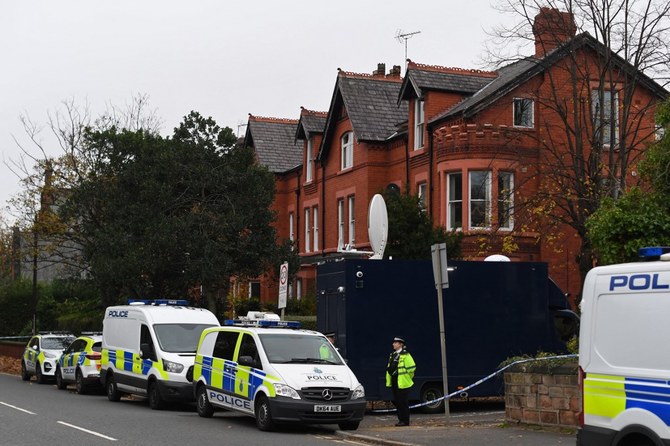
Britain’s fight against terrorism has become more challenging than ever before, a senior police official has said. (File/AFP)
Short Url
Updated 09 January 2022
Follow

Fight against terrorism ‘greater challenge’ than ever before, says UK police official

  • Combined cost of all UK terror acts in 2017 was less than $6,800
  • Lone attackers have carried out the majority of terror incidents in Britain since 2017

LONDON: Britain’s fight against terrorism has become more challenging than ever before, a senior police official has told The Independent newspaper.

Changing methods in planning, targeting and execution meant that authorities were struggling to detect potential attacks, said Dean Haydon, senior national coordinator for Counter Terrorism Policing.

Lone attackers have carried out the majority of terror incidents in Britain since 2017.

And although the majority of incidents, including failed attacks, are carried out by Islamists, a growth in the number of far-right terrorists has concerned police.

“The main threat we currently see is from people within this country that are being self-radicalised,” he added. “The timelines have been shortened. You can go out and buy a kitchen knife in a supermarket and decide, ‘This afternoon I’m going to commit an attack’ in the name of whatever ideology, and it’s a terrorist attack.

“Would we see that coming? That’s really difficult to detect. Our collective challenge is far more difficult than it has ever been. The profile of a terrorist has completely changed, and that comes back to how the threat has changed.”

He said the radicalization leading up to an attack had altered significantly since the 1990s. Then, it was terrorists typically allied with a single group or individual. But now radicals “mix and match” content from a range of sources, Haydon said.

“You’ve got no command and control, mostly, so you’ve got people in their head who have decided, after looking at material, that ‘I’m going to go and commit an attack.’ They’re not waiting for some kind of direction or approval from above.

“People can access literally anything online. Where previously you had to go to a training camp in a desert somewhere, now you just have to look online to make an IED.”

These changes, as well as the reduced costs of carrying out attacks, had made it more difficult for authorities to detect potential attacks.

“If you put all five of the 2017 attacks in Britain together — all of their planning, the weapons they brought, the vehicles they hired and the precursor chemicals — it came to less than £5,000 ($6,800). People are looking at everyday items and stuff you can access legitimately online – you don’t need vast amounts of money to commit an attack now.

“We do need parents, family members, we need the whole of the system to be flagging people that are a concern. The terrorism threat and the challenge that we all face trying to stop attacks has become ever more difficult.”

Haydon warned that the COVID-19 pandemic and associated lockdowns had added to the terror threat, creating a “perfect storm” of isolation and radicalization.


Flash floods in Nairobi kill 23, disrupt flights at major airport

Updated 7 sec ago
Follow

Flash floods in Nairobi kill 23, disrupt flights at major airport

  • Ruto said he had deployed a team of emergency responders, including soldiers, to coordinate rescue efforts
  • “I have also ⁠ordered that relief ⁠food from our national strategic reserves be immediately released”

NAIROBI: Aid workers pulled bodies from floodwaters across Nairobi on Saturday after flash floods that began overnight killed at least 23 people, swept away dozens of cars and disrupted flights at East Africa’s biggest airport, authorities said.
Kenyan President William Ruto said he had deployed a team of emergency responders, including soldiers, to coordinate rescue efforts, while offering condolences to the affected communities.
“I have also ⁠ordered that relief ⁠food from our national strategic reserves be immediately released and distributed to families affected by the floods,” he said in a statement on social media.
In the industrial neighborhood of Grogan, security guard John Lomayan, 34, looked at the body of an elderly man he recognized — a roadside egg seller — trapped beneath a car that had been ⁠washed away when the Nairobi River burst its banks.
“I saw him being carried by the water from up there,” he said, gesturing up the road. “We didn’t know where he had gone. It is only now that we see him under the car.”
Bus driver John Mwai recounted how he turned his bus into a rescue vehicle to move people to higher ground.
Kenya Airways said the rains had disrupted flights to Nairobi and forced some to divert to the coastal city of Mombasa.
Scientists say global warming is worsening ⁠floods and droughts ⁠across East Africa by concentrating rainfall into shorter, more intense bursts. A 2024 World Weather Attribution study found climate change had made devastating rains in the region twice as likely as before.
A Reuters reporter saw three bodies pulled from underneath cars. Some of the dead had been electrocuted by damaged power lines. National provider Kenya Power separately said the waters had damaged equipment at a substation, listing 14 neighborhoods that had been affected.
“So many cars, so much stuff, I don’t know. Everything was just (washed away). All of the water (came) ... from that river,” shocked resident Cedric Mwanza said, referring to the Nairobi River.