Syrians seek word of loved ones missing in regime jails

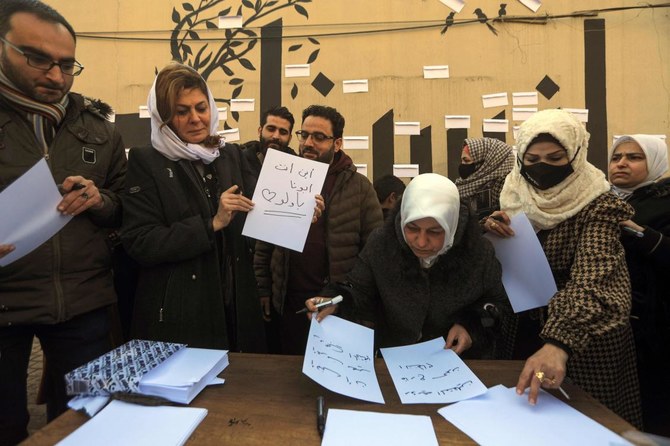
Families and relatives of Syrian detainees and missing persons rally and demand information on their loved ones, in Azaz in the rebel-controlled northern countryside of Syria’s Aleppo province, on Friday. (AFP)
Short Url
Updated 07 January 2022
Follow

Syrians seek word of loved ones missing in regime jails

  • Since civil war broke out in Syria in 2011, nearly one million people have been detained in the network of prisons and camps run by the various security services
  • Of those, around 105,000 have died in custody, while others have been released, but tens of thousands remain unaccounted for, according to Observatory figures

AZAZ, Syria: More than 70 families gathered in the rebel-held Syrian town of Azaz on Friday to highlight the plight of loved ones missing in the government’s feared jail system.
Since civil war broke out in Syria in 2011, nearly one million people have been detained in the network of prisons and camps run by the various security services, according to Britain-based monitoring group the Syrian Observatory for Human Rights.
Of those, around 105,000 have died in custody, while others have been released, but tens of thousands remain unaccounted for, according to Observatory figures.
Lama Andani said it was nine years since her husband was arrested.
For 18 months, she had received some updates indirectly, but then nothing.
“I know what it’s like to be tortured in the jails of the regime,” said Andani, who said she spent nine years in prison during a previous outbreak of political unrest in Syria during the 1980s.
“We came here in the hope of getting our message through to the international community... so that it isn’t forgotten.
“I dream of seeing my husband... and of knowing what happened to him,” she said, as she joined others in posting messages in a square in Azaz.
The northern town, hard by the border with Turkey, was occupied by Turkish troops in 2016 to prevent it falling to US-backed Kurdish forces, which had taken swathes of northern Syria from the Daesh group.
It has since been under the control of rebel groups supported by Ankara.
In 2013, a military defector known as “Caesar” smuggled more than 50,000 photographs out of Syria, many of them documenting the deaths of prisoners in detention centers or military hospitals.
The name went on to be used in the title of US legislation that provides for economic sanctions against Syria.
Despite efforts to open dialogue about the missing on both sides of the conflict, little progress has been made on establishing their fate.


Lebanese finance minister denies any plans for a Kushner-run economic zone in the south

Updated 45 min 44 sec ago
Follow

Lebanese finance minister denies any plans for a Kushner-run economic zone in the south

  • Proposal was made by US Envoy Morgan Ortagus but was ‘killed on the spot’
  • Priority is to regain control of state in all aspects, Yassine Jaber tells Arab News

DAVOS: Lebanon’s finance minister dismissed any plans of turning Lebanon’s battered southern region into an economic zone, telling Arab News on the sidelines of the World Economic Forum’s meeting in Davos that the proposal had died “on the spot.”

Yassine Jaber explained that US Envoy to Lebanon Morgan Ortagus had proposed the idea last december for the region, which has faced daily airstrikes by Israel, and it was immediately dismissed.

Jaber’s comments, made to Arab News on the sidelines of the World Economic Forum in Davos, were in response to reports which appeared in Lebanese media in December which suggested that parts of southern Lebanon would be turned into an economic zone, managed by a plan proposed by Jared Kushner, US President Donald Trump’s son in law.

Meanwhile, Jaber also dismissed information which had surfaced in Davos over the past two days of a bilateral meeting between Lebanese ministers, US Middle East Envoy Steve Witkoff and Kushner.

Jaber said that the meeting on Tuesday was a gathering of “all Arab ministers of finance and foreign affairs, where they (Witkoff and Kushner) came in for a small while, and explained to the audience the idea about deciding the board of peace for Gaza.”

He stressed that it did not develop beyond that.

When asked about attracting investment and boosting the economy, Jaber said: “The reality now is that we need to reach the situation where there is stability that will allow the Lebanese army, so the (Israeli) aggression has to stop.”

Over the past few years, Lebanon has witnessed one catastrophe after another: one of the world’s worst economic meltdowns, the largest non-nuclear explosion in its capital’s port, a paralyzed parliament and a war with Israel.

A formal mechanism was put in place between Lebanon and Israel to maintain a ceasefire and the plan to disarm Hezbollah in areas below the Litani river.

But, the minister said, Israel’s next step is not always so predictable.

“They’re actually putting pressure on the whole region. So, a lot of effort is being put on that issue,” he added.

“There are still attacks in the south of the country also, so stability is a top necessity that will really succeed in pushing the economy forward and making the reforms beneficial,” he said.

Lawmakers had also enacted reforms to overhaul the banking sector, curb the cash economy and abolish bank secrecy, alongside a bank resolution framework.

Jaber also stressed that the government had recently passed a “gap law” intended to help depositors recover funds and restore the banking system’s functionality.

“One of the priorities we have is really to deal with all the losses of the war, basically reconstruction … and we have started to get loans for reconstructing the destroyed infrastructure in the attacked areas.”

As Hezbollah was battered during the war, Lebanon had a political breakthrough as the army’s general, Joseph Aoun, was inaugurated as president. His chosen prime minister was the former president of the International Court of Justice, Nawaf Salam.

This year marks the first time a solid delegation from the country makes its way to Davos, with Salam being joined by Jaber, Economy and Trade Minister Amr Bisat, and Telecoms Minister Charles Al-Hage.

“Our priority is to really regain the role of the state in all aspects, and specifically in rebuilding the institutions,” Jaber said.