Sudanese security forces kill 3 in new anti-coup protests

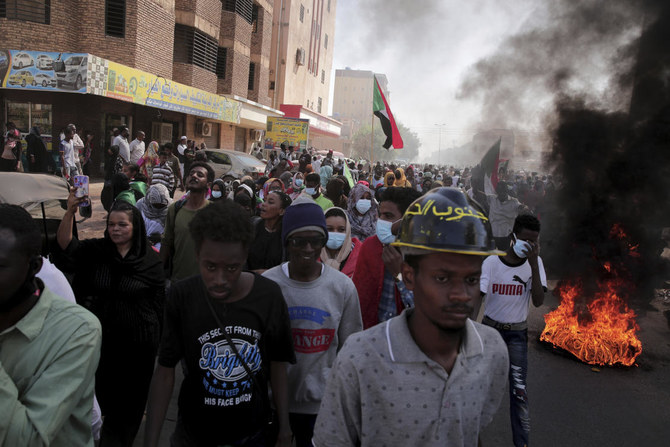
People chant slogans during a protest to denounce the October 2021 military coup, in Khartoum, Sudan on Thursday. (AP)
Short Url
Updated 06 January 2022
Follow

Sudanese security forces kill 3 in new anti-coup protests

  • In Omdurman two protesters were killed, while in Bahri one demonstrator was shot and killed, according to activist Nazim Sirag and the Sudan Doctors Committee
  • Activists posted live videos on social media showing protesters waving the Sudanese flag in several cities and chanting: “Power to the people!”

CAIRO: Sudanese security forces fired tear gas and live ammunition Thursday, killing at least three people as thousands once again took to the streets in the capital of Khartoum and other cities to protest the October military coup.
In Omdurman, the twin city of Khartoum, two protesters were killed, while in the Sudanese capital’s district of Bahri one demonstrator was shot and killed, according to activist Nazim Sirag and the Sudan Doctors Committee.
Sirag said one of the fatalities in Omdurman was a man who was shot in the head and died before reaching the hospital. Many were wounded, including by gunshots, the activist and the committee said.
The spasm of violence is the latest since the Oct. 25 military takeover that has scuttled hopes of a peaceful transition to democracy in Sudan. Thursday’s fatalities bring to at least 63 the number of people killed since the coup, and hundreds have been wounded in clashes with security forces trying to thwart protests.
Earlier Thursday, as protesters took to the streets, activists posted live videos on social media showing protesters waving the Sudanese flag in several cities and chanting: “Power to the people!” and “The military belongs in the barracks!”
Social media also swarmed with images showing tear gas clouding rallies in Khartoum, and protesters hurling stones and throwing back empty gas canisters at security forces.
The Sudanese Professionals Association, which has spearheaded many rallies since the Oct. 25 coup, called earlier on protesters to march to the presidential palace, the seat of the ruling military government in Khartoum.
Thursday’s protests come less than a week after Prime Minister Abdallah Hamdok resigned from office citing failure to reach a compromise between the generals and the country’s pro-democracy movement. Hamdok was ousted in the coup, only to be reinstated a month later following a deal with the military meant to calm tensions and anti-coup protests.
The deal was rejected by most political groups and parties who insisted the generals should promptly hand power over to civilians. Meanwhile, the military said they would not relinquish power until a new government is elected in July, as laid out in a constitutional document governing the transitional period.
Earlier on Thursday, the advocacy NetBlocs group said on Twitter that the mobile Internet was disrupted ahead of the protests, a routine measure taken by authorities since the coup. Some activists also tweeted that many bridges and roads were closed.
Sudan has been politically paralyzed since the coup. The military takeover came more than two years after a popular uprising forced the removal of longtime autocrat Omar Al-Bashir and his Islamist government in April 2019.


Trump warns Iran of ‘very traumatic’ outcome if no nuclear deal

Updated 12 February 2026
Follow

Trump warns Iran of ‘very traumatic’ outcome if no nuclear deal

  • Speaking a day after he hosted Netanyahu at the White House, Trump said he hoped for a result “over the next month”

WASHINGTON: US President Donald Trump threatened Iran Thursday with “very traumatic” consequences if it fails to make a nuclear deal — but Israeli Prime Minister Benjamin Netanyahu said he was skeptical about the quality of any such agreement.
Speaking a day after he hosted Netanyahu at the White House, Trump said he hoped for a result “over the next month” from Washington’s negotiations with Tehran over its nuclear program.
“We have to make a deal, otherwise it’s going to be very traumatic, very traumatic. I don’t want that to happen, but we have to make a deal,” Trump told reporters.
“This will be very traumatic for Iran if they don’t make a deal.”
Trump — who is considering sending a second aircraft carrier to the Middle East to pressure Iran — recalled the US military strikes he ordered on Tehran’s nuclear facilities during Israel’s 12-day war with Iran in July last year.
“We’ll see if we can get a deal with them, and if we can’t, we’ll have to go to phase two. Phase two will be very tough for them,” Trump said.
Netanyahu had traveled to Washington to push Trump to take a harder line in the Iran nuclear talks, particularly on including the Islamic Republic’s arsenal of ballistic missiles.
But the Israeli and US leaders apparently remained at odds, with Trump saying after their meeting at the White House on Wednesday that he had insisted the negotiations should continue.

- ‘General skepticism’ -

Netanyahu said in Washington on Thursday before departing for Israel that Trump believed he was laying the ground for a deal.
“He believes that the conditions he is creating, combined with the fact that they surely understand they made a mistake last time when they didn’t reach an agreement, may create the conditions for achieving a good deal,” Netanyahu said, according to a video statement from his office.
But the Israeli premier added: “I will not hide from you that I expressed general skepticism regarding the quality of any agreement with Iran.”
Any deal “must include the elements that are very important from our perspective,” Netanyahu continued, listing Iran’s ballistic missile program and its support for armed groups such as the Palestinian movement Hamas, Yemen’s Houthi rebels and Hezbollah in Lebanon.
“It’s not just the nuclear issue,” he said.
Despite their differences on Iran, Trump signaled his strong personal support for Netanyahu as he criticized Israeli President Isaac Herzog for rejecting his request to pardon the prime minister on corruption charges.
“You have a president that refuses to give him a pardon. I think that man should be ashamed of himself,” Trump said on Thursday.
Trump has repeatedly hinted at potential US military action against Iran following its deadly crackdown on protests last month, even as Washington and Tehran restarted talks last week with a meeting in Oman.
The last round of talks between the two foes was cut short by Israel’s war with Iran and the US strikes.
So far, Iran has rejected expanding the new talks beyond the issue of its nuclear program. Tehran denies seeking a nuclear weapon, and has said it will not give in to “excessive demands” on the subject.