Soudah Development eyes 2 million annual visitors over 3,000 meters above sea level: Year in Review

Short Url
Updated 05 January 2022
Follow

Soudah Development eyes 2 million annual visitors over 3,000 meters above sea level: Year in Review

  • The attraction is likely to contribute SR29 billion to Saudi gross domestic product by 2030

RIYADH:  It has been a busy year for Souda Development, after the Kingdom’s Public Investment Fund said that a new firm would turn the mountain destination in the Asir region into a world-class luxury resort.

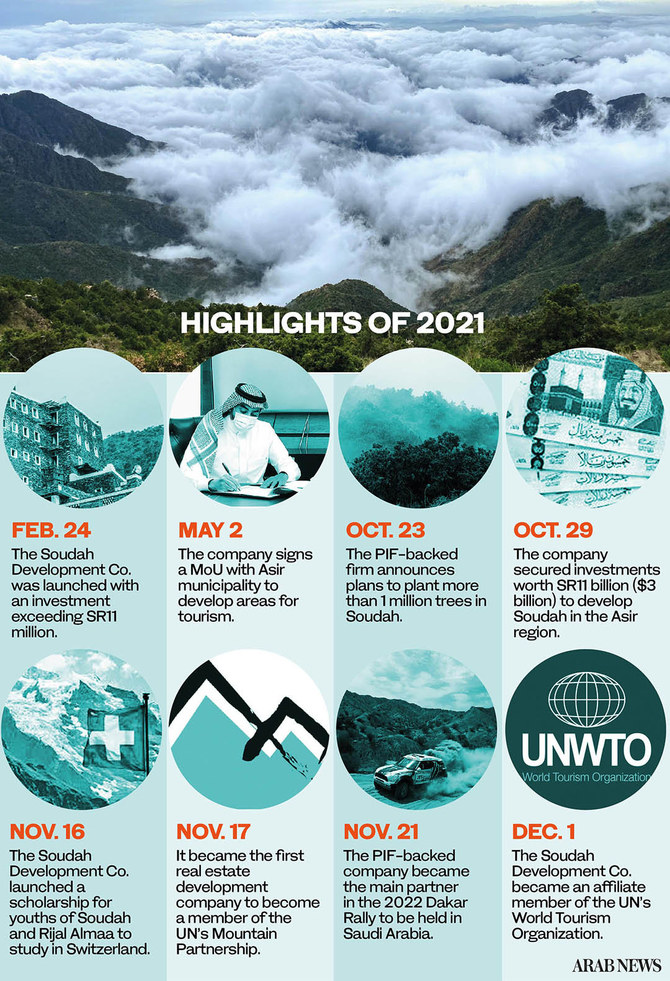
Crown Prince Mohammed bin Salman announced the move on Feb. 24, which will see the Soudah Development spend SR11 billion ($3 billion) to boost tourism in Soudah and parts of Rijal Alma’a governorate.

The move is a key driver of the Kingdom’s Vision 2030 ambitions, which aims to diversify the Kingdom’s economy and reduce reliance on oil.

Soudah mountain is the juniper- covered highest peak in Saudi Arabia, over 3,000 meters above sea level, which attracts about 1 million visitors a year. But the company targets 2 million annual visitors, to make the Soudah area an international tourist destination.

FASTFACT

1 million

The company announced during the Green Saudi Green Initiative in October that it would plant more than 1 million trees in Soudah and parts of Rijal Alma’a within eight years, which aims to reduce carbon emissions by 4 percent.

SD forecasts the attraction will contribute SR29 billion to the Saudi gross domestic product by 2030, it also expects to create 8,000 direct and indirect jobs by that time.

The firm signed a memorandum of understanding with the Asir municipality in May to organize building permits and allow commercial activities of all kinds. The deal also defined the areas proposed by the municipality for investment.

The company announced during the Green Saudi Green Initiative in October that it would plant more than 1 million trees in Soudah and parts of Rijal Alma’a within eight years, which aims to reduce carbon emissions by 4 percent. This will lift naturally protected areas to more than 30 percent of the Kingdom.

SD CEO Husameddin Al-Madani told Arab News at the green summit that $3 billion would be spent on transport such as primary, secondary and tertiary roads, with other invest ments going into energy and microgrid projects.
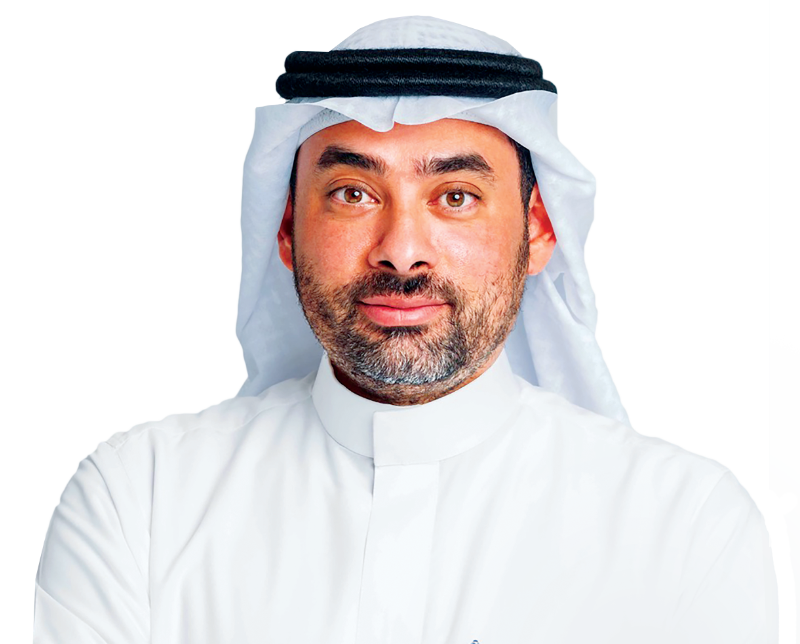


Soudah Development CEO Husameddin Al-Madani. (Supplied)

The company announced a deal with the Swiss in November to run scholarships for young people in Soudah and Rijal Alma’a to study at Switzerland’s best culinary, hospitality and business management schools.

The move will offer diplomas, undergraduate or postgraduate courses at four of Switzerland’s top schools — The Swiss Hotel Management School, Cesar Ritz Colleges Switzerland, the Culinary Arts Academy, and the Hotel Institute Montreux.

Also, in November the SD became a member of the UN’s Mountain Partnership, which aims to boost the sustainability of buildings in the region.

The development company also became a key partner in one of the world’s toughest endurance motorsports events, the 2022 Dakar Rally, which takes place across the Saudi Arabian desert, to promote adventure sports in the area.

The body finished the year strongly, by becoming an affiliate member of the World Tourism Organization in December, allowing it to work with more than 500 global companies, educational and research institutions, resorts, and Nongovernmental organizations.

SD will release its masterplan in the first quarter of 2022 after discussions with local and international investment communities.

“We have started demolition and our site preparation work on the ground in preparation for starting our large construction program by April 2022,” said CEO, Al-Madani to Arab News in an interview last year.

Next year, SD will release its masterplan in the first quarter of 2022 after discussions with local and international investment communities.

Just recently, the SD has been confirmed as an official partner of the ongoing motorsport Dakar Rally 2022.
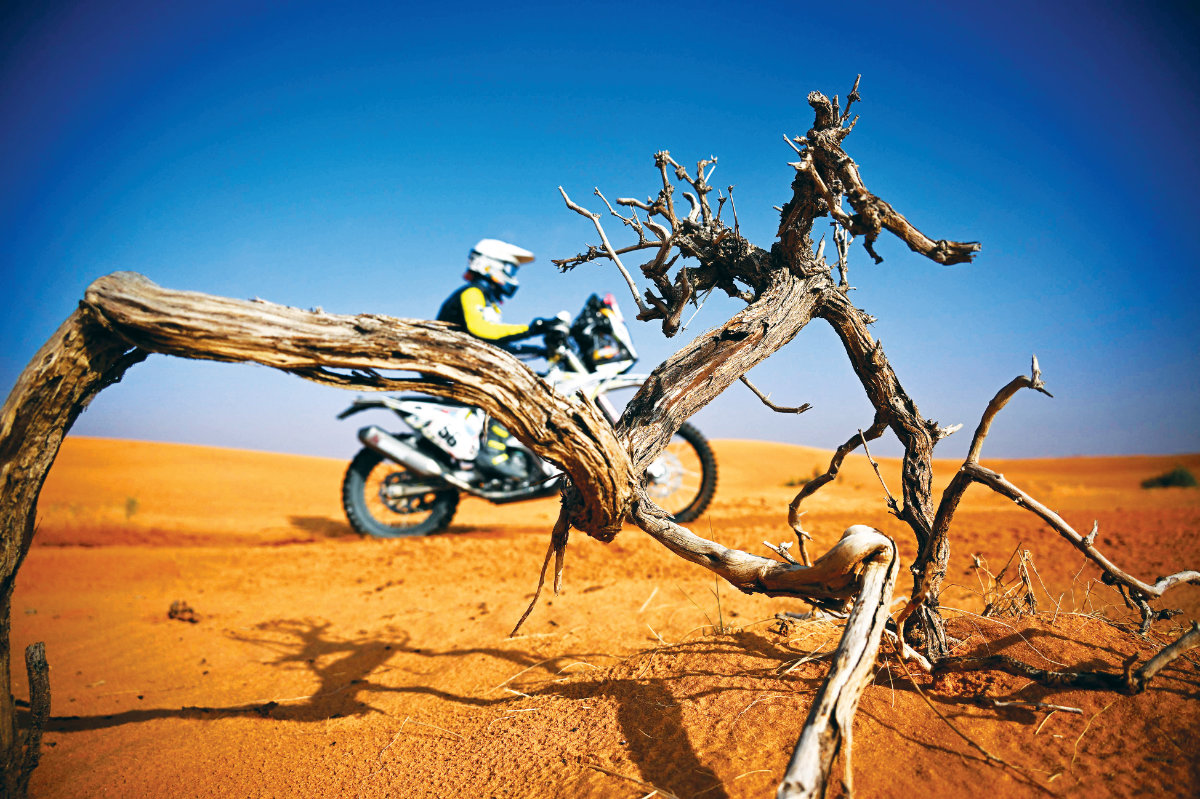


Just recently, the SD has been confirmed as an official partner of the ongoing motorsport Dakar Rally 2022. (AFP)

The partnership will see Soudah present traditional live performances as part of the post-racing entertainment in camps set up for participants, stakeholders, and the media.

Hundreds of riders, drivers and crew will experience live traditional Asiri music and performances alongside the culture of Soudah and Rijal Almaa after completing a tough day’s racing.

These performances will take place during the Riyadh, Jeddah, Bisha and Ha’il stages of the rally.

The partnership, the company said, reflects its commitment to “promoting the Soudah and Rijal Almaa region as a destination for sports and adventure tourism,” as part of its wider goal to become a leading luxury mountain destination.

Now in its 44th edition, the Dakar Rally is organized by AOS in partnership with the Fédération Internationale de l’Automobile (FIA), The Saudi Arabian Automobile and Motorcycle Federation as well as other local authorities

More than 1,000 participants from 70 countries aboard over 600 vehicles will travel across Hail, Riyadh, Jeddah, and the Asir region as part of the race.

The Dakar Rally 2022 is the first sporting event sponsored by Soudah Development since its launch last February.

“We have started demolition and our site preparation work on the ground in preparation for starting our large construction program by April 2022,” said CEO, Al-Madani to Arab News in an interview. 


Saudi youth turn to AI for art and culture

Updated 13 February 2026
Follow

Saudi youth turn to AI for art and culture

  • Creativity, heritage and technology converge in a new generation of artists

RIYADH: As Saudi Arabia’s Vision 2030 places creativity, culture and technological innovation at the core of national development, the impact of these priorities is becoming increasingly visible across a wide range of disciplines and practices.

Through the use of artificial intelligence, young Saudis are integrating technology into their creative work both as a practical tool and as a medium in its own right. In doing so, they are expanding their capabilities, exploring personal and collective identity, and finding new ways to preserve and reinterpret cultural heritage.

“AI gives young Saudis a new way to interact with their own cultural inheritance,” said Dmitry Zaytsev, founder of Dandelion Civilization, a platform designed to help individuals shape unique professional paths.

Dmitry Zaytsev, founder of Dandelion Civilization. (Supplied)

“Traditional design elements such as calligraphy or geometric motifs were once difficult to modify. Experimentation required resources and formal approval. AI removes that barrier and makes exploration immediate. A creator can test many versions of a pattern and see which ones still feel authentic to them,” he told Arab News.

According to Zaytsev, this emerging form of expression does not signal a rejection of tradition, but rather a deeper engagement with it. “The young creator discovers what can change and what must remain constant. AI becomes a sketchbook that allows culture to evolve through curiosity rather than fear. When creators correct a model or push it toward local rhythm, they strengthen rather than dilute cultural identity,” he explained.

Sarah AlBaiz, an art adviser, researcher and artist, uses code to blend visual art with concepts drawn from culture and philosophy. While her early practice focused primarily on painting, her trajectory shifted during the 2020 AI Artathon, a pioneering international event highlighting collaboration between humans and machines in artmaking, where she discovered how to merge her engineering background with her creative work.

DID YOU KNOW?

• Saudi youth are using AI as a creative tool to reinterpret heritage, from calligraphy to folklore.

• AI is helping artists experiment faster without the traditional barriers of resources or formal approval.

• The Kingdom is backing creative AI nationally, with programs like SAMAI aiming to empower 1 million Saudis for an AI-driven future.

Operating within the field of computational creativity, where technology actively participates in the artistic process, AlBaiz explores themes of finance and faith. “Because they’re two sides of who I am,” she said. “When you talk about values, for example, that is both a term used in finance and trade from an objective perspective, but also moral and spiritual value.”

“When you understand prompting in AI, you can get it to produce almost anything. But it’s also informed by the training data it has,” she said.

Sarah Albaiz's "Diriyah II (2020)" melds a traditional Saudi landmark with the avant-garde. This generative artwork rejuvenates the historic Alsalwa Palace in Diriyah. By infusing Munira AlTheeb's artistry through GAN style transfer, the piece stands as a testament to the evolving narrative of Saudi heritage. (Supplied)

Rather than relying on a single platform, AlBaiz experiments with multiple AI models to test their limitations and audience reception. “I work a lot with language as well, so large language models are right up my street when it comes to computational creativity.”ee

Her work has gained international recognition. At the 2022 Islamic Arts Biennale in Jeddah, she co-created an artwork under the banner of Super Artistic AI that generated Al-Qatt Al-Asiri motifs from southern Saudi Arabia. The piece received an Audience Award.

Beyond her artistic practice, AlBaiz is developing an intelligent art advisory system aimed at helping users navigate the Saudi art landscape. Designed as an initial point of contact, the system would guide users through potential pathways before they engage with a human adviser.

Inverting established gender norms, Sarah Albaiz's digital collage reimagines masculinity. Set against a generative backdrop, its core message "real men cry" challenges familial WhatsApp discourses. (Supplied)

“It’s about understanding what role AI plays in the pursuit of what you want,” she said. “When I decided to focus on Qantara and building the advisory, I recognized that many of the systems required would need to be intelligent systems that offload a lot of work from me and the team.”

“When AI is an enabler rather than the end result, it becomes less intimidating because it feels risk-free for the end user,” she added.

Zaytsev echoed this idea, describing AI as a kind of rehearsal space. “Young people practice conversations, explore sensitive topics and organize their thoughts without social risk. This builds emotional clarity and confidence,” he said.

While generative tools such as large language models attract much of the attention, AI’s creative applications extend far beyond text and image generation.

Fairooz Alawami, trained as both an architect and engineer, uses AI to create self-expressive visual works inspired by dance.

Fairooz AlAwami's work. (Supplied)

“My practice is focused on contextualizing movement,” she said. “Because of my architectural training, I work with 3D modeling software called Rhino, which includes a visual coding language. Within that environment, you can also write code in Python, JavaScript or C#.”

Alawami employs OpenPose to analyze videos of her dancing by mapping points across her body. She then applies another computer vision model, MIDAS, which converts images or videos into depth frames. “If OpenPose gives me a skeleton, MIDAS gives me depth,” she explained. The resulting data is fed into 3D modeling software, where it is refined and manipulated into finished artworks.

She began dancing at a young age. “I didn’t find it, it found me,” she said. Movement later became the foundation of her artistic practice, leading to her first major project around three years ago while completing her master’s degree using the Grasshopper plugin. At the time, the workflow was slow and fragmented, but the arrival of ChatGPT helped streamline the process by making it easier to write and learn code.

Fairooz AlAwami's work. (Supplied)

“I think my love for dance and my love for art and design came together in a way that felt uniquely me,” she said. “Once I found that space, I just ran with it. It is my singular voice.”

Her work also draws heavily on cultural and musical heritage. One recent project was inspired by folklore referenced in the iconic song “Al Leila wa Leila” by Umm Kulthum. Alawami extracted musical stems from the track and mapped them to characters within the narrative. “The vocals were Shahrazad, the storyteller, and each stem represented a different narrative element,” she said. Earlier works were influenced by Islamic architecture and the geometric patterns found throughout Saudi Arabia and the wider Arab world.

“There are some incredible artists using generative AI to do very impressive things, and I don’t think I fall into that camp,” she said. “For me, AI is more like a skills-gap tool that helps me reach where I want to go.

“As humans, whether we realize it or not, the act of creating feeds us in some way. Lowering the barrier to entry makes creativity less intimidating.”

Opinion

This section contains relevant reference points, placed in (Opinion field)

Today, Saudi Arabia’s creative sector is supported by expanding national infrastructure. Initiatives such as the Cultural Scholarship Program place Saudi students in more than 60 universities worldwide, spanning disciplines from archaeology and literature to design, filmmaking and culinary arts. In parallel, the Kingdom launched the SAMAI initiative last year, aiming to equip 1 million Saudis with the skills needed to engage confidently in an AI-driven world.

Within Vision 2030, culture, tourism, digitalization and AI are treated as strategic sectors rather than peripheral concerns. As Saudi Arabia develops its creative economy as a form of soft power, its youth are becoming increasingly digitally fluent. AI tools are now embedded within creative workflows, enabling a new generation to explore heritage, remix traditional aesthetics and develop narratives that resonate on a global stage.