

Dance, music return to Bali but not foreign tourists

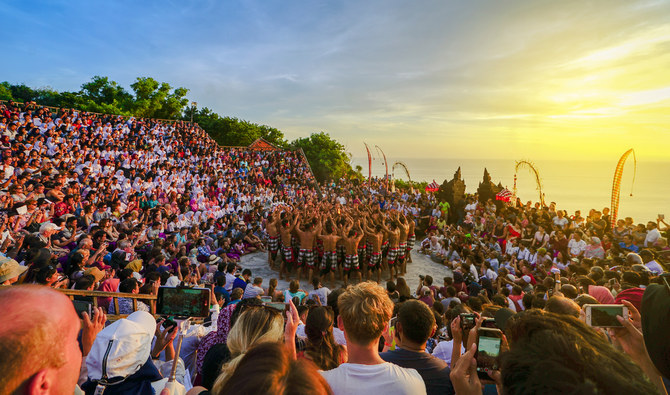
The Kecak dance was developed in the 1930s by Balinese artist Wayan Limbak and German painter Walter Spies as an art form that does not use any musical instruments instead relying on human voices for its background rhythm. (Shutterstock)
Short Url
Updated 04 January 2022
Follow

Dance, music return to Bali but not foreign tourists

  • Recent visitor numbers have represented a significant surge on figures for July and August, the peak of the outbreak of the delta variant of COVID-19, when the average number of daily trippers was between 700 and 800

DENPASAR: Hypnotic chants accompanying the famous Kecak dance have become a symbol of the gradual recovery of the beleaguered tourism industry on Indonesia’s holiday island of Bali.

Dancers have resumed regular performances of their routines, although only for domestic tourists.

The Kecak dance was developed in the 1930s by Balinese artist Wayan Limbak and German painter Walter Spies as an art form that does not use any musical instruments instead relying on human voices for its background rhythm.

It is an adaptation of the story of the Hindu epic Ramayana, involving up to 100 bare-chested male Kecak dancers wearing black and white checkered sarongs, who harmoniously chant the cak throughout the show while sitting in a circle as the character dancers perform Ramayana roles such as Hanuman, Rama, Shinta, Ravana, and the golden deer in the middle.

Since the start of the coronavirus pandemic, many tourist attractions across the island had to close, including the Uluwatu Temple amphitheater in southern Bali, which for years has hosted Kecak performances. However, as the global health crisis has eased, Indonesians are increasingly making their way to the island and during the year-end holidays hundreds of spectators watched the captivating show.

Bali Tourism Board chairman, Ida Bagus Agung Partha Adnyana, told Arab News: “We are very grateful for the domestic tourist arrivals. In December, an average of 15,000 domestic tourists entered the island every day. With limited international destinations and foreign travel restrictions still in place, Bali remains the main destination for domestic tourists.”

Recent visitor numbers have represented a significant surge on figures for July and August, the peak of the outbreak of the delta variant of COVID-19, when the average number of daily trippers was between 700 and 800.

But Bali is still experiencing a dearth of foreign tourists, despite officially reopening for direct international flights on Oct. 14.

Adnyana said industry stakeholders and the government would be reviewing the situation based on the global development of the omicron variant.

“If the situation looks good, we hope the number of days for mandatory quarantine upon arrival will be shortened, and regulations about international flights to Bali will be revised,” he added.

Restrictions throughout the pandemic have brought tourism — a lifeline for Bali’s economy — to a standstill, severely impacting life across the island, including those of the Kecak dancers.

“There are only two things that can stop the show — the COVID-19 pandemic and Nyepi Day,” dancer I Komang Adi Kusyanto told Arab News, referring to the Balinese new year, or Day of Silence, when the predominantly Hindu island refrains from all activities.

Following multiple readjustments, the group finally restarted daily performances at the end of October for limited audiences. Troupe spokesperson I Nyoman Adi Ardika said that the dance was slightly changed to comply with social distancing measures, including reducing the number of male chanters to 40, modifying formations that required close physical contacts, and the use of face masks and face shields.

“The adjustment doesn’t change the core composition although the dancers acknowledged it makes them less expressive,” Ardika added.

Regardless of the changes and the limited audience, Kusyanto, 33, who has been a Kecak dancer since he was 15, said: “We are just really happy to perform again.”

The pandemic has hit him and fellow troupe members hard as they lost their dancing and main jobs in the hospitality sector.

“I wasn’t so shocked back in March 2020 when the border was closed. I thought it was only temporary for a few months. I never thought it would be this long,” Kusyanto added.

He worked odd jobs in between to make ends meet, including producing and selling big kites during the kite season in Bali, and as a garbage truck driver for his village administration.

But now, as domestic tourists return to the island, Kusyanto has resumed his main hospitality job working as a bartender and barista in his brother’s restaurant.



Sending soldiers to Minneapolis for immigration crackdown would be unconstitutional, mayor says

Updated 6 sec ago
Follow

Sending soldiers to Minneapolis for immigration crackdown would be unconstitutional, mayor says

  • The rarely-used 19th century law would allow him to send military troops into Minnesota, where protesters have been confronting federal immigration agents for weeks

MINNEAPOLIS: The mayor of Minneapolis said Sunday that sending active duty soldiers into Minnesota to help with an immigration crackdown is a ridiculous and unconstitutional idea as he urged protesters to remain peaceful so the president won’t see a need to send in the US military.
Daily protests have been ongoing throughout January since the Department of Homeland Security ramped up immigration enforcement in the Twin Cities of Minneapolis and St. Paul by bringing in more than 2,000 federal officers.
In a diverse neighborhood where Immigration and Customs Enforcement officers have been frequently seen, US postal workers marched through on Sunday, chanting: “Protect our routes. Get ICE out.”
The Pentagon has ordered about 1,500 active-duty soldiers based in Alaska who specialize in operating in arctic conditions to be ready in case of a possible deployment to Minnesota, two defense officials said Sunday.
The officials, who spoke on condition of anonymity to discuss sensitive military plans, said two infantry battalions of the Army’s 11th Airborne Division have been given prepare-to-deploy orders.
One defense official said the troops are standing by to deploy to Minnesota should President Donald Trump invoke the Insurrection Act.
The rarely-used 19th century law would allow him to send military troops into Minnesota, where protesters have been confronting federal immigration agents for weeks. He has since backed off the threat, at least for now.
“It’s ridiculous, but we will not be intimidated by the actions of this federal government,” Minneapolis Mayor Jacob Frey told CNN’s State of the Union on Sunday. “It is not fair, it’s not just, and it’s completely unconstitutional.”
Thousands of Minneapolis citizens are exercising their First Amendment rights and the protests have been peaceful, Frey said.
“We are not going to take the bait. We will not counter Donald Trump’s chaos with our own brand of chaos here,” Frey said.
Gov. Tim Walz has mobilized the Minnesota National Guard, although no units have been deployed to the streets.
Peter Noble joined dozens of other US Post Office workers Sunday on their only day off from their mail routes to march against the immigration crackdown. They passed by the place where an immigration officer shot and killed Renee Good, a US citizen and mother of three, during a Jan. 7 confrontation.
“I’ve seen them driving recklessly around the streets while I am on my route, putting lives in danger,” Noble said.
Letter carrier Susan Becker said she came out to march on the coldest day since the crackdown started because it’s important to keep telling the federal government she thinks what it is doing is wrong. She said people on her route have reported ICE breaking into apartment buildings and tackling people in the parking lot of shopping centers.
“These people are by and large citizens and immigrants. But they’re citizens, and they deserve to be here; they’ve earned their place and they are good people,” Becker said.
A Republican US House member called for Walz to tone down his comments about fighting the federal government and instead start to help law enforcement.
Many of the officers in Minnesota are neighbors just doing the jobs they were sent to do, House Majority Whip Tom Emmer told WCCO-AM in Minneapolis.
“These are not mean spirited people. But right now, they feel like they’re under attack. They don’t know where the next attack is going to come from and who it is. So people need to keep in mind this starts at the top,” Emmer said.
Across social media, videos have been posted of federal officers spraying protesters with pepper spray, knocking down doors and forcibly taking people into custody. On Friday, a federal judge ruled that immigration officers can’t detain or tear gas peaceful protesters who aren’t obstructing authorities, including when they’re observing the officers during the Minnesota crackdown.