Sending soldiers to Minneapolis for immigration crackdown would be unconstitutional, mayor says

1 / 4
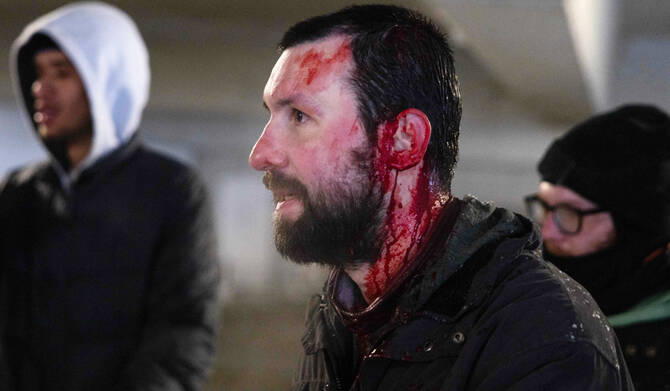
A suspected white nationalist demonstrator is bloodied after clashing with immigrant rights protestors on January 17, 2026 in Minneapolis, Minnesota. (AFP)
2 / 4
Demonstrators display signs, in front of the Bishop Henry Whipple Federal Building, during a protest more than a week after a U.S. Immigration and Customs Enforcement (ICE) agent fatally shot Renee Nicole Good, in Minneapolis, Minnesota, U.S., January 17, 2026. (REUTERS)
3 / 4
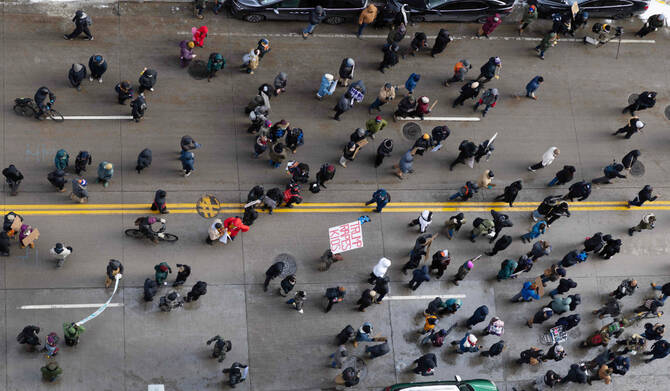
Demonstrators protest the Trump administration's push to round up and deport undocumented immigrants on January 15, 2026 in Minneapolis, Minnesota. (AFP)
4 / 4
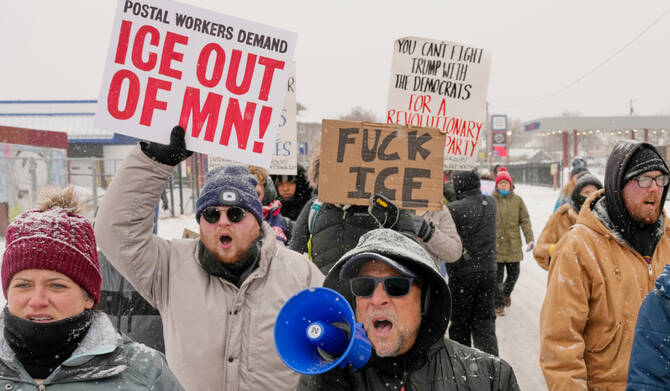
People march and gather near the post office during a protest, Sunday, Jan. 18, 2026, in Minneapolis. (AP)
Short Url
Updated 19 January 2026
Follow

Sending soldiers to Minneapolis for immigration crackdown would be unconstitutional, mayor says

  • The rarely-used 19th century law would allow him to send military troops into Minnesota, where protesters have been confronting federal immigration agents for weeks

MINNEAPOLIS: The mayor of Minneapolis said Sunday that sending active duty soldiers into Minnesota to help with an immigration crackdown is a ridiculous and unconstitutional idea as he urged protesters to remain peaceful so the president won’t see a need to send in the US military.
Daily protests have been ongoing throughout January since the Department of Homeland Security ramped up immigration enforcement in the Twin Cities of Minneapolis and St. Paul by bringing in more than 2,000 federal officers.
In a diverse neighborhood where Immigration and Customs Enforcement officers have been frequently seen, US postal workers marched through on Sunday, chanting: “Protect our routes. Get ICE out.”
The Pentagon has ordered about 1,500 active-duty soldiers based in Alaska who specialize in operating in arctic conditions to be ready in case of a possible deployment to Minnesota, two defense officials said Sunday.
The officials, who spoke on condition of anonymity to discuss sensitive military plans, said two infantry battalions of the Army’s 11th Airborne Division have been given prepare-to-deploy orders.
One defense official said the troops are standing by to deploy to Minnesota should President Donald Trump invoke the Insurrection Act.
The rarely-used 19th century law would allow him to send military troops into Minnesota, where protesters have been confronting federal immigration agents for weeks. He has since backed off the threat, at least for now.
“It’s ridiculous, but we will not be intimidated by the actions of this federal government,” Minneapolis Mayor Jacob Frey told CNN’s State of the Union on Sunday. “It is not fair, it’s not just, and it’s completely unconstitutional.”
Thousands of Minneapolis citizens are exercising their First Amendment rights and the protests have been peaceful, Frey said.
“We are not going to take the bait. We will not counter Donald Trump’s chaos with our own brand of chaos here,” Frey said.
Gov. Tim Walz has mobilized the Minnesota National Guard, although no units have been deployed to the streets.
Peter Noble joined dozens of other US Post Office workers Sunday on their only day off from their mail routes to march against the immigration crackdown. They passed by the place where an immigration officer shot and killed Renee Good, a US citizen and mother of three, during a Jan. 7 confrontation.
“I’ve seen them driving recklessly around the streets while I am on my route, putting lives in danger,” Noble said.
Letter carrier Susan Becker said she came out to march on the coldest day since the crackdown started because it’s important to keep telling the federal government she thinks what it is doing is wrong. She said people on her route have reported ICE breaking into apartment buildings and tackling people in the parking lot of shopping centers.
“These people are by and large citizens and immigrants. But they’re citizens, and they deserve to be here; they’ve earned their place and they are good people,” Becker said.
A Republican US House member called for Walz to tone down his comments about fighting the federal government and instead start to help law enforcement.
Many of the officers in Minnesota are neighbors just doing the jobs they were sent to do, House Majority Whip Tom Emmer told WCCO-AM in Minneapolis.
“These are not mean spirited people. But right now, they feel like they’re under attack. They don’t know where the next attack is going to come from and who it is. So people need to keep in mind this starts at the top,” Emmer said.
Across social media, videos have been posted of federal officers spraying protesters with pepper spray, knocking down doors and forcibly taking people into custody. On Friday, a federal judge ruled that immigration officers can’t detain or tear gas peaceful protesters who aren’t obstructing authorities, including when they’re observing the officers during the Minnesota crackdown.


House Republicans barely defeat Venezuela war powers resolution to check Trump’s military actions

Updated 23 January 2026
Follow

House Republicans barely defeat Venezuela war powers resolution to check Trump’s military actions

WASHINGTON: The House rejected a Democratic-backed resolution Thursday that would have prevented President Donald Trump from sending US military forces to Venezuela after a tied vote on the legislation fell just short of the majority needed for passage.
The tied vote was the latest sign of Republican House Speaker Mike Johnson’s tenuous hold on the majority, as well as some of the growing pushback in the GOP-controlled Congress to Trump’s aggressions in the Western Hemisphere. A Senate vote on a similar resolution was also tied last week until Vice President JD Vance broke the deadlock.
To defeat the resolution Thursday, Republican leaders had to hold the vote open for more than 20 minutes while Republican Rep. Wesley Hunt, who had been out of Washington all week campaigning for a Senate seat in Texas, rushed back to Capitol Hill to cast the decisive vote.
On the House floor, Democrats responded with shouts that Republican leaders were violating the chamber’s procedural rules. Two Republicans — Reps. Don Bacon of Nebraska and Thomas Massie of Kentucky — voted with all Democrats for the legislation.
The war powers resolution would have directed Trump to remove US troops from Venezuela. The Trump administration told senators last week that there are no US troops on the ground in the South American nation and committed to getting congressional approval before launching major military operations there.
But Democrats argued that the resolution is necessary after the US raid to capture Venezuelan leader Nicolás Maduro and since Trump has stated plans to control the country’s oil industry for years to come.
The response to Trump’s foreign policy
Thursday’s vote was the latest test in Congress of how much leeway Republicans will give a president who campaigned on removing the US from foreign entanglements but has increasingly reached for military options to impose his will in the Western Hemisphere. So far, almost all Republicans have declined to put checks on Trump through the war powers votes.
Rep. Brian Mast, the Republican chair of the House Armed Services Committee, accused Democrats of bringing the war powers resolution to a vote out of “spite” for Trump.
“It’s about the fact that you don’t want President Trump to arrest Maduro, and you will condemn him no matter what he does, even though he brought Maduro to justice with possibly the most successful law enforcement operation in history,” Mast added.
Still, Democrats stridently argued that Congress needs to assert its role in determining when the president can use wartime powers. They have been able to force a series of votes in both the House and Senate as Trump, in recent months, ramped up his campaign against Maduro and set his sights on other conflicts overseas.
“Donald Trump is reducing the United States to a regional bully with fewer allies and more enemies,” Rep. Gregory Meeks, the top Democrat on the House Foreign Affairs Committee, said during a floor debate. “This isn’t making America great again. It’s making us isolated and weak.”
Last week, Senate Republicans were only able to narrowly dismiss the Venezuela war powers resolution after the Trump administration persuaded two Republicans to back away from their earlier support. As part of that effort, Secretary of State Marco Rubio committed to a briefing next week before the Senate Foreign Relations Committee.
Yet Trump’s insistence that the US will possess Greenland over the objections of Denmark, a NATO ally, has alarmed some Republicans on Capitol Hill. They have mounted some of the most outspoken objections to almost anything the president has done since taking office.
Trump this week backed away from military and tariff threats against European allies as he announced that his administration was working with NATO on a “framework of a future deal” on Arctic security.
But Bacon still expressed frustration with Trump’s aggressive foreign policy and voted for the war powers resolution even though it only applies to Venezuela.
“I’m tired of all the threats,” he said.
Trump’s recent military actions — and threats to do more — have reignited a decades-old debate in Congress over the War Powers Act, a law passed in the early 1970s by lawmakers looking to claw back their authority over military actions.
The war powers debate
The War Powers Resolution was passed in the Vietnam War era as the US sent troops to conflicts throughout Asia. It attempted to force presidents to work with Congress to deploy troops if there hasn’t already been a formal declaration of war.
Under the legislation, lawmakers can also force votes on legislation that directs the president to remove US forces from hostilities.
Presidents have long tested the limits of those parameters, and Democrats argue that Trump in his second term has pushed those limits farther than ever.
The Trump administration left Congress in the dark ahead of the surprise raid to capture Maduro. It has also used an evolving set of legal justifications to blow up alleged drug boats and seize sanctioned oil tankers near Venezuela.
Democrats question who gets to benefit from Venezuelan oil licenses
As the Trump administration oversees the sale of Venezuela’s petroleum worldwide, Senate Democrats are also questioning who is benefiting from the contracts.
In one of the first transactions, the US granted Vitol, the world’s largest independent oil broker, a license worth roughly $250 million. A senior partner at Vitol, John Addison, gave roughly $6 million to Trump-aligned political action committees during the presidential election, according to donation records compiled by OpenSecrets.
“Congress and the American people deserve full transparency regarding any financial commitments, promises, deals, or other arrangements related to Venezuela that could favor donors to the President’s campaign and political operation,” 13 Democratic senators wrote to White House Chief of Staff Susie Wiles Thursday in a letter led by Democratic Sen. Adam Schiff of California.
The White House has said it is safeguarding the South American country’s oil for the benefit of both the people of Venezuela and the US