

Canada court awards $83.94 million to families of Ukraine airliner downed by Iran

1 / 2
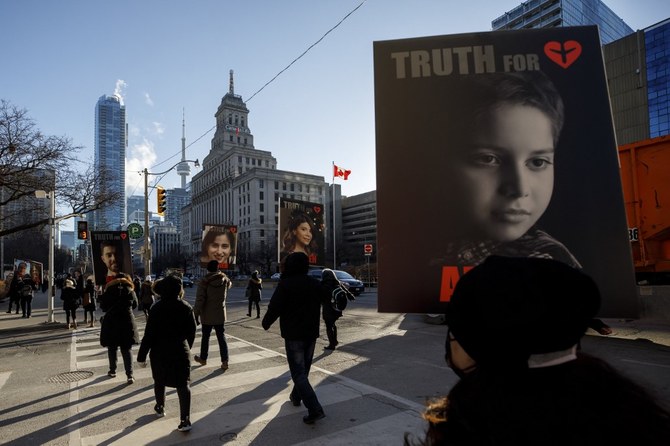
People hold signs with images of the victims of the downed Ukraine International Airlines flight PS752, which was shot down near Tehran, during a march in Ontario, Canada, on Jan. 8, 2021. (AFP)
2 / 2
A handout picture provided by the Iranian Red Crescent on January 8, 2020 shows rescue teams working at the scene after a Ukrainian plane carrying 176 passengers crashed near Imam Khomeini airport in the Iranian capital Tehran. (AFP)
Short Url
Updated 04 January 2022
Follow

Canada court awards $83.94 million to families of Ukraine airliner downed by Iran

  • Iran blamed a ‘disastrous mistake’ by forces on high alert after plane was shot down

OTTAWA: A court in Ontario, Canada, has awarded C$107 million ($83.94 million), plus interest, to the families of six people who died when the Iranian Revolutionary Guards downed a Ukraine International Airlines plane near Tehran two years ago.
Iran shot down the airliner in January 2020. All 176 people onboard were killed, including 55 Canadian citizens and 30 permanent residents.
The six family members awarded compensation by the Ontario court lost spouses, siblings, children, nieces and nephews aboard Flight 752, their lawyer, Mark Arnold, said in a statement on Monday. They had filed a civil lawsuit against Iran and other officials they believe were to blame for the incident.
The lawyer said his team will look to seize Iranian assets in Canada and abroad. He said Iran has oil tankers in other countries and his team will be looking to seize whatever it can to pay what the families are owed.
The decision by Justice Edward Belobaba of Ontario’s Superior Court of Justice was dated Dec. 31 and announced by Arnold on Monday.
The case was filed by Shahin Moghaddam, Mehrzad Zarei and Ali Gorji. Fearing reprisals from Iran, some of the other plaintiffs withheld their names, CBC News reported earlier.
A special Canadian forensic team had produced a report in mid-2021 that accused Iran of incompetence and recklessness over the downing of the Ukrainian passenger plane. Iran criticized the report as being “highly politicized.”
The report found that while the shooting down of Ukrainian International Airlines flight 752 had not been premeditated, it did not absolve Iranian officials of responsibility for the incident.
Iran admitted it shot down the airliner shortly after takeoff from Tehran in January 2020 and blamed a “disastrous mistake” by forces on high alert during a confrontation with the United States.
At the time, Iran was on edge about possible attacks after it fired missiles at Iraqi bases housing US forces in retaliation for the killing days before of its most powerful military commander, Qassem Soleimani, in a US missile strike at Baghdad airport.


Sudanese nomads trapped as war fuels banditry and ethnic splits

Updated 4 sec ago
Follow

Sudanese nomads trapped as war fuels banditry and ethnic splits

  • War disrupts nomads’ traditional routes and livelihoods
  • Nomads face threats from bandits as well as ethnic tensions
NEAR AL-OBEID: Gubara Al-Basheer and his family used ​to traverse Sudan’s desert with their camels and livestock, moving freely between markets, water sources, and green pastures. But since war erupted in 2023, he and other Arab nomads have been stuck in the desert outside the central Sudanese city of Al-Obeid, threatened by marauding bandits and ethnic tensions. The war between the Sudanese army and the paramilitary Rapid Support Forces (RSF) has left nearly 14 million people displaced, triggered rounds of ethnic bloodshed, and spread famine ‌and disease. It ‌has also upset the delicate balance of ‌land ⁠ownership ​and livestock routes ‌that had maintained the nomads’ livelihoods and wider relations in the area, local researcher Ibrahim Jumaa said. Al-Obeid is one of Sudan’s largest cities and capital of North Kordofan state, which has seen the war’s heaviest fighting in recent months. Those who spoke to Reuters from North Kordofan said they found themselves trapped as ethnic hatred, linked to the war and fueled largely online, spreads.
“We used to be ⁠able to move as we wanted. Now there is no choice and no side accepts you,” ‌al-Basheer said. “In the past there were a ‍lot of markets where we ‍could buy and sell. No one hated anyone or rejected anyone. Now ‍it’s dangerous,” he said.
RISK OF ROBBERY
As well as the encroaching war, the nomads — who Jumaa said number in the millions across Sudan — face a threat from bandits who steal livestock.
“There are so many problems now. We can’t go anywhere and if we ​try we get robbed,” said Hamid Mohamed, another shepherd confined to the outskirts of Al-Obeid. The RSF emerged from Arab militias known ⁠as the Janjaweed, which were accused of genocide in Darfur in the early 2000s. The US and rights groups have accused the RSF of committing genocide against non-Arabs in West Darfur during the current conflict, in an extension of long-running violence stemming from disputes over land. The RSF has denied responsibility for ethnically charged killings and has said those responsible for abuses will be held to account. Throughout the war the force has formed linkages with other Arab tribes, at times giving them free rein to loot and kidnap.
But some Arab tribes, and many tribesmen, have not joined the fight.
“We require a national program to counter ‌hate speech, to impose the rule of law, and to promote social reconciliation, as the war has torn the social fabric,” said Jumaa.