

Pakistani army says will play ‘due part’ in achieving vision of new national security policy

Pakistani troops patrol along Pakistan-Afghanistan border at Big Ben post in Khyber district in Khyber Pakhtunkhwa province, Pakistan, on August 3, 2021. (AFP/File)
Short Url
Updated 29 December 2021
Follow

Pakistani army says will play ‘due part’ in achieving vision of new national security policy

  • Maj Gen Babar Iftikhar says framework recognizes interlinkages between strands of national security
  • The policy has been formulated over last seven years in consultation with all relevant stakeholders

ISLAMABAD: The armed forces of Pakistan will play their “due part” in achieving the vision laid out in the National Security Policy (NSP) 2022-2026, the Pakistani military spokesman said on Tuesday. 
Pakistan’s National Security Committee (NSC) endorsed the policy in a high-level huddle on Monday, aiming to ensure safety, security and dignity of its citizens. 
Earlier in the day, Prime Minister Imran Khan's cabinet approved the new strategy, with the national security adviser saying it was “citizen-centric” and had “economic security” at its core. 
"NSP is an important milestone in strengthening national security of Pakistan. The comprehensive framework recognizes interlinkages between various strands of national security, imperative to meet emerging challenges in evolving global environment through a whole-of-government effort," said Major General Babar Iftikhar, the director-general of the Inter-Services Public Relations (ISPR), the Pakistani military’s media wing. 
"Pakistan’s armed forces will play their due part in achieving the vision laid out in the policy," he added. 
Pakistan's National Security Adviser Moeed Yusuf earlier said the approval of the NSP by the cabinet was a “historic achievement.” 
"A citizen-centric comprehensive National Security Policy with economic security at the core will now be pursued in earnest," Pakistani NSA Moeed Yusuf said on Twitter. 
“This umbrella document will, over time, help guide sectoral policies for the fulfilment of our national security objectives.” 
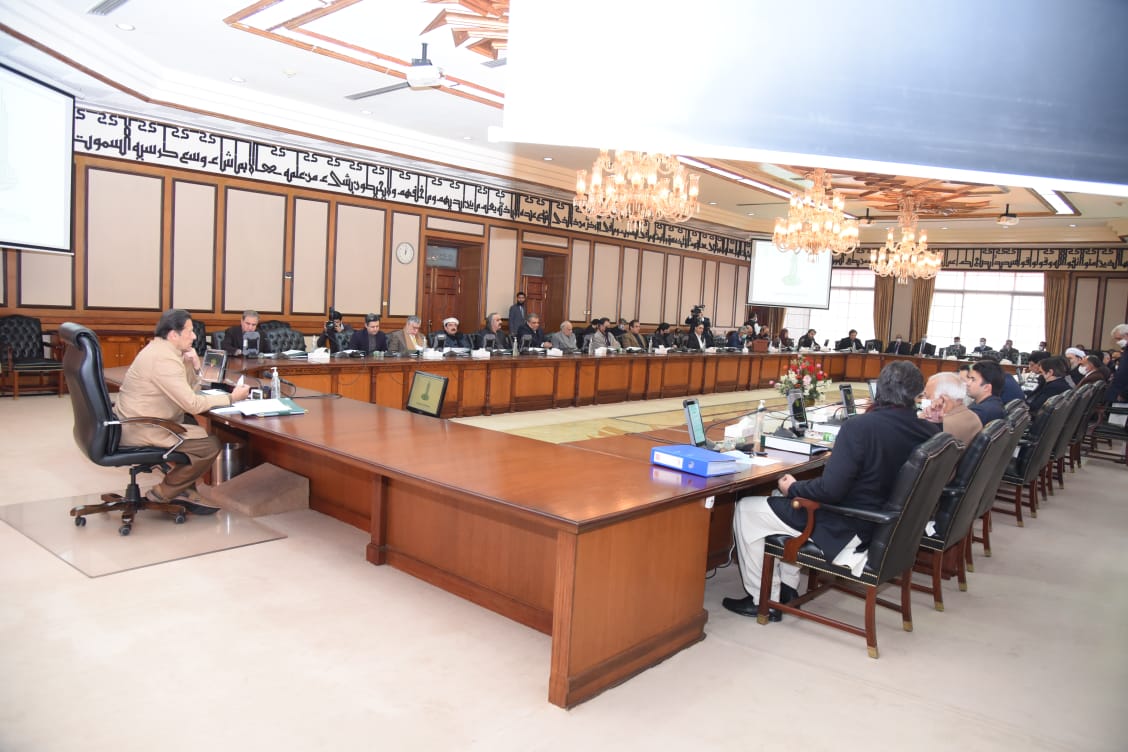


Prime Minister Imran Khan (center) chairs cabinet meeting in Islamabad, Pakistan, on December 28, 2021. (PM Office)

He thanked the civil and military leadership for all their support and input, saying the policy would not have seen the light of day without the prime minister’s constant leadership and encouragement. 
“The success of the policy will lie in its implementation for which a plan has been developed,” Yusuf said, adding a public version of the document would be released in due course.  
On Monday, PM Khan directed that the policy must guide all organs of the government to ensure their efforts were synchronized with the overall direction of the strategy.  
“The security of Pakistan rests in the security of its citizens,” he emphasized during the NSC meeting, while reposing confidence that Pakistan was well prepared to thwart any internal and external threats.  
Pakistan’s National Security Division has devised a detailed framework to review the implementation of the policy in collaboration with relevant ministries and departments. 


Pakistan, ADB sign $730 loan agreements to boost SOE reforms, energy infrastructure

Updated 25 December 2025
Follow

Pakistan, ADB sign $730 loan agreements to boost SOE reforms, energy infrastructure

  • Both sign $330 million Power Transmission Strengthening Project and $400 million SOE Transformation Program loan agreements
  • Economic Affairs Division official says Transmission Project will secure Pakistan’s energy future by strengthening national grid’s backbone

KARACHI: Pakistan and the Asian Development Bank (ADB) on Thursday signed two loan agreements totaling $730 million to boost reforms in state-owned enterprises (SOEs) and energy infrastructure in the country, the bank said.

The first of the two agreements pertains to the SOE Transformation Program worth $400 million while the second loan, worth $330 million, is for a Power Transmission Strengthening Project, the lender said. 

The agreements were signed by ADB Country Director for Pakistan Emma Fan and Pakistan’s Secretary of Economic Affairs Division Humair Karim. 

“The agreements demonstrate ADB’s enduring commitment to supporting sustainable and inclusive economic growth in Pakistan,” the ADB said. 

Pakistan’s SOEs have incurred losses worth billions of dollars over the years due to financial mismanagement and corruption. These entities, including the country’s national airline Pakistan International Airlines, which was sold to a private group this week, have relied on subsequent government bailouts over the years to operate.

The ADB approved the $400 million loan for SOE reforms on Dec. 12. It said the program seeks to improve governance and optimize the performance of Pakistan’s commercial SOEs. 

Karim highlighted that the Power Transmission Strengthening Project will enable reliable evacuation of 2,300 MW from Pakistan’s upcoming hydropower projects, relieve overloading of existing transmission lines and enhance resilience under contingency conditions, the Press Information Department (PID) said. 

“The Secretary emphasized that both initiatives are transformative in nature as the Transmission Project will secure Pakistan’s energy future by strengthening the backbone of the national grid whereas the SOE Program will enhance transparency, efficiency and sustainability of state-owned enterprises nationwide,” the PID said. 

The ADB has supported reforms by Pakistan to strengthen its public finance and social protection systems. It has also undertaken programs in the country to help with post-flood reconstruction, improve food security and social and human capital. 

To date, ADB says it has committed 764 public sector loans, grants and technical assistance totaling $43.4 billion to Pakistan.