



LONDON: For two years, the global refugee crisis has been overshadowed by the battle against COVID-19. But in 2021 there was a worrying uptick in the number of people fleeing poverty and conflict, and there is every indication that the situation will get even worse in 2022.
Anyone who followed media coverage in November of the unseemly squabbling between Britain and the EU after the tragic deaths of 27 migrants in the English Channel could be forgiven for thinking the economic and social burden of the global refugee crisis in 2021 fell mainly on northern Europe.
Nothing could be further from the truth. As the UN refugee agency, UNHCR, frequently points out, 85 percent of the world’s 20 million or more refugees are hosted either in neighboring countries or elsewhere in developing regions.
Turkey, for example, has more refugees within its borders than any other country — more than 3.5 million (or 43 for every 1,000 of its own citizens). Jordan has almost 3 million, while tiny Lebanon hosts 1.5 million — more than 13 refugees for every 100 Lebanese.
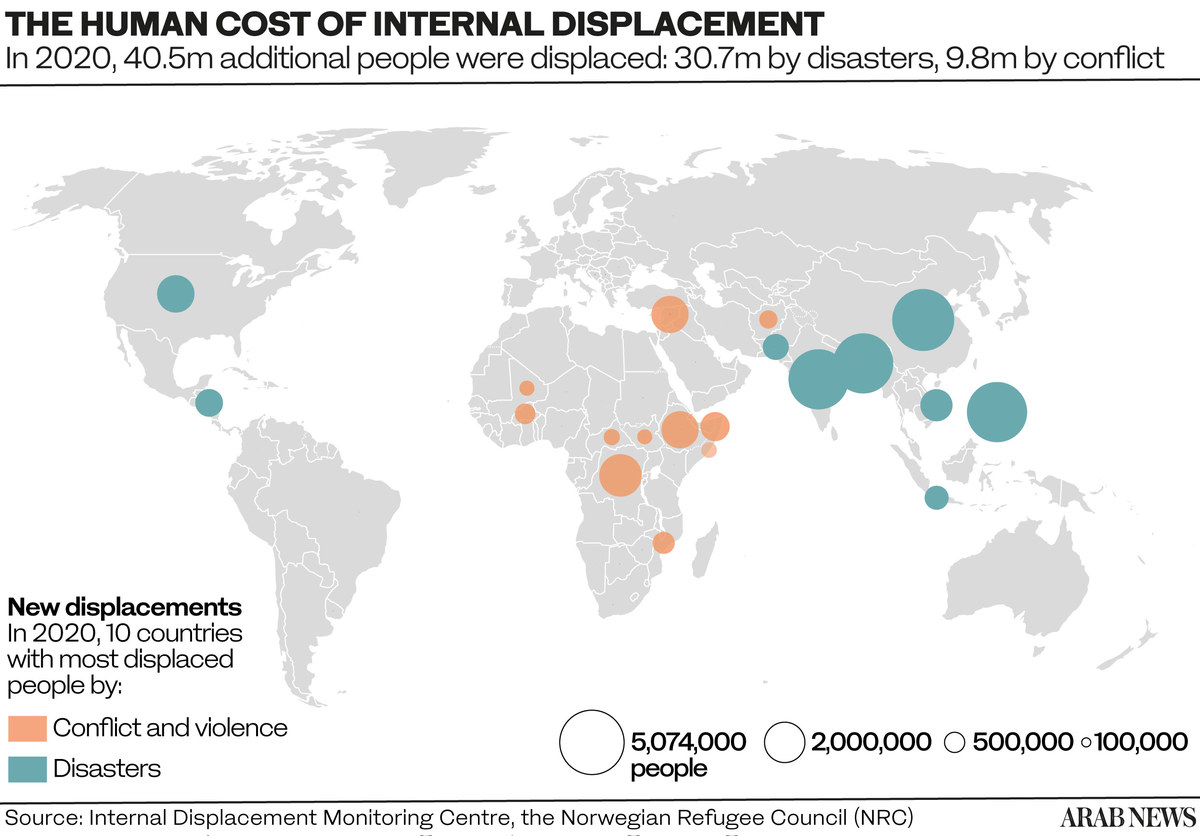
Germany, home to a million former refugees, has been the most generous of the European states. In the UK, which receives far fewer applications than either Germany or France, but where politicians whip up animosity towards migrants by suggesting, falsely, that the country is being overrun, there is only one tenth of that number.
Iranians made up the largest proportion of those claiming asylum in the UK in the year ending September 2021.
By the end of November, 23,500 migrants had successfully crossed the Channel over the course of 2021 — double the number that did so in 2020 — while France had prevented 18,000 more from attempting the crossing.
But it is clear that the treacherous Mediterranean Sea remains the focus of the great exodus of people from Africa and the Middle East in search of a better life. Figures from UNHCR show that between January and October 2021, a total of 81,647 people risked it all in a bid to set foot in Spain, Italy, Malta, Greece or Cyprus.
It goes without saying that the deaths of the 27 people, including three children, when their flimsy rubber craft foundered off the coast of France on Nov. 25, is a tragedy that has touched the hearts of many.
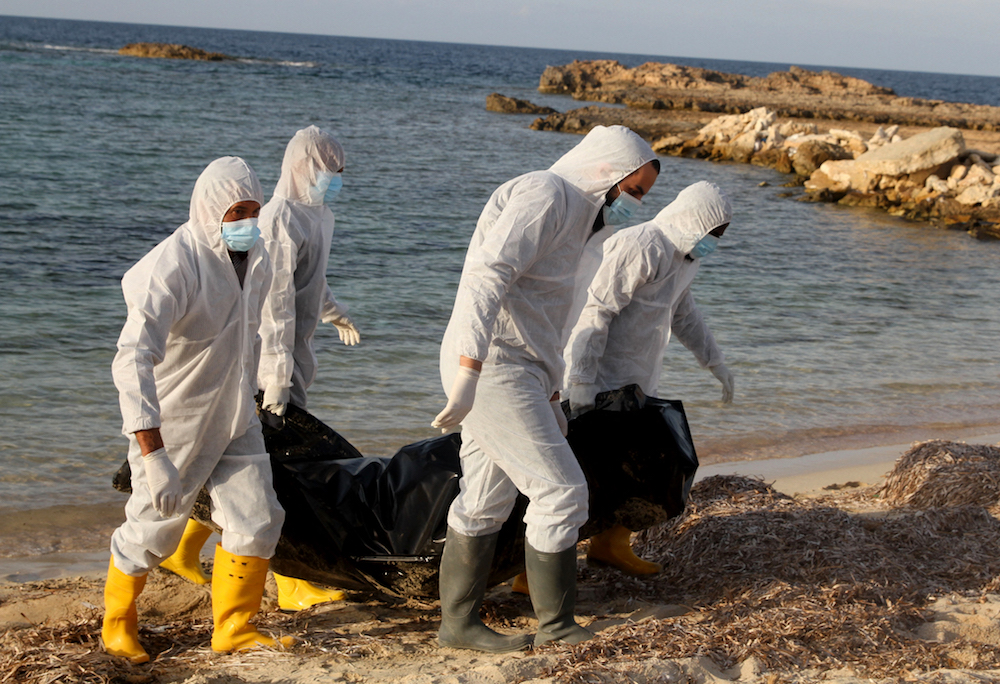
Libyan health workers recover bodies of drowned migrants, who were hoping to travel to Europe by sea, after a shipwreck off the beach in Sabratha, some 120 kilometres west of the Libyan capital Tripoli, on November 25, 2021. (AFP)
But what the coverage has largely overlooked is that during the year up to that date no fewer than 2,543 people had already drowned in the Mediterranean or the eastern Atlantic while seeking refuge in Europe.
The majority, some 1,422 individuals, perished on the infamous central Mediterranean route, bound for Italy or Malta. Overall, the Missing Migrants Project reports, deaths in the Mediterranean “drastically increased in the first nine months of 2021, compared to the same period in 2020,” a phenomenon it attributed in part to the relaxation of mobility restrictions imposed in 2020 in response to the COVID-19 pandemic.
Another 959 people lost their lives in 2021 attempting the increasingly popular, but deceptively hazardous, crossing from West Africa to the Spanish Canary Islands, 100 kilometers offshore at their closest point to Morocco or the Western Sahara.
One of the most recent lives lost on this route was that of a baby, found dead in one of five inflatable dinghies, carrying nearly 300 people from sub-Saharan Africa, that were intercepted off the islands at the beginning of December.
Yet despite such tragedies, compassion fatigue appears to have set in.
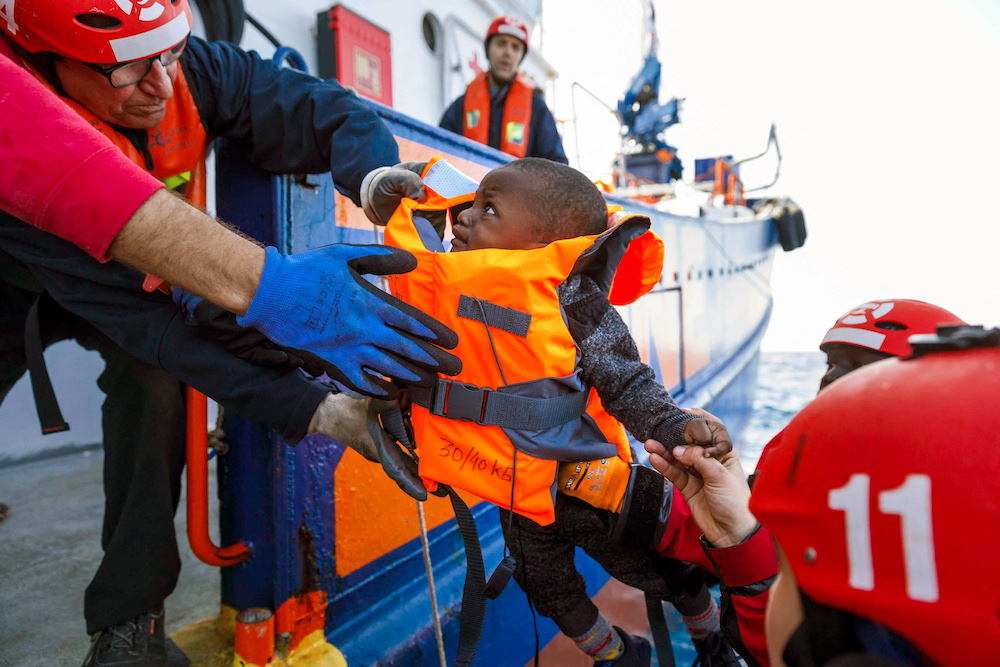
A baby is rescued by members of the Spanish NGO Maydayterraneo on board the Aita Mari rescue boat during the rescue of about 90 migrants in the Mediterranean open sea off the Libyan coast on February 9, 2020. (AFP)
Such catastrophes would once have made front-page news around the world, as in 2015 when the body of three-year-old Syrian refugee Alan Kurdi washed ashore near Bodrum in Turkey.
For a while, the uproar created by the harrowing photographs of the child’s body face-down in the surf a few hundred meters from a popular tourist spot, seemed like it might tip attitudes in favor of the world’s refugees.
Since then, however, the drownings have continued, and a world now preoccupied with the COVID-19 pandemic has largely lost interest.
In the five years that followed Kurdi’s death in 2015, no fewer than 17,000 people lost their lives attempting the sea crossing to Europe. Exactly how many of them were children is unclear. But given that one in five migrants are children, it is plausible that Kurdi has been followed to his untimely death by approximately 3,400 of his young peers.
In the flood of statistics that has been generated since the refugee crisis exploded in 2015, it is easy to lose sight of the reality of the myriad human tragedies that lie behind the numbers — the countless families and communities devastated by the loss of mothers, fathers and children. And it seems there is no end in sight.
With a total of 109,726 refugee arrivals in Europe as of the end of November, 2021 has not been a particularly bad year — certainly when compared to 2015 when over a million people sought sanctuary on the northern shores of the Mediterranean.
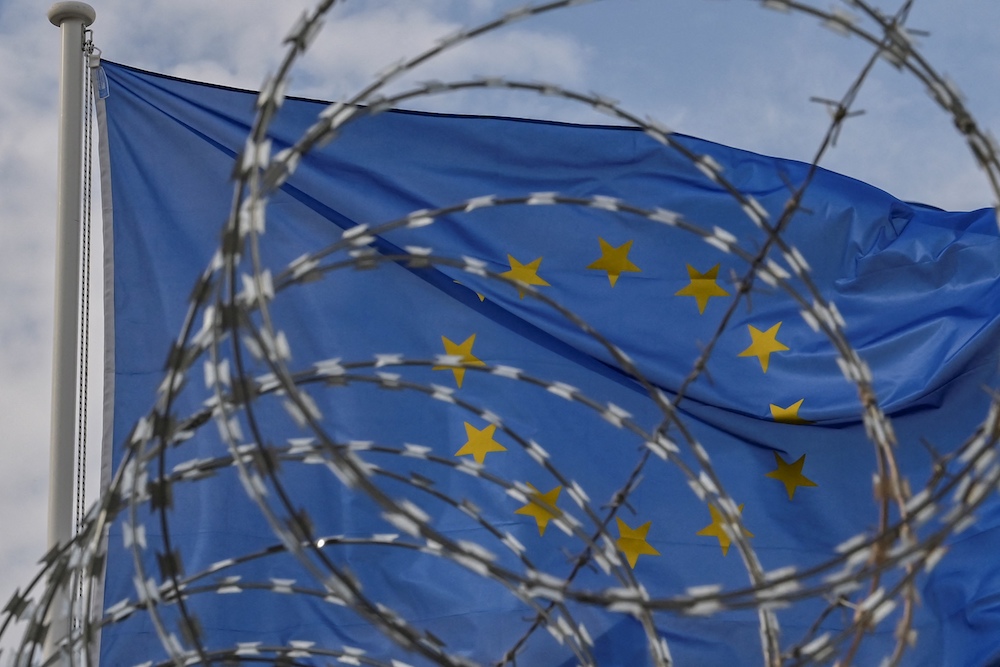
A European Union flag waves behind barbwires at the new closed center for migrants in the Greek island of Kos on November 27, 2021. (AFP)
Indeed, the numbers have declined year on year since 2015 — dramatically so in 2016, to 380,300, and again in 2017, when “only” 178,700 came to Europe. Over the next three years the numbers dropped steadily, from 141,400 in 2018 to 95,700 in 2020.
But in 2021, for the first time in five years, the downward trend began to reverse. In the 11 months to November, some 14,000 people had already come to Europe — more than in the whole of 2020.
Experts are divided on the cause of the recent flurry. Certainly, the movements of people serve as a barometer of global affairs. That the largest proportion of refugees in 2021 — some 25 percent of the total — came from Tunisia reflects that country’s ongoing socio-economic problems.
But second to Tunisia, and accounting for more than 11 percent of all refugees in 2021, was Bangladesh, which in the past year made a surprise appearance in a top 10 of source nations, a list previously dominated by countries in Africa and the Middle East.
Between January and the end of October this year, 6,455 refugees whose journey began in Bangladesh arrived in Europe. An unknown number died trying. In May 2021, 50 would-be migrants drowned when their boat sank off Tunisia. Rescuers were surprised to find that all 33 of the survivors, found clinging to an oil platform, were from Bangladesh.
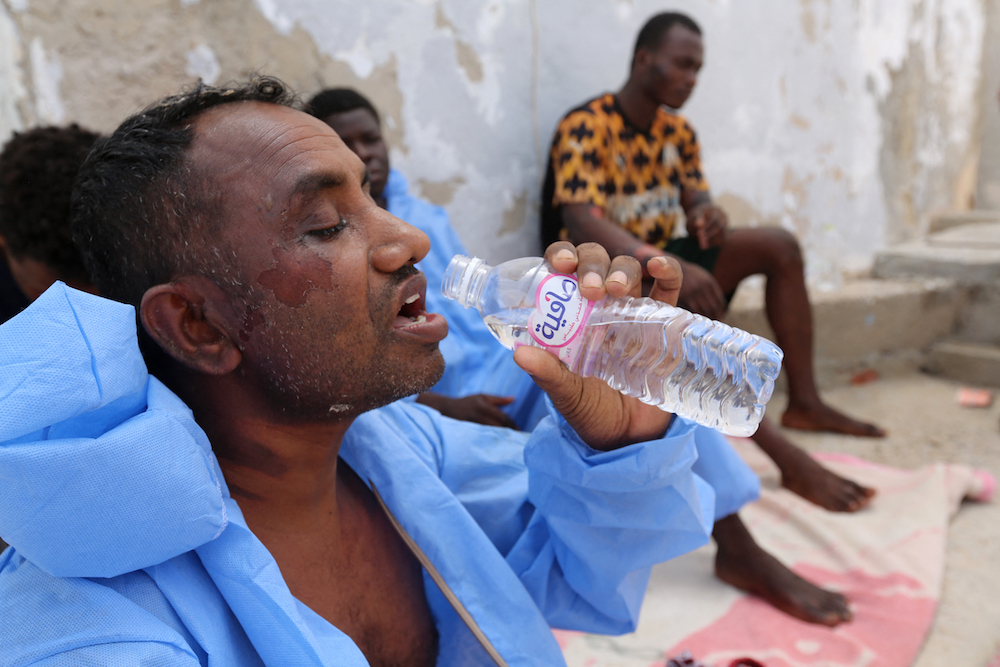
Migrants rescued by Tunisia's national guard during an attempted crossing of the Mediterranean by boat, rest at the port of El-Ketef in Ben Guerdane in southern Tunisia near the border with Libya on June 27, 2021. (AFP)
It is, however, unclear whether they were in fact Bangladeshis. One ominous explanation for the sudden appearance of Bangladesh in the statistics may be the plight of the Rohingya, the persecuted Muslim minority in predominantly Buddhist Myanmar’s Rakhine State, about a million of whom have been driven to seek sanctuary across the border in Bangladesh.
Life in the overcrowded, under-resourced Bangladeshi refugee camps is becoming intolerable, and there are fears for the wellbeing of large numbers of Rohingya who have recently been resettled on a remote island about 50 kilometers offshore in the Bay of Bengal.
As UNHCR reported in August, between January 2020 and June 2021, some 3,046 Rohingya, two thirds of whom were women and children, attempted to cross the Andaman Sea and the Bay of Bengal to seek refuge in Indonesia or Malaysia, departing either from Rakhine State or from Bangladesh. More than 200 perished in the attempt.
It remains to be seen exactly how the composition of the world’s refugee population will change in 2022. Events in Eritrea and Ethiopia will doubtless contribute to the mix in the coming year, while there is every indication that countries such as Egypt, Iran and Syria, whose citizens together accounted for more than 20 percent of Mediterranean crossings in 2021, will continue to contribute more than their fair share to the global refugee crisis.
“Despite the pandemic, wars and conflict continue to rage across the world, displacing millions and barring many from returning home,” said Gillian Triggs, UNHCR’s chief of international protection, at the launch of the Projected Global Resettlement Needs 2022 report.
“With rising humanitarian needs far outpacing solutions, we appeal to countries to make more resettlement places available for the refugees whose lives are in danger or who are otherwise at risk,” Triggs continued.
UNHCR is in the business of resettlement, persuading countries to take a share of the growing army of refugees. It is a task seemingly as hopeless as it is noble.
Last year, of the 20.7 million known refugees in the world, just 35,000 were resettled. The UN refugee agency predicts that an additional 1.47 million refugees will be in need of resettlement in 2022.


