

Italian project to host refugees to expand nationwide

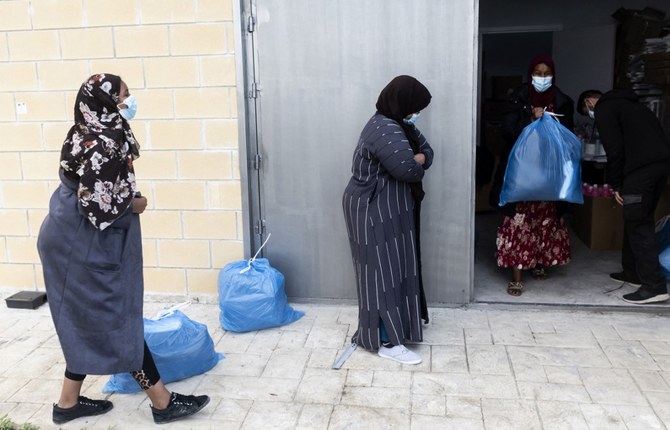
Six asylum seekers Pope Francis is helping relocate from Cyprus expressed gratitude and hope as they left to start their new lives in Italy today barely a week before Christmas. (File/AFP)
Short Url
Updated 18 December 2021
Follow

Italian project to host refugees to expand nationwide

  • Family scheme to integrate migrants has so far helped 119 people, returned positive economic impact

ROME: A project which has placed 113 refugees, mostly from Syria and the Horn of Africa, with Italian families in five cities since 2019 is to expand nationwide.

The NGO Refugees Welcome Italia said the project, called “From Experiences to Model: Family Stays as a Path of Integration,” would expand thanks to a future collaboration with ANCI, the Italian national association of municipalities,.

The project was launched in 2019 in Rome, Palermo, Bari, Ravenna and Macerata. Rome’s Tor Vergata University offered its expertise and even allowed some refugees to work there as part of the program.

Even though the family-stay model is not entirely new in Italy, the version proposed by RWI has innovative elements.

The project’s organisers explain it is built on the involvement of trained, active citizens, and structured in groups of local activists who act as a “community garrison.”

The organizers say that dialogue with local administrations has led to the creation of a “Register of Family Stays” sponsored by the municipalities of Ravenna and Bari, and also officially approved by the municipality of Rome.

The register represents “the most advanced tool in terms of policy to obtain the structured involvement of active citizens in family reception, as well as other forms of community help and support: A tool that helps to overcome fragmentation in civil society (foster care, voluntary guardians, supporting families) and creates an unequivocal administrative procedure and a shared work model,” RWI said in a press conference attended by Arab News.

In three years, 90 percent of the refugees involved have gained full financial independence. There are 754 families registered in the project’s areas ready to host refugees.

Tor Vergata University developed tools for assessing the project’s social impact. The results of the survey showed that for every euro invested in the host family project, €3.01 were generated.

“We hope that in the future the family stay experience will remain not only a good practice tested locally, but can become a policy and a governance tool at the national level,” Fabiana Musicco, director of RWI, said.

“This way we will be able to allow more refugees who come to Italy to find a better future, more chances to build a new life here.”


Russia thinks it can outsmart the US during Ukraine peace talks, a European intelligence chief says

Updated 5 sec ago
Follow

Russia thinks it can outsmart the US during Ukraine peace talks, a European intelligence chief says

LONDON: Russian officials have no desire to halt Russia’s almost 4-year-old invasion of neighboring Ukraine and think they can “outsmart” the United States during talks with Washington about how to end the war, a senior European intelligence official told The Associated Press.
Kaupo Rosin, the head of Estonia’s foreign intelligence service, said Moscow is playing for time in the talks with Washington and “there is absolutely no discussion about how to really cooperate with the US in a meaningful way.”
Rosin, who spoke at an online briefing with reporters ahead of the publication of Estonia’s annual security report on Tuesday, said the findings were based on intelligence his country gathered from “Russian internal discussions.” He did not elaborate on how the information was obtained.
Russian officials have publicly insisted they want a negotiated deal, but they show little willingness to compromise and remain adamant their demands must be met.
US-brokered talks between envoys from Russia and Ukraine in recent weeks have been described by officials from both sides as constructive and positive, but there has been no sign of any progress on key issues in the discussions.
Russian President Vladimir Putin, “in his head, still thinks that he can actually militarily win (in Ukraine) at some point,” Rosin said.
A White House official responded to the Estonian intelligence chief’s comments and said the president’s negotiators had made “tremendous progress” on the talks to end the war in Ukraine. Although prisoner exchanges have happened sporadically since May, they pointed in particular to a recent agreement in Abu Dhabi among the US, Ukraine and Russia to release more than 300 prisoners.
That agreement was evidence that efforts to end the war are advancing, said the official, who was granted anonymity because they did not have permission to speak publicly.
In an indication that US President Donald Trump wants to accelerate the momentum of peace efforts, Ukrainian President Volodymyr Zelensky said last week that Washington has given Ukraine and Russia a June deadline to reach a settlement. Trump over the past year has set several deadlines that have come and gone without apparent consequences.
Fiona Hill, a Russia expert and adviser to Trump in his first term, said Trump and his officials are spinning a story that depicts the US president as a peacemaker and, for that reason, they are not interested in changing their assessment that Putin wants to end the war.
Both leaders, she told the AP, “need their version of events to play out” and are hanging on to their version of the truth — Putin as the victor in Ukraine and Trump as the dealmaker.
It’s unclear why US officials believe Putin wants peace
Although Trump has repeatedly suggested that Putin wants peace, he has sometimes appeared frustrated with the Russian leader’s lukewarm approach to talks.
From an intelligence perspective, Rosin said he doesn’t know why US officials believe the Russian leader wants to end the war.
Hill, who served as a national intelligence officer under previous US administrations, said it’s unclear what intelligence information Trump gets on Russia — or if he reads it.
He relies heavily on his lead negotiators, special envoy Steve Witkoff and son-in-law Jared Kushner, who Hill said may struggle to believe that the damage to the Russian economy caused by the war is a price Putin is willing to pay for Ukraine.
Referring to reports that Witkoff has attended meetings with Putin without a US State Department translator, she questioned if Trump’s envoys understood what was being said in meetings and suggested officials may be “selectively” looking for what they want to hear.
Being told what they want to hear
Putin is fixated on controlling all of Ukraine and the idea “is so deep in his head” that it takes priority over anything else, including economics, Rosin said, suggesting that the conflict will continue in some form for several years.
He said Putin’s position may change only if the situation in Russia, or on the front line, becomes “catastrophic,” threatening his power. For now, the Russian leader still believes he can take Ukraine and “outsmart everybody,” Rosin said.
One reason Putin thinks he can win militarily in Ukraine is because he is “definitely” getting some incorrect information from his officials, the Estonian intelligence chief said.
Not all Russian officials, however, believe they are winning the war in Ukraine, Rosin said.
“The lower you go in the food chain,” the more people understand “how bad it is actually on the ground,” he said, whereas higher up, officials are more optimistic because they are given more positive reports. Rosin cited examples of officials being told Russian forces had captured Ukrainian settlements when that was not true.
The reports that arrive at Putin’s desk may be “much more optimistic” than the situation on the ground because Putin only wants to see success, Rosin said.
Hill said both Trump and Putin are probably being told what they want to hear by people who want to please them.