



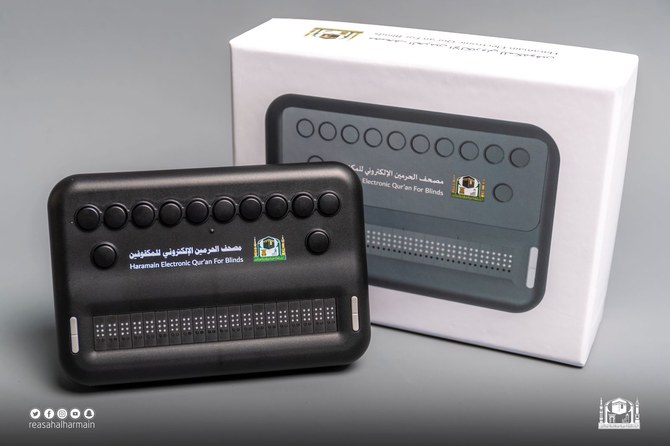

JEDDAH: An electronic Qur’an is being introduced at Makkah’s Grand Mosque to help blind and visually impaired Muslims.
Advanced braille-based technology is being used to create the Haramain electronic Qur’an, allowing blind and visually impaired visitors and pilgrims to read and access the verses of Islam’s holy book more easily.
Ghazi Al-Thubyani, from the General Presidency for the Affairs of the Two Holy Mosques, said special shelves were being prepared for the 100 electronic braille devices that had been designed for the visually impaired.
The device, which is nearly six inches long and four inches wide, means users can move smoothly between pages using high-quality braille cells.
“Each cell can accommodate six dotted points, as well as 10 digital keys that allow the users to enter the page number for swift navigation, as well as rotation buttons. They can also scroll the lines on each side of the texts in braille,” Al-Thubyani told Arab News. “This service will be provided very soon. We are nearly finished with preparing shelves for these devices to be at the reach of the sightless worshippers who visit the holy mosque.”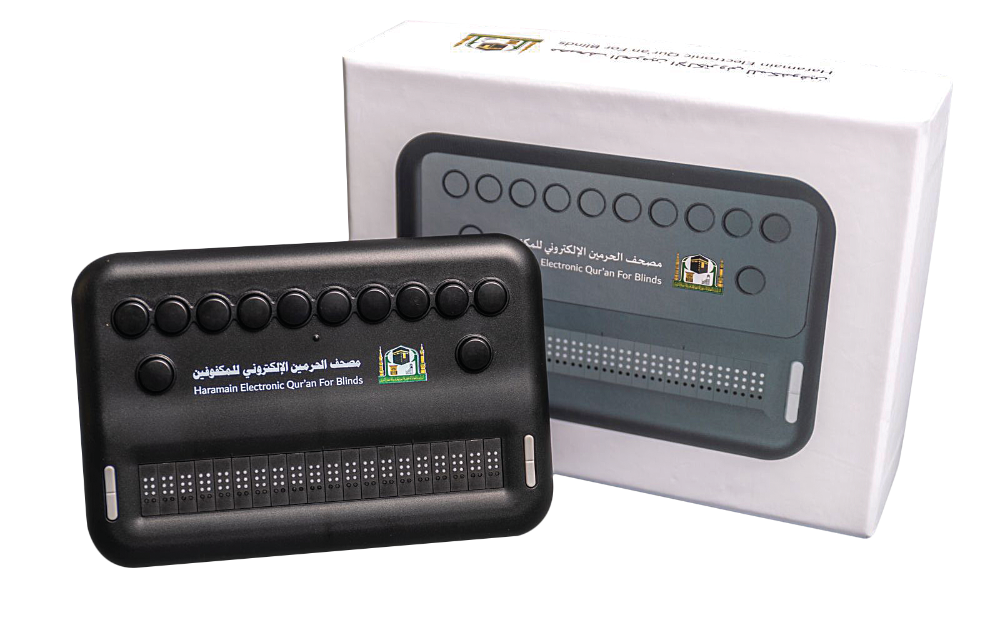
He added that the Grand Mosque offered paper copies of the Qur’an in Braille in addition to the new devices. “Each mus’haf (Qur’an copy) consists of six volumes. We also have booklets in braille tailored for blind children to help them learn about monotheism and the basics of Islam.”
HIGHLIGHTS
• As part of its plans to digitalize the services provided, the presidency has been making every effort to facilitate people’s experience when visiting the Two Holy Mosques.
• Misha’al Al-Harasani, who led the team that created the new device, previously described his invention as an electronic board with 28 characters.
Blind and visually impaired Muslims experience challenges when reading Qur’an copies available in braille. They need to have up to six paper volumes to read the sacred 600-page book. As part of its plans to digitalize the services provided, the presidency has been making every effort to facilitate people’s experience when visiting the Two Holy Mosques.
Al-Thubyani said that the project’s first phase, which took nearly 10 months, focused on the Qur’an. There will be another phase in which the elucidations and explanations of the Holy Qur’an will be added using the same technology.
The presidency was keen to utilize technology in all its services at the Two Holy Mosques and that their plans complied with the Kingdom’s Vision 2030, he added.
The visually impaired can read the Qur’an easily and navigate through the pages the same way as the entire Qur’an is registered on the board.
Misha’al Al-Harasani
The project began when a meeting at the presidency concluded that the help of inventors should be sought to come up with a device that could spare the exertions and time of the blind and visually impaired when they were reading paper copies of the Qur’an in braille.
Misha’al Al-Harasani, who led the team that created the new device, previously described his invention as an electronic board with 28 characters. Each character had six braille letters, and the board page contained 28 rows.
“The visually impaired can read the Qur’an easily and navigate through the pages the same way as the entire Qur’an is registered on the board,” Al-Harasani told Arab News in an earlier interview.
He explained how the digital mus’haf would ease the process of reading the Qur’an for the visually impaired, compared with the regular version of the Qur’an in braille.
“The visually impaired read the Qur’an in braille in six large volumes that make it difficult for them to reach the page, passage, or surah. Carrying them and storing them is difficult, too, because of the size.”
He was inspired to create the digital mus’haf when he visited the King Fahd Complex for the Printing of the Holy Qur’an in Madinah to participate in a Qur’an teaching seminar for those with special needs.
“With the help of my team, I researched on the reading of the Qur’an for those with special needs, especially for the visually impaired. And from there, the idea of creating a digital mus’haf for the visually impaired came to be.”
Al-Harasani, whose previous inventions for the visually impaired include a mobile phone, a currency, and a plane passenger seat, said that part of the team he was working with were visually impaired individuals.


