

GCC-UK FMs: Strategic partnership essential to promoting Middle East security and stability

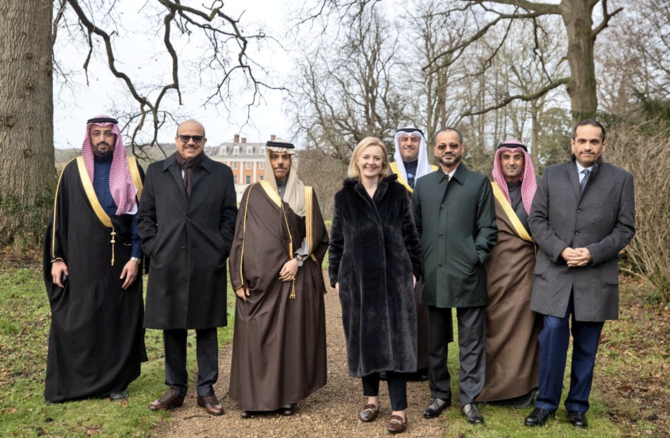
Britain’s Foreign Secretary Liz Truss poses with foreign ministers of the GCC and its Secretary General at Chevening, England. (@trussliz)
Short Url
Updated 21 December 2021
Follow

GCC-UK FMs: Strategic partnership essential to promoting Middle East security and stability

  • UK and GCC already cooperate closely in a wide range of areas including foreign policy, trade, and development
  • Foreign ministers urged Iran to seize the current diplomatic opportunity to restore the JCPOA now

LONDON: Foreign Ministers from the Gulf Cooperation Council and the UK said that the strategic UK-GCC relationship is essential in promoting peace, security, stability, and economic growth in the Middle East region and beyond.

Britain’s Foreign Secretary Liz Truss met foreign ministers of the GCC and its Secretary General at Chevening, England on Monday.

During the meeting, the foreign ministers agreed the UK-GCC relationship will be strengthened across all fields and that they were committed to developing the partnership in emerging areas such as clean technology, digital infrastructure, and cyber.

The UK and the GCC already cooperate closely in a wide range of areas including political dialogue, security, foreign policy, trade and investment, and development.

The reenergised UK-GCC partnership will help keep UK and GCC citizens safe, and generate business opportunities and jobs, the UK’s Foreign, Commonwealth and Development Office said.

The UK and GCC member states emphasised the importance of enhancing people-to-people links, which are an essential element in promoting understanding between their peoples, and a key driver of innovation, business opportunities, and cultural and educational exchange.

The UK and GCC member states underlined their commitment to work together to identify bilateral opportunities for joint investment in infrastructure and clean technology in the developing world.

As a first step, they committed to develop mechanisms for strong partnerships on these issues and work together to develop a pipeline of potential joint investment projects.

The foreign ministers welcomed the ambitious five-year strategy and enlarged remit of British Investment International (BII), the UK’s development finance institution.

BII will play a central role in the UK government’s offer to help developing and emerging countries meet their significant financing needs for infrastructure and enterprise.

The foreign ministers also discussed the resumption of Joint Comprehensive Plan of Action talks in Vienna, and underlined that this is the last opportunity to restore the JCPOA as Iran’s continued nuclear escalation is permanently eroding the benefits of the deal and undermining regional and international security.

They urged Iran to seize the current diplomatic opportunity to restore the JCPOA now to avoid bringing the region and international community to a crisis point.

Foreign Ministers also noted that a restored JCPOA is the best avenue towards inclusive, and more lasting diplomatic efforts to ensure regional security in a Gulf region permanently free of nuclear weapons.


UN rights chief Shocked by ‘unbearable’ Darfur atrocities

Updated 18 January 2026
Follow

UN rights chief Shocked by ‘unbearable’ Darfur atrocities

  • Mediation efforts have failed to produce a ceasefire, even after international outrage intensified last year with reports of mass killings, rape, and abductions during the RSF’s takeover of El-Fasher in Darfur

PORT SUDAN: Nearly three years of war have put the Sudanese people through “hell,” the UN’s rights chief said on Sunday, blasting the vast sums spent on advanced weaponry at the expense of humanitarian aid and the recruitment of child soldiers.
Since April 2023, Sudan has been gripped by a conflict between the army and the paramilitary Rapid Support Forces that has left tens of thousands of people dead and around 11 million displaced.
Speaking in Port Sudan during his first wartime visit, UN Human Rights commissioner Volker Turk said the population had endured “horror and hell,” calling it “despicable” that funds that “should be used to alleviate the suffering of the population” are instead spent on advanced weapons, particularly drones.
More than 21 million people are facing acute food insecurity, and two-thirds of Sudan’s population is in urgent need of humanitarian aid, according to the UN.
In addition to the world’s largest hunger and displacement crisis, Sudan is also facing “the increasing militarization of society by all parties to the conflict, including through the arming of civilians and recruitment and use of children,” Turk added.
He said he had heard testimony of “unbearable” atrocities from survivors of attacks in Darfur, and warned of similar crimes unfolding in the Kordofan region — the current epicenter of the fighting.
Testimony of these atrocities must be heard by “the commanders of this conflict and those who are arming, funding and profiting from this war,” he said.
Mediation efforts have failed to produce a ceasefire, even after international outrage intensified last year with reports of mass killings, rape, and abductions during the RSF’s takeover of El-Fasher in Darfur.
“We must ensure that the perpetrators of these horrific violations face justice regardless of the affiliation,” Turk said on Sunday, adding that repeated attacks on civilian infrastructure could constitute “war crimes.”
He called on both sides to “cease intolerable attacks against civilian objects that are indispensable to the civilian population, including markets, health facilities, schools and shelters.”
Turk again warned on Sunday that crimes similar to those seen in El-Fasher could recur in volatile Kordofan, where the RSF has advanced, besieging and attacking several key cities.
Hundreds of thousands face starvation across the region, where more than 65,000 people have been displaced since October, according to the latest UN figures.