

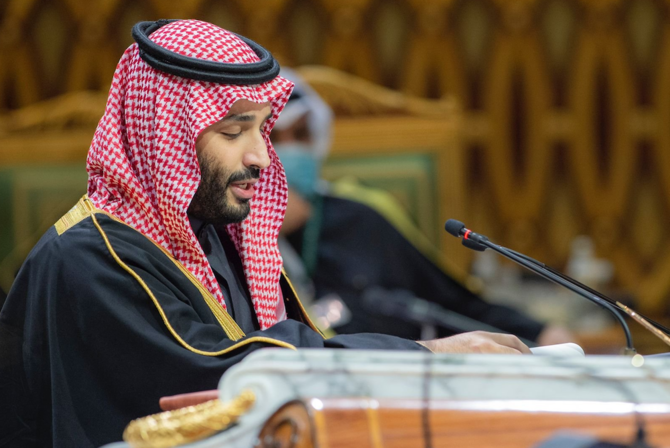

RIYADH: Gulf state leaders called on Tuesday for greater regional economic and defense integration as the annual GCC summit in Riyadh came to a close.
Saudi Crown Prince Mohammed bin Salman, who chaired the meeting, stressed the importance of Gulf unity in the face of security challenges. “We continue to make all efforts to enhance security in the region,” he said.
“We laud the commitment and solidarity that led to the success of the outputs of the AlUla declaration. We look forward to building a prosperous economy that depends on diversifying sources of income and keeping pace with developments in all fields.”
The GCC had achieved a great deal since it was established in 1981, the crown prince said. “We look forward to achieving more.”
Regional security was a key item on the summit agenda, including Iran’s nuclear ambitions, and challenges in Iraq, Yemen, Lebanon, Palestine, Sudan, and Libya. “Saudi Arabia stresses the importance of dealing seriously with the Iranian nuclear issue. We stress the importance of Iraq’s stability, and the importance of reaching a political solution in Yemen,” the crown prince said.
After the meeting, Saudi Foreign Minister Prince Faisal bin Farhan said the Kingdom was closely following the progress of talks in Vienna on Iran’s nuclear program. “Iran's tough stance in Vienna is worrying,” he said. “The Gulf states face the biggest threat from Iran’s nuclear program. We want a long and comprehensive nuclear deal with Iran. We want to have a normal relationship with Iran, and that depends on them.”
In a final communique, GCC Secretary-General Dr. Nayef Al-Hajraf called for teamwork to face regional challenges, and stressed the importance of strengthening the role of women and young people.
“The leaders agreed on principles and policies to develop strategic cooperation and economic and development integration among the GCC states,” Al-Hajraf said.
The communique emphasized the issue of joint defense, pointing out that for GCC member states, “any attack on any of them is an attack on all, and any danger that threatens one of them is a threat to all.”
Leaders discussed the implementation of King Salman’s vision for Gulf integration. “The leaders emphasized the importance of accurate, complete and continuous implementation of King Salman’s vision, completing the elements of economic unity and joint defense and security systems, coordinating their positions in a way that enhances the solidarity and stability of the GCC states, preserves their interests, and avoids regional and international conflicts,” Al-Hajraf said.
The communique emphasized the issue of joint defense, pointing out that for GCC member states, “any attack on any of them is an attack on all, and any danger that threatens one of them is a threat to all.”
The leaders also stressed the importance of coordinating and integrating the foreign policies of member states “to crystallize a unified and effective foreign policy that serves the aspirations of the people of the Gulf states and preserves their interests and gains.”
Al-Hajraf said the leaders also confirmed the importance of coordinating plans to achieve sustainability, deal with climate change and its effects, and applying the circular carbon economy approach launched by the Kingdom during its presidency of the G20.
“The leaders stressed the importance of following up on the achievement of the economic vision of the GCC to achieve economic diversification and benefit from economic potential,” he said.
They also stressed the need to curb Hezbollah’s terrorist activities, and urged Lebanon to implement political reforms and extend its sovereignty over its institutions.
Visiting national delegations at the summit were led by King Hamad of Bahrain, Qatar’s Emir Sheikh Tamim Al-Thani, Sheikh Fahd Al-Said of Oman, Kuwait’s Crown Prince Sheikh Mishal Al-Jaber Al-Sabah, and UAE Prime Minister Sheikh Mohammed bin Rashid Al-Maktoum.


