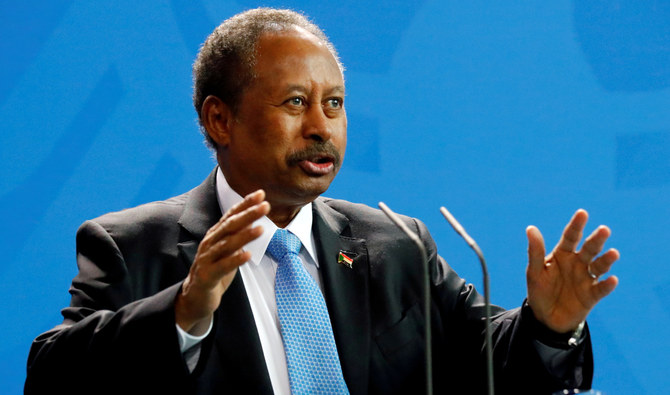
The UN “cautiously” welcomed the agreement reached on Nov. 21 in Sudan between Prime Minister Abdalla Hamdok and the leaders of October’s military coup.
During a meeting on Friday to discuss the latest UN report on the situation in the country, Volker Perthes, the UN’s special representative for Sudan, told the Security Council that the agreement is “far from perfect” but could help to avoid further bloodshed and provide a first step toward comprehensive dialogue and a return to constitutional order.
But he pointed out that there is strong opposition to the deal from a large segment of Sudanese stakeholders, including parties and associations within the Forces of Freedom and Change coalition, resistance committees, civil society organizations and women’s groups, who feel “betrayed” by the coup.
“Forthcoming decisions on government formation, high-level appointments and the establishment of transitional institutions will test the will and ability of the stakeholders to seek a common way out of the crisis,” said Perthes.
The military takeover on Oct. 25, during which Hamdok and other senior officials and activists were arrested, sparked protests across the country in what Perthes described as “the greatest crisis to date” faced by the political transition in the country.
The coup “exposed and deepened the mistrust between the military and civilian components, and within the civilian components” themselves, he told the members of the Security Council.
According to the UN, at least 44 people were killed and hundreds injured when Sudanese security forces used lethal force to crack down on peaceful protesters.
Perthes said this has caused the crisis to escalate as protesters continue to organize mass demonstrations in an effort “to reclaim the revolution and push for civilian rule.”
He once again urged military leaders to reverse all unilateral decisions they have made in the wake of the coup, including the appointment of civilian members to the Sovereignty Council.
Referring to the ongoing state of emergency declared on the day of the coup by its leader, Gen. Abdel Fattah Al-Burhan, Perthes warned that “a lack of inclusivity and consensus could cause further fragmentation.
Referring to Nov. 21 agreement, which stipulates the formation of technocratic cabinet, Perthes warned that such a move, while potentially a step toward advancing the political transition, could also create “a constitutional challenge if not based on consultations with the Forces for Freedom and Change.”
He said: “Sudan’s military and political leaders will primarily have to rebuild trust with their own domestic public, particularly with the young generation,” and added that Sudanese authorities also need to work on regaining financial, economic and political support from the international community.
For this to happen, the envoy reiterated the need to release all political detainees, halt arbitrary arrests, guarantee the right to peaceful protest, and bring to justice those guilty of using violence against protesters.
Other key steps toward rebuilding trust among the international community include allowing the prime minister to freely form his own technocratic cabinet, lifting the state of emergency and restoring freedom of the press.
However, Perthes called on the international community to adopt a balanced approach to Sudan and not block aid to the country for too long.
“In the aftermath of the coup, the decision by donors to pause international development assistance is having a significant impact on the livelihoods of the Sudanese people, and risks rolling back the hard-won achievements of the past two years,” he said.
In addition, he urged Sudanese authorities to guarantee meaningful participation by women in the political process. The message from women in the country is clear, he said: “There can be no going back on the hard-earned gains on women’s rights, and they are asking for the international community’s support in this regard.


UN ‘cautiously welcomes’ Sudan accord amid post-coup erosion of trust
https://arab.news/6yfsn
UN ‘cautiously welcomes’ Sudan accord amid post-coup erosion of trust

- While acknowledging the Nov. 21 agreement is ‘far from perfect’ envoy Volker Perthes said it could prevent bloodshed and be a step toward a return to order
- He added that there is strong opposition to the deal among a large section of people in the country who feel ‘betrayed’ by the coup


Israeli military says unintentionally struck UN agency truck in Gaza
- “Our teams are taking extraordinary risks every day to keep humanitarian operations and life-sustaining services running,” UNOPS Executive Director Jorge Moreira da Silva said in a statement, calling for an investigation into the incident
TEL AVIV: Israel’s military said on Friday that a “firing component” launched by its navy unintentionally struck a fuel truck belonging to a United Nations agency in Gaza the previous day, an incident that prompted the agency to publicly call for a full investigation.
The United Nations Office for Project Services, which oversees fuel distribution in Gaza, said that the empty fuel truck was struck on Thursday around 5 a.m. from the direction of the sea, causing damage to the vehicle. There were no injuries.
“Our teams are taking extraordinary risks every day to keep humanitarian operations and life-sustaining services running,” UNOPS Executive Director Jorge Moreira da Silva said in a statement, calling for an investigation into the incident.
“They should not have to do that under fire,” he said.
In response to Reuters questions, the Israeli military said that the incident occurred during defensive naval activity, and that a firing component deviated from its intended trajectory.
The fuel truck sustained “minor damage,” the military said in a statement. The military did not say what type of munitions had been fired, or what had been the navy’s intended target.
“The incident was reviewed, and lessons were learned accordingly,” it said, without providing further details.
The fuel truck had been on its way to the Kerem Shalom crossing when it was struck, and the truck’s movements had been coordinated with Israeli authorities in advance, UNOPS said.


