

Sudan youth radio gagged for six weeks after coup

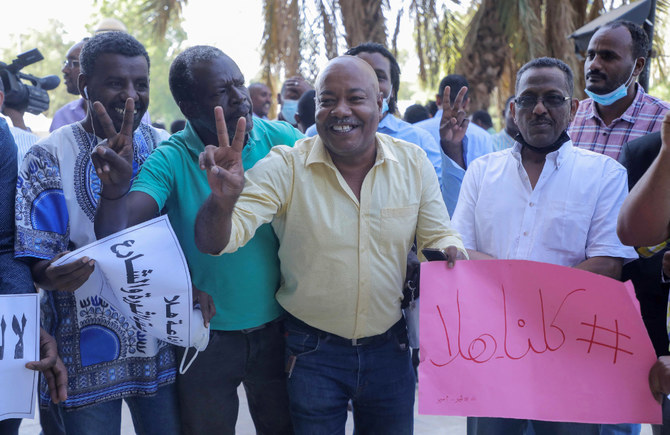
Sudanese journalists rally in front of Hala 96 radio station’s headquarters in Khartoum on Friday to protest its closure following a coup in October. (AFP)
Short Url
Updated 11 December 2021
Follow

Sudan youth radio gagged for six weeks after coup

  • Dozens of journalists protest in front of channel’s headquarters carrying banners with the words ‘Free Hala 96’

KHARTOUM: A lively youth-run radio station, Sudan’s 96.0 FM was muzzled for 46 days after authorities banished the channel from the airwaves following an Oct. 25 military coup.

“I felt like a person who had the ability to speak and suddenly stopped ... It’s a painful feeling,” Khaled Yehia, production manager of “Hala 96,” told AFP from the station’s headquarters overlooking the Nile in Khartoum.
Sudan, with a long history of military coups, has undergone a fragile journey toward civilian rule since the 2019 ousting of former President Omar Bashir following mass street protests.
A joint military-civilian transitional government took over, but the troubled alliance was shattered on Oct. 25 when Gen. Abdel Fattah Al-Burhan launched a military coup that sparked international condemnation, mass protests and deadly crackdowns.
Despite the release of Prime Minister Abdalla Hamdok from effective house arrest, several radio broadcasts were silenced.
The Information Ministry refused to renew the license of Monte Carlo radio’s Arabic service, which broadcasts from Paris, while the BBC’s Arabic service was banned.

I felt like a person who had the ability to speak and suddenly stopped ... It’s a painful feeling.

Khaled Yehia, Production manager of Hala 96

“All of the other radio channels were back on air two weeks after the coup except for Hala 96, BBC and Monte Carlo (RMC),” said Abiy Abdel Halim, Hala’s programming manager.
“When we asked the authorities for the reason, we were referred to a military official who said there were orders from above regarding the editorial line of the station,” he added.
Hala 96 was finally allowed to go back on the air on Thursday.
Founded in 2014 under the heavy-handed rule of Bashir, Hala Radio hit the airwaves with daily programs alternating between politics, culture and sports.
“We started playing patriotic songs that would mobilize crowds,” when the demonstrations against Bashir in December 2018 began, Abdel Halim said.
“And we weren’t even stopped back then save for one time and only for 24 hours.”
Boasting a staff of 35 on-air presenters, journalists, technicians and administrators all under 40, they mirror the demographics of Sudan.
Youth represent about 68 percent of the country’s 48 million-strong population.
On Wednesday, dozens of journalists protested in front of the radio channel’s headquarters carrying banners with the words “Free Hala 96.”
Throughout Bashir’s dictatorial reign, Sudan ranked 174 out of 180 countries on Reporters Without Borders’ Press Freedom Index. Following his ousting, it marginally improved to 159.
“What with propaganda, the internet being disconnected and the crackdown on journalists, this military coup has jeopardized the fragile gains from the revolution,” the Paris-based press freedom group said last month.
It described Sudan as a “very hostile environment” for media to operate.
Last week in a report submitted to the Security Council, UN Secretary-General Antonio Guterres urged Sudanese authorities to “respect freedom of speech and of the press.”


Syria moves military reinforcements east of Aleppo after telling Kurds to withdraw

Updated 43 min 52 sec ago
Follow

Syria moves military reinforcements east of Aleppo after telling Kurds to withdraw

  • The United States, which for years has supported Kurdish fighters but also backs Syria’s new authorities, urged all parties to “avoid actions that could further escalate tensions” in a statement by the US military’s Central Command chief

ALEPPO: Syria’s army was moving reinforcements east of Aleppo city on Wednesday, a day after it told Kurdish forces to withdraw from the area following deadly clashes last week.
The deployment comes as Syria’s Islamist-led government seeks to extend its authority across the country, but progress has stalled on integrating the Kurds’ de facto autonomous administration and forces into the central government under a deal reached in March.
The United States, which for years has supported Kurdish fighters but also backs Syria’s new authorities, urged all parties to “avoid actions that could further escalate tensions” in a statement by the US military’s Central Command chief Admiral Brad Cooper.
On Tuesday, Syrian state television published an army statement with a map declaring a large area east of Aleppo city a “closed military zone” and said “all armed groups in this area must withdraw to east of the Euphrates” River.
The area, controlled by Kurdish forces, extends from near Deir Hafer, around 50 kilometers (30 miles) from Aleppo, to the Euphrates about 30 kilometers further east, as well as toward the south.
State news agency SANA published images on Wednesday showing military reinforcements en route from the coastal province of Latakia, while a military source on the ground, requesting anonymity, said reinforcements were arriving from both Latakia and the Damascus region.
Both sides reported limited skirmishes overnight.
An AFP correspondent on the outskirts of Deir Hafer reported hearing intermittent artillery shelling on Wednesday, which the military source said was due to government targeting of positions belonging to the US-backed, Kurdish-led Syrian Democratic Forces.

Declaration of war’

The SDF controls swathes of the country’s oil-rich north and northeast, much of which it captured during Syria’s civil war and the fight against the Daesh group.
On Monday, Syria accused the SDF of sending reinforcements to Deir Hafer and said it would send its own personnel there in response.
Kurdish forces on Tuesday denied any build-up of their personnel and accused the government of attacking the town, while state television said SDF sniper fire there killed one person.
Cooper urged “a durable diplomatic resolution through dialogue.”
Elham Ahmad, a senior official in the Kurdish administration, said that government forces were “preparing themselves for another attack.”
“The real intention is a full-scale attack” against Kurdish-held areas, she told an online press conference, accusing the government of having made a “declaration of war” and breaking the March agreement on integrating Kurdish forces.
Syria’s government took full control of Aleppo city over the weekend after capturing its Kurdish-majority Sheikh Maqsud and Ashrafiyeh neighborhoods and evacuating fighters there to Kurdish-controlled areas in the northeast.
Both sides traded blame over who started the violence last week that killed dozens of people and displaced tens of thousands.

PKK, Turkiye

On Tuesday in Qamishli, the main Kurdish city in the country’s northeast, thousands of people demonstrated against the Aleppo violence, with some burning pictures of Syrian President Ahmed Al-Sharaa, an AFP correspondent said, while shops were shut in a general strike.
Some protesters carried Kurdish flags and banners in support of the SDF.
“Leave, Jolani!” they shouted, referring to President Sharaa by his former nom de guerre, Abu Mohammed Al-Jolani.
“This government has not honored its commitments toward any Syrians,” said cafe owner Joudi Ali.
Other protesters burned portraits of Turkish Foreign Minister Hakan Fidan, whose country has lauded the Syrian government’s Aleppo operation “against terrorist organizations.”
Turkiye has long been hostile to the SDF, seeing it as an extension of the Kurdistan Workers’ Party (PKK) and a major threat along its southern border.
Last year, the PKK announced an end to its long-running armed struggle against the Turkish state and began destroying its weapons, but Ankara has insisted that the move include armed Kurdish groups in Syria.
On Tuesday, the PKK called the “attack on the Kurdish neighborhoods in Aleppo” an attempt to sabotage peace efforts between it and Ankara.
A day earlier, Ankara’s ruling party levelled the same accusation against Kurdish fighters.
The Britain-based Syrian Observatory for Human Rights reported 45 civilians and 60 soldiers and fighters from both sides killed in the Aleppo violence.
Aleppo civil defense official Faysal Mohammad said Tuesday that 50 bodies had been recovered from the Kurdish-majority neighborhoods after the fighting.