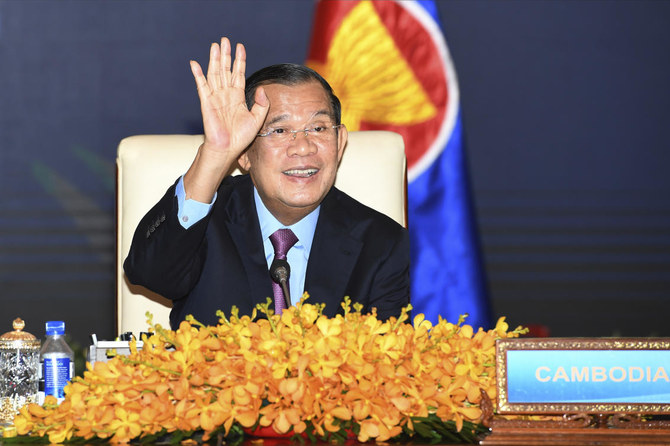
PHNOM PENH: Cambodian leader Hun Sen ordered the country’s military to destroy any US weaponry or dump it in warehouses on Friday, after Washington imposed an arms embargo over human rights concerns and Phnom Penh’s close ties with China.
The US on Wednesday imposed an arms embargo on Cambodia, citing concerns about human rights and corruption in the southeast Asian nation as well as China’s activities there.
The actions taken by the US State and Commerce departments aimed to restrict access to “defense articles and defense services” by Cambodia’s military and intelligence agencies, according to a statement.
But Cambodian Prime Minister Hun Sen downplayed the quality of US weapons and equipment on Friday.
“I order all army units to immediately review arms and military items that Cambodia currently has. (We) must recall all US arms and military items if there are any — put them in warehouses or destroy them accordingly,” he said in a Facebook post.
“(The US arms embargo) is a warning message to the next generation of Cambodians who lead the government that if they want an independent defense sector, please don’t use US weapons.”
“A lot of those who use US arms lost wars,” the Cambodian strongman said, citing Afghanistan.
In November, Washington sanctioned two Cambodian officials for corruption allegations linked to a US-funded naval base.
Cambodia’s longtime leader is one of China’s closest partners in Asia, and his government has been dismantling facilities at the Ream base that were built partly with American money and hosted to US exercises.
The Sihanoukville-base on the Gulf of Thailand has been a running sore in US-Cambodia relations in recent years, with Washington suspecting it is being converted for use by China.
Hun Sen has repeatedly denied his country would host the Chinese military at the base.
Beijing has been increasingly exerting territorial claims in the South China Sea and East China Sea, raising tensions with numerous Asian nations, but Cambodia has increasingly appeared to be an ally.


![]()


Cambodian PM orders US weapons destroyed after arms embargo
Short Url
https://arab.news/cr5dr
Cambodian PM orders US weapons destroyed after arms embargo
- In November, Washington sanctioned two Cambodian officials for corruption allegations linked to a US-funded naval base
- Hun Sen has repeatedly denied his country would host the Chinese military at the base


Congress taking first votes on Iran war as debate rages about US goals
- The US Senate is headed toward a vote on President Donald Trump’s decision to embark on a war against Iran
- It’s an extraordinary test in Congress for a conflict that has rapidly spread across the Middle East with no clear US exit strategy
WASHINGTON: The US Senate is headed toward a vote Wednesday on President Donald Trump’s decision to embark on a war against Iran, an extraordinary test in Congress for a conflict that has rapidly spread across the Middle East with no clear US exit strategy.
The legislation, known as a war powers resolution, gives lawmakers an opportunity to demand congressional approval before any further attacks are carried out. The Senate resolution and a similar bill being voted on in the House later this week face unlikely paths through the Republican-controlled Congress and would almost certainly be vetoed by Trump even if they were to pass.
Nonetheless, the votes marked a weighty moment for lawmakers. Their decisions on the five-day-old war — which Trump entered without congressional approval — could determine the fates of US military members, countless other lives and the future of the region.
“Wars without clear objectives do not remain small. They get bigger, bloodier, longer and more expensive,” said Senate Democratic leader Chuck Schumer at a news conference Tuesday. “This is not a necessary war. It’s a war of choice.”
Trump administration scrambles for congressional support
After launching a surprise attack against Iran on Saturday, Trump has scrambled to win support for a conflict that Americans of all political persuasions were already wary of entering. Trump administration officials have been a frequent presence on Capitol Hill this week as they try to reassure lawmakers that they have the situation under control.
“We are not going to put American troops in harm’s way,” Secretary of State Marco Rubio told reporters in a raucous news conference at the Capitol Tuesday.
But six US military members were killed over the weekend in a drone strike in Kuwait.
Trump has also not ruled out deploying US ground troops. He has said he is hoping to end the bombing campaign within a few weeks, but his goals for the war have shifted from regime change to stopping Iran from developing nuclear capabilities to crippling its navy and missile programs.
“I think they are achieving great success with what they’ve done so far,” Senate Majority Leader John Thune said Tuesday, adding that what happens next in the country will be “largely up to the Iranian people.”
Almost all Republican senators were readying to vote Wednesday against the war powers resolution to halt military action, but a number still expressed hesitation at the idea of deploying troops on the ground in Iran.
“I don’t think the American people want to see troops on the ground,” said Sen. Bill Cassidy, R-Louisiana, as he exited a classified briefing Tuesday. He added that Trump administration officials “left open that possibility,” but it wasn’t an option they were emphasizing.
Lawmakers to go on record
The votes in Congress this week represented potentially consequential markers of just where lawmakers stand on the war as they look ahead to midterm elections and the consequences of the conflict.
“Nobody gets to hide and give the president an easy pass or an end-run around the Constitution,” said Sen. Tim Kaine, the Virginia Democrat leading the war powers resolution. “Everybody’s got to declare whether they’re for this war or against it.”
Republican leaders have successfully, though narrowly, defeated a series of war powers resolutions pertaining to several other conflicts that Trump has entered or threatened to enter. This one, however, is different.
Unlike Trump’s military campaigns against alleged drug boats or even Venezuelan leader Nicolás Maduro, the attack on Iran represents an open-ended conflict that is already ricocheting across the region. For Republicans who are used to operating in a political party dominated by Trump and his promises of keeping the US out of foreign entanglements, the moment represented a bit of whiplash.
“War is ugly, it always has been ugly, but we’re taking out a regime that has been trying to attack us for quite some time,” said Sen. Markwayne Mullin, an Oklahoma Republican.
Meanwhile, Sen. Lindsey Graham, a South Carolina Republican who has long pushed Trump to engage overseas, argued that the widening conflict represented an opportunity for Arab and European countries to join in the fight against Iran and the militant groups it supports.
“I don’t mind people being on record as to whether or not they think this is a good idea,” he told reporters, but also argued that too much power over the military was ceded to Congress in the War Powers Act, which mandates that presidents must withdraw troops from a conflict within 90 days if there is no congressional authorization.
House vote looms
On the other side of the Capitol, House leaders were also readying for an intense debate over the war followed by a vote Thursday.
“I do believe we have the votes to defeat it, I certainly hope we do,” House Speaker Mike Johnson said after an all-member briefing on Tuesday night.
Meanwhile, House Democratic leader Hakeem Jeffries said he expected a strong showing from Democrats in favor of the war powers resolution.
As lawmakers emerged from a closed-door briefing Tuesday night, Rep. Gregory Meeks, the top Democrat on the House Foreign Affairs Committee, implored the Trump administration to “come to Congress” and speak directly to the American people about the rationale for the war.
His voice filled with emotion as he said, “Our young men and women’s lives are on the line.”
The legislation, known as a war powers resolution, gives lawmakers an opportunity to demand congressional approval before any further attacks are carried out. The Senate resolution and a similar bill being voted on in the House later this week face unlikely paths through the Republican-controlled Congress and would almost certainly be vetoed by Trump even if they were to pass.
Nonetheless, the votes marked a weighty moment for lawmakers. Their decisions on the five-day-old war — which Trump entered without congressional approval — could determine the fates of US military members, countless other lives and the future of the region.
“Wars without clear objectives do not remain small. They get bigger, bloodier, longer and more expensive,” said Senate Democratic leader Chuck Schumer at a news conference Tuesday. “This is not a necessary war. It’s a war of choice.”
Trump administration scrambles for congressional support
After launching a surprise attack against Iran on Saturday, Trump has scrambled to win support for a conflict that Americans of all political persuasions were already wary of entering. Trump administration officials have been a frequent presence on Capitol Hill this week as they try to reassure lawmakers that they have the situation under control.
“We are not going to put American troops in harm’s way,” Secretary of State Marco Rubio told reporters in a raucous news conference at the Capitol Tuesday.
But six US military members were killed over the weekend in a drone strike in Kuwait.
Trump has also not ruled out deploying US ground troops. He has said he is hoping to end the bombing campaign within a few weeks, but his goals for the war have shifted from regime change to stopping Iran from developing nuclear capabilities to crippling its navy and missile programs.
“I think they are achieving great success with what they’ve done so far,” Senate Majority Leader John Thune said Tuesday, adding that what happens next in the country will be “largely up to the Iranian people.”
Almost all Republican senators were readying to vote Wednesday against the war powers resolution to halt military action, but a number still expressed hesitation at the idea of deploying troops on the ground in Iran.
“I don’t think the American people want to see troops on the ground,” said Sen. Bill Cassidy, R-Louisiana, as he exited a classified briefing Tuesday. He added that Trump administration officials “left open that possibility,” but it wasn’t an option they were emphasizing.
Lawmakers to go on record
The votes in Congress this week represented potentially consequential markers of just where lawmakers stand on the war as they look ahead to midterm elections and the consequences of the conflict.
“Nobody gets to hide and give the president an easy pass or an end-run around the Constitution,” said Sen. Tim Kaine, the Virginia Democrat leading the war powers resolution. “Everybody’s got to declare whether they’re for this war or against it.”
Republican leaders have successfully, though narrowly, defeated a series of war powers resolutions pertaining to several other conflicts that Trump has entered or threatened to enter. This one, however, is different.
Unlike Trump’s military campaigns against alleged drug boats or even Venezuelan leader Nicolás Maduro, the attack on Iran represents an open-ended conflict that is already ricocheting across the region. For Republicans who are used to operating in a political party dominated by Trump and his promises of keeping the US out of foreign entanglements, the moment represented a bit of whiplash.
“War is ugly, it always has been ugly, but we’re taking out a regime that has been trying to attack us for quite some time,” said Sen. Markwayne Mullin, an Oklahoma Republican.
Meanwhile, Sen. Lindsey Graham, a South Carolina Republican who has long pushed Trump to engage overseas, argued that the widening conflict represented an opportunity for Arab and European countries to join in the fight against Iran and the militant groups it supports.
“I don’t mind people being on record as to whether or not they think this is a good idea,” he told reporters, but also argued that too much power over the military was ceded to Congress in the War Powers Act, which mandates that presidents must withdraw troops from a conflict within 90 days if there is no congressional authorization.
House vote looms
On the other side of the Capitol, House leaders were also readying for an intense debate over the war followed by a vote Thursday.
“I do believe we have the votes to defeat it, I certainly hope we do,” House Speaker Mike Johnson said after an all-member briefing on Tuesday night.
Meanwhile, House Democratic leader Hakeem Jeffries said he expected a strong showing from Democrats in favor of the war powers resolution.
As lawmakers emerged from a closed-door briefing Tuesday night, Rep. Gregory Meeks, the top Democrat on the House Foreign Affairs Committee, implored the Trump administration to “come to Congress” and speak directly to the American people about the rationale for the war.
His voice filled with emotion as he said, “Our young men and women’s lives are on the line.”
Latest updates


© 2026 SAUDI RESEARCH & PUBLISHING COMPANY, All Rights Reserved And subject to Terms of Use Agreement.