HONIARA: The Solomon Islands abruptly lifted a two-week-old curfew on the capital of Honiara Friday, as political tensions eased in the Pacific nation
Royal Solomon Islands Police Commissioner Mostyn Mangau announced the lifting of restrictions, which included a ban on vessels entering the port of Honiara from neighboring islands.
“I would like to thank those living in the Emergency Zone for your cooperation during the curfew period and to my hard-working officers for the job well done,” he said.
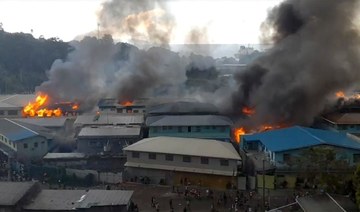
The nighttime curfew entered into force on November 26 as police struggled to bring three days of deadly rioting under control.
Anti-government protests late last month brought widespread looting and left at least three people dead.
The country’s central bank has put the damage caused by the riots at $67 million, saying 63 buildings in the capital were burned and looted.
Around 200 foreign peacekeepers from Australia, Fiji, New Zealand and Papua New Guinea have been deployed around the capital.
Life has slowly returned to normal, even as political tensions linger.
The protests were sparked by opposition to veteran Prime Minister Manasseh Sogavare, who is keen to forge closer ties with Beijing.
The 66-year-old four-time leader sailed through a vote of no confidence in parliament this week, blunting the attacks of his opponents.
His rule is opposed by the leaders of Malaita — the Solomons’ most populous island.
They continue to call for more autonomy and hint at a push for statehood, but so far have not returned to the streets in protest.
The international peacekeeping mission was expected to last just “weeks” according to Australian officials, although no end date has yet been announced.

Solomon Islands lifts curfew as unrest subsides
https://arab.news/8u5yg
Solomon Islands lifts curfew as unrest subsides
- Nighttime curfew entered into force on November 26 as police struggled to bring three days of deadly rioting under control
NATO wants ‘automated’ defenses along borders with Russia: German general
- That zone would act as a defensive buffer before any enemy forces advanced into “a sort of hot zone,” said Lowin
- The AI-guided system would reinforce existing NATO weapons and deployed forces, the general said
FRANKFURT: NATO is moving to boost its defenses along European borders with Russia by creating an AI-assisted “automated zone” not reliant on human ground forces, a German general said in comments published Saturday.
That zone would act as a defensive buffer before any enemy forces advanced into “a sort of hot zone” where traditional combat could happen, said General Thomas Lowin, NATO’s deputy chief of staff for operations.
He was speaking to the German Sunday newspaper Welt am Sonntag.
The automated area would have sensors to detect enemy forces and activate defenses such as drones, semi-autonomous combat vehicles, land-based robots, as well as automatic air defenses and anti-missile systems, Lowin said.
He added, however, that any decision to use lethal weapons would “always be under human responsibility.”
The sensors — located “on the ground, in space, in cyberspace and in the air” — would cover an area of several thousand kilometers (miles) and detect enemy movements or deployment of weapons, and inform “all NATO countries in real time,” he said.
The AI-guided system would reinforce existing NATO weapons and deployed forces, the general said.
The German newspaper reported that there were test programs in Poland and Romania trying out the proposed capabilities, and all of NATO should be working to make the system operational by the end of 2027.
NATO’s European members are stepping up preparedness out of concern that Russia — whose economy is on a war footing because of its conflict in Ukraine — could seek to further expand, into EU territory.
Poland is about to sign a contract for “the biggest anti-drone system in Europe,” its defense minister, Wladyslaw Kosiniak-Kamysz, told the Gazeta Wyborcza daily.
Kosiniak-Kamysz did not say how much the deal, involving “different types of weaponry,” would cost, nor which consortium would ink the contract at the end of January.
He said it was being made to respond to “an urgent operational demand.”


