

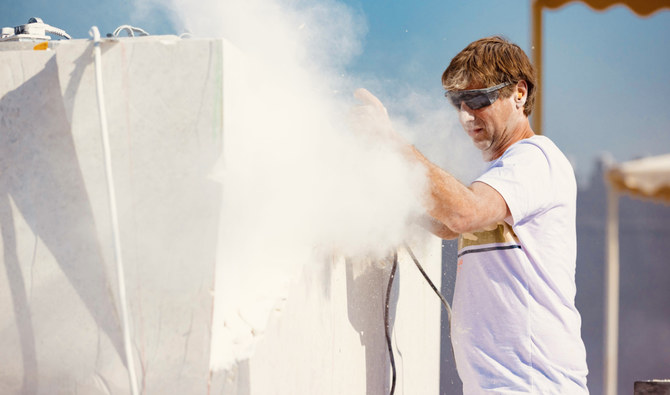

RIYADH: Two sculptures glisten in the sunlight in an outdoor space in JAX, the recently developed creative district in the industrial zone of Diriyah, just outside of Riyadh. They are part of the third Tuwaiq International Sculpture Symposium held under the theme of The Poetics of Space, which featured 20 works by Saudi and international artists focusing largely on the interplay between light and shadow.
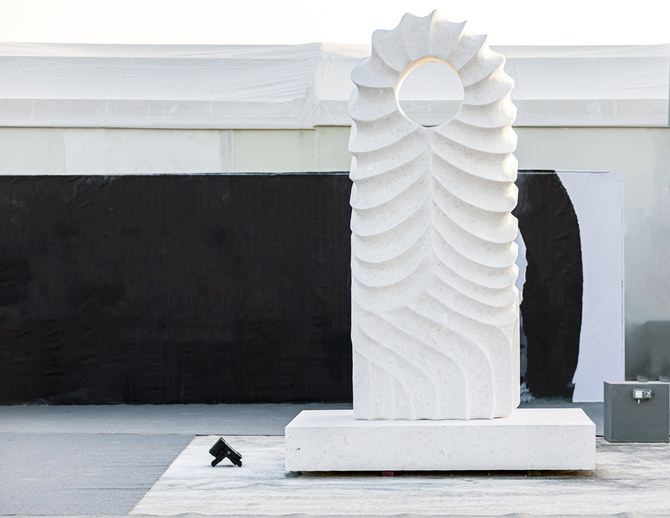
Some of the large abstract sculptures appear to undulate like waves with their curvaceous forms while others challenge the surrounding desert landscape with their bold geometric forms. Saudi artist Wafa Al-Qunibit’s work Allah is representative of her desire to speak to both the Saudi and international community through intersecting and overlapping circles carved into marble depicting the name of God in Arabic. Karin van Ommeren’s Awareness Stone was created to symbolize eternity through a composition that has no beginning or end.
The 20 sculptors were chosen out of 418 applicants from 71 countries. The selected artists came to Riyadh, where they all created their works over a period of three weeks from Nov. 15 until Dec. 5 from giant blocks of black and white pearl marble imported from Oman. The resulting works are exhibited on site in JAX for four days until Dec.10.
What was crucial to the initiative was the element of cultural exchange — uniting artists from around the world in Riyadh through creative dialogue with the end goal of beautifying the city of Riyadh.
HIGHLIGHT
Artists Anna Korver, Haider Alawi Al-Alawi and Kim De Ruysscher announced as winners of the 2021 symposium
The symposium was organized by Riyadh Art, dubbed as one of the world’s largest public art projects of its kind. It is also one of Riyadh’s four megaprojects launched by King Salman bin Abdulaziz, on March 19, 2019. An integral component of Saudi Vision 2030, its mission is to transform Riyadh into a sustainable and environmentally friendly city.
“We tried to update the project this year to make it bigger and more international through workshops and panels and educational programs,” Sarah Alruwayti, architectural project advisor at The Royal Commission for Riyadh City responsible for Riyadh Art, told Arab News. “We aim to create a cultural platform not only for visitors but also for sculptors from around the world to engage with each other. We need to get our talents out into the world and the rest of the world needs to learn about us more.”
“We have 12 projects under Riyadh Art, of which two are annual and 10 are permanent, all of which add a lot of value to the economy and society as they focus on developing roads and bridges and they all encompass art,” Alruwayti said. “The projects work to beautify Riyadh—Riyadh is already beautiful but we are working to add more artistry to the city reflecting Vision 2030’s aims to transform the city into a gallery with no walls.”
Ali Jabbar, the curator of the Tuwaiq International Sculpture Symposium, founded the event three years ago in cooperation with the Saudi Ministry of Culture. The first and second symposia, in 2019 and 2020, were held in Riyadh’s diplomatic quarter.
This year marks the first time that the symposium takes place under the umbrella of Riyadh Art. Jabbar, with the help of five heads of international museums, including Eike Dieter Schmidt, the director of the Uffizi Gallery in Florence, and Cristiana Collu, the director of Rome’s Galleria Nazionale d’Arte Moderna, chose the final selection of 20 sculptors.
“The Tuwaiq symposium is the largest one in the world now in terms of organization, size and quality of sculptures and their artistic and technical value,” Jabbar said. “It has placed the Saudi sculpture scene in the world map.”
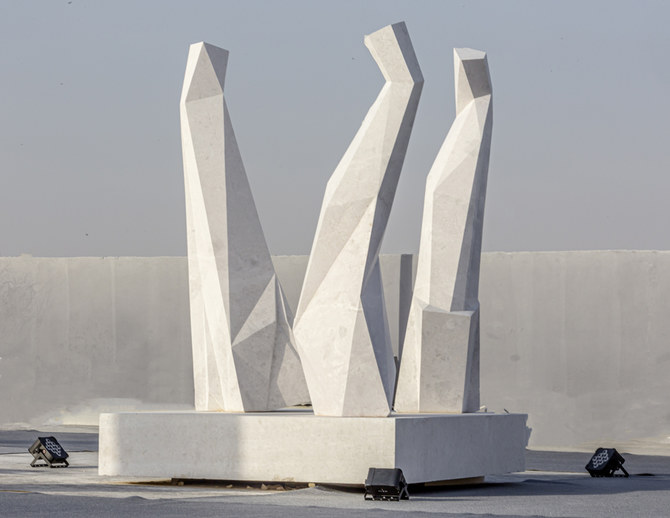
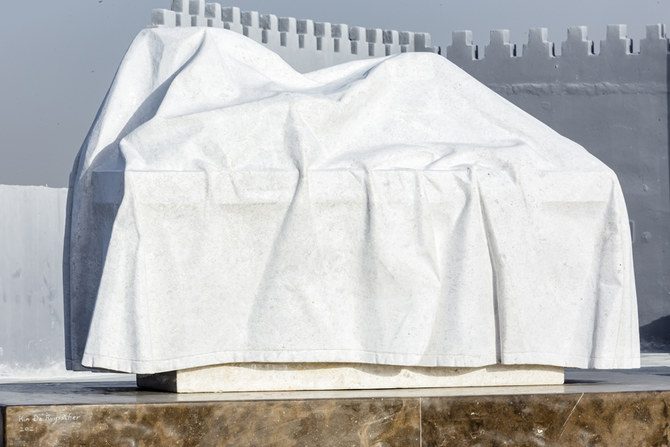
The winners of the competition were announced on Dec. 7. First prize was awarded to New Zealand artist Anna Korver for her artwork entitled The Lighthouses triptych, which fused abstract geometrical forms with multiple cultural associations, suggesting female figures. Second prize went to Haider Alawi Al-Alawi of Saudi Arabia for his approach in depicting the landscape through a fusion of abstraction and figuration. His sculpture entitled Beauty evokes the Saudi landscape, featuring the sun, wind and sand. Third prize went to the Belgian Kim De Ruysscher for his Unseen, depicting a figurative form covered in what appears to be a kind of drapery, exploring the concepts of illusion and perception.
The next Tuwaiq Sculpture Symposium will take place in 2022.


