

Pakistan imposes travel ban on seven countries due to new coronavirus variant

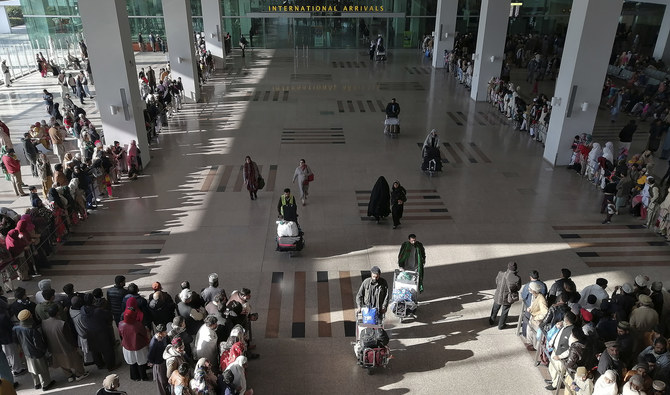
People gather to receive arriving passengers at the airport in Islamabad, Pakistan, on February 3, 2020. (AFP/File)
Short Url
Updated 27 November 2021
Follow

Pakistan imposes travel ban on seven countries due to new coronavirus variant

  • The omicron variant was first detected in South Africa where it infected young people in their 20s
  • Pakistan's planning minister says the new variant has made it more urgent to vaccinate eligible population of 12 years and older

ISLAMABAD: Pakistan on Saturday imposed a complete ban on travel from seven countries after the emergence of a new coronavirus variant in South Africa which has started spreading to other parts of the world.

Medical experts say the omicron variant of the virus is highly transmissible, causing a rapid increase in the number of new COVID-19 infections in the African state.

Media reports indicate the omicron variant has also infected South Africa's young population, making some of them require intensive care.

"Consequent to emergence of Omicron corona variant in South Africa and its spread to adjoining regions, the following countries have also been included in [Category C] and complete ban has been imposed on direct/indirect inbound travel from these countries with immediate effect," said a notification circulated by the National Command and Operation Center (NCOC), the country's central pandemic body.

The official statement named South Africa, Hong Kong, Mozambique, Namibia, Lesotho, Eswatini and Botswana, asking the aviation division to devise a mechanism for the screening of passengers traveling from these states through indirect flights.

The NCOC said the government would allow Pakistani passengers from the Category C countries to travel after obtaining emergency exemptions and following certain requirements which include a vaccination certificate, negative PCR report and rapid antigen test on arrival.

The statement added that stranded Pakistanis in these countries would be allowed to travel back until December 5 without seeking exemption, though they would have to follow the same health and testing protocols.

The NCOC has also made a three-day quarantine at home mandatory for those testing negative for the rapid antigen test on arrival.

However, any Pakistani national flying from one of these countries who tests positive for the virus will have to undergo a stricter 10-day quarantine period.

Pakistan's planning minister Asad Umar, who also heads the national pandemic response body, said in a Twitter post the emergence of the new coronavirus variant had made it "even more urgent to vaccinate all eligible citizens [of] 12 years and older."


The country's COVID-19 positivity rate is currently less than one percent, though it reported seven deaths caused by the debilitating respiratory disease in the last 24 hours on Saturday.


Pakistan to invest $1 billion in AI by 2030 in push to modernize economy

Updated 5 sec ago
Follow

Pakistan to invest $1 billion in AI by 2030 in push to modernize economy

  • PM says government will introduce AI curriculum in schools nationwide
  • The transformation plan will help train 1 million non-IT professionals in AI

ISLAMABAD: Prime Minister Shehbaz Sharif on Monday announced that Pakistan would invest $1 billion in artificial intelligence (AI) by 2030, in a major step to modernize the South Asian nation’s digital economy.

Pakistan, a country of 240 million people, seeks to become a key participant in the global AI economy, amid growing interest from governments in the Global South to harness AI for productivity, skills development and innovation.

The South Asian nation has been actively developing its AI landscape and approved its National AI Policy in July last year, which was followed by the launch of the country’s sovereign AI cloud and a startup fund.

Speaking at the launch of the Indus AI Week 2026 in Islamabad, Sharif unveiled a multi-pronged roadmap intended to transform Pakistan from a provider of IT technicians into a global hub for AI expertise.

“I am pleased to announce that the Government of Pakistan is committed to invest $1 billion in AI by 2030, which will go a long way in building AI ecosystem in our country,” he told policymakers and international tech experts at Islamabad’s Jinnah Convention Center.

Sharif detailed several flagship initiatives to support this transformation, including a sweeping educational reform, at the event organized by the Information Technology (IT) Ministry, which will be running until Feb. 15, featuring strategic dialogues on sovereign AI and technical showcases.

“AI curriculum will be introduced not only in all federally controlled or run schools, but also in all schools of AJK, that is Azad Jammu and Kashmir, and Gilgit-Baltistan, as well as remote parts of Balochistan,” he said.

The government will provide 1,000 fully funded PhD scholarships in AI to postgraduates to bolster high-level research, according to the PM. It plans to launch a nationwide program to train 1 million “non-IT professionals in AI skills” to enhance productivity and improve livelihoods across traditional sectors of the economy.

Sharif emphasized that the focus would remain on high-impact sectors, including agriculture, mines and minerals, and the empowerment of Pakistan’s youth which makes up 60 percent of its 240 million population.

“We will, God willing, bring in programs to transform them from IT technicians to AI experts, which will lead to our agriculture production in terms of its yield, its quality, its efficiency, like never before,” he said.

Drawing parallels to previous digitization efforts in the Punjab province, such as land record digitization and the establishment of the first IT university in Lahore, Sharif framed the AI push as a “gamechanger” for national governance. He noted the Federal Board of Revenue is already undergoing a digital overhaul to curb smuggling and tax evasion.

“Pakistan is absolutely ready to accept the challenge and walk with our global partners absolutely with great commitment and dedication,” he said. “Our commitment is solid, unwavering. We will never look back.”