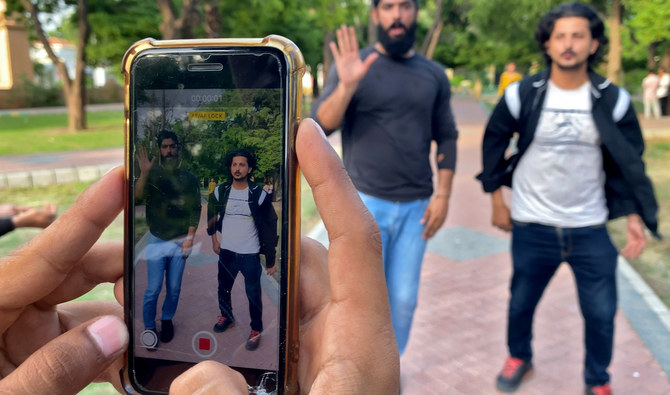
ISLAMABAD: Pakistan’s media regulating authority on Friday again lifted a ban on TikTok, this time after four months, following assurances from the popular Chinese video-sharing service that it would control the spread of indecent content.
It was the fourth time in the past 15 months that Pakistan Telecommunication Authority imposed and lifted such a ban.
Pakistan first blocked TikTok, which is very popular among Pakistani teens and young adults, in October 2020 over what it described as widespread complaints about allegedly “immoral, obscene and vulgar” content on the app.
The regulatory agency said in a statement on Twitter that senior management of TikTok had assured it of its commitment to take necessary measures to control “unlawful content” in accordance with local laws and societal norms.
“The company also assured that the users who are continuously involved in uploading unlawful content will be blocked from using the platform,” the Pakistan Telecommunication Authority (PTA) said.
“Keeping in view the assurances, the Authority has decided to lift the ban on TiKToK forthwith.”
The app, owned by China’s ByteDance, has been downloaded almost 39 million times in Pakistan.
Pakistan, which has close relations with China, has been urging TikTok to develop an effective mechanism to control unlawful content.
Over the years, Pakistan has also forwarded hundreds of complaints to Facebook and Twitter about content, alleging it is offensive and potentially insulting to Islam, which goes against Pakistani law.
In 2008, Pakistan banned YouTube over videos depicting the Prophet Muhammad (PBUH).


Pakistan again lifts ban, fourth so far, on China’s TikTok
https://arab.news/yhebu
Pakistan again lifts ban, fourth so far, on China’s TikTok

- South Asian nation first blocked TikTok in October 2020
- App has been downloaded almost 39 million times in Pakistan

Peshawar church attack haunts Christians at Christmas
- The 2013 suicide attack at All Saints Church killed 113 worshippers, leaving lasting scars on survivors
- Prime Minister Shehbaz Sharif vowed to protect religious minorities on Christmas, act against any injustice
PESHAWAR: After passing multiple checkpoints under the watchful eyes of snipers stationed overhead, hundreds of Christians gathered for a Christmas mass in northwest Pakistan 12 years after suicide bombers killed dozens of worshippers.
The impact of metal shards remain etched on a wall next to a memorial bearing the names of those killed at All Saints Church in Peshawar, in the violence-wracked province of Khyber Pakhtunkhwa.
“Even today, when I recall that day 12 years ago, my soul trembles,” Natasha Zulfiqar, a 30-year-old housewife who was wounded in the attack along with her parents, told AFP on Thursday.
Her right wrist still bears the scar.
A militant group claimed responsibility for the attack on September 22, 2013, when 113 people were killed, according to a church toll.
“There was blood everywhere. The church lawn was covered with bodies,” Zulfiqar said.
Christians make up less than two percent of Pakistan’s 240 million people and have long faced discrimination in the conservative Muslim country, often sidelined into low-paying jobs and sometimes the target of blasphemy charges.
Along with other religious minorities, the community has often been targeted by militants over the years.
Today, a wall clock inside All Saints giving the time of the blast as 11:43 am is preserved in its damaged state, its glass shattered.
“The blast was so powerful that its marks are still visible on this wall — and those marks are not only on the wall, but they are also etched into our hearts as well,” said Emmanuel Ghori, a caretaker at the church.
Addressing a Christmas ceremony in the capital Islamabad, Prime Minister Shehbaz Sharif vowed to protect religious minorities.
“I want to make it clear that if any injustice is done to any member of a minority, the law will respond with full force,” he said.
For Azzeka Victor Sadiq, whose father was killed and mother wounded in the blasts, “The intensity of the grief can never truly fade.”
“Whenever I come to the church, the entire incident replays itself before my eyes,” the 38-year-old teacher told AFP.


